"Automated security testing" is not one category. It solves three different jobs: catching bugs in code before you ship, scanning production for known vulnerabilities against your running surface, and proving what an attacker can actually exploit against your live estate. Most enterprises need one platform from each layer. Buying only from one leaves the other two untested.
Multiple platforms shipped material capability upgrades in the last six months (Invicti Agentic Pentest EA July 2026, Wiz Red Agent GA July 2026, Horizon3.ai NodeZero WebApp July 2026, ProjectDiscovery Neo GA August 2026, Pentera Peer in beta with GA slated Q4 2026), and the current SERP does not yet reflect the consolidation between scanning and autonomous exploitation. This guide compares the 8 leading platforms of 2026 mapped to the layer each does best. Ethiack built Hackian, an agentic AI pentester, to run continuous adversarial validation at the Layer 3 end of the stack.
What follows: the three-layer landscape with reference vendors at each layer, an at-a-glance capability matrix, definitions and situational guidance, eight vendor profiles with tradeoff framing, honest treatment of open-source alternatives (OWASP catalogs the #1 SERP result on this keyword), a seven-factor decision framework, and a summary comparison. Every capability claim is defensible against published vendor documentation.
Key takeaways (TL;DR)
- Automated security testing splits into three layers. Layer 1 (pre-ship, in the pipeline): SAST for source code and SCA for open-source dependencies. Layer 2 (production surface): DAST, ASM discovery, and VM scanning. Layer 3 (exploitability proof): autonomous adversarial exposure validation with reproducible proof of exploit
- Ethiack sits at Layer 3 with continuous 24/7 adversarial exposure validation, Hackian agentic pentesting, automatic regression detection, and proof of exploit for every finding at a false-positive rate below 0.5% (Ethiack-reported)
- XBOW is architecturally similar to Ethiack on web + API depth but per its documentation excludes mobile, network ranges, IP addresses, cloud infrastructure, and internal hosts; metered attack credits meter how often teams re-verify fixes
- Horizon3.ai NodeZero is the Layer 3 leader on internal network + Active Directory; its WebApp Pentesting module shipped July 2026 with published exclusions (GraphQL, business logic, deserialization, race conditions, file-upload-to-RCE)
- Pentera is a Gartner AEV Representative Vendor with mature infrastructure and identity depth; agentic web app testing (Peer) is in beta with GA slated for Q4 2026, creating a timing gap for web-heavy buyers
- Invicti is a Layer 2 legacy DAST platform with Proof-Based Scanning; Invicti Agentic Pentest launched in Early Access on 30 July 2026, layering emerging Layer 3 capability on top
- Astra Pentest combines Layer 2 DAST + Layer 3 agentic testing (Attack AI engine, certified pentester backstop); Astra's team co-authored the OWASP Autonomous Penetration Testing Standard
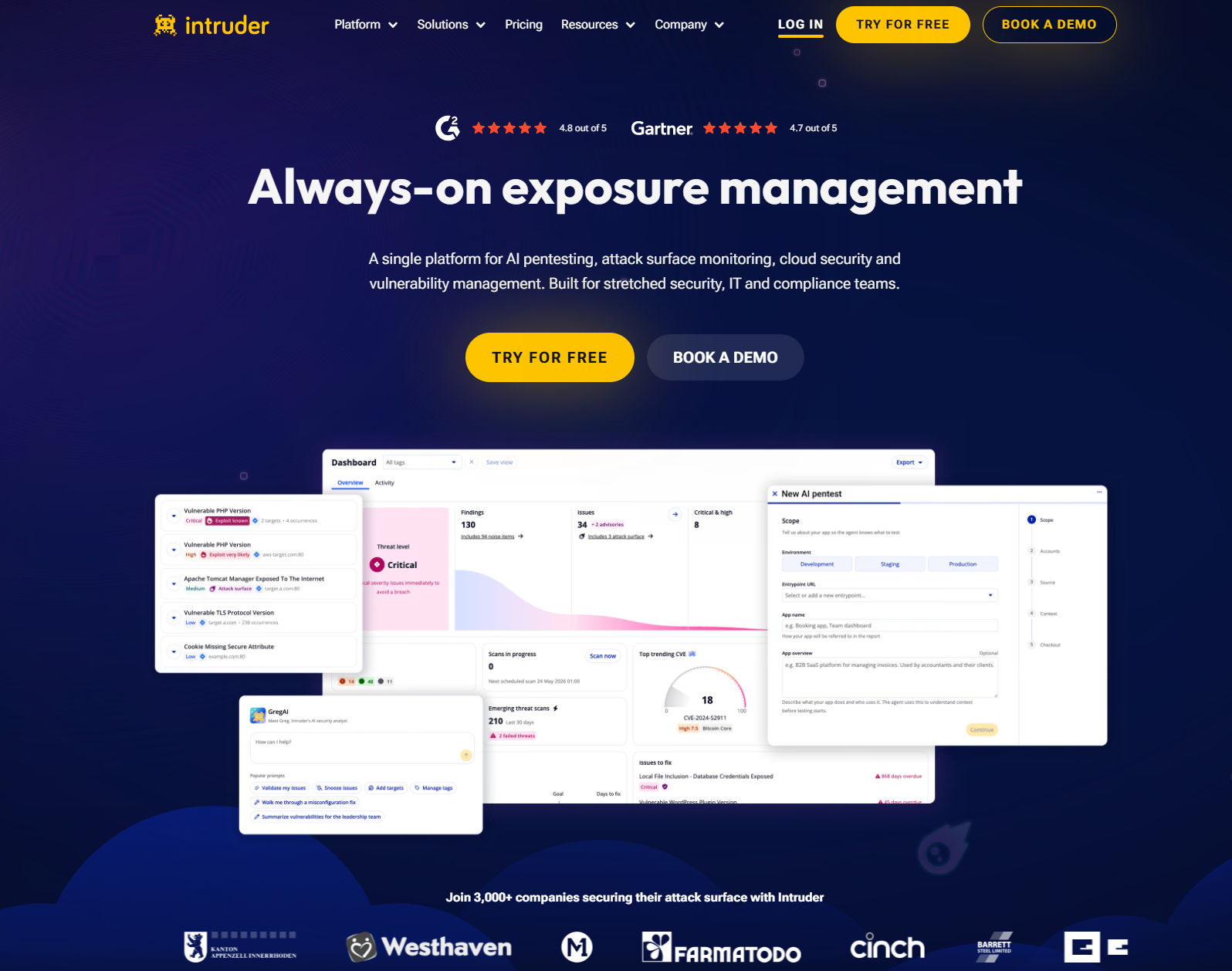
- Intruder is a leading Layer 2 continuous vulnerability scanning platform used by 3,000+ customers with 140,000+ security checks; scanning-tier engines include Nuclei, OpenVAS, and Tenable Nessus depending on plan
- Rapid7 spans Layer 2 (InsightVM + InsightAppSec DAST) and Layer 3 (Vector Command human red team + Metasploit Pro); Vector Command is human-gated periodic exercise rather than continuous autonomous validation
- Open-source options exist and matter: OWASP ZAP (Layer 2 DAST proxy), Nuclei (Layer 2 templated scanning), PentaGi (Layer 3 experimental). Useful for research and red team practitioners; commercial platforms add continuous cadence, safety guardrails, compliance reporting, EU sovereignty, and validated results
The 8 best automated security testing platforms at a glance
The matrix below maps each platform to five decision criteria a CISO or AppSec lead uses. Read horizontally to see how a platform positions on layer and autonomy. Read vertically to compare fit by attack surface. Every cell is defensible against published vendor documentation as of August 2026.
Ethiack (Hackian)
Layer 3 (AEV)
Fully autonomous, agentic AI
24/7 continuous with automatic regression detection
External + internal (via Beacon) + cloud + web/API + AI-driven components
Reproducible proof of exploit for every finding; EU compute (Belgium); Gartner Peer Insights AEV Top Trending Product
XBOW
Layer 3 (AEV)
Fully autonomous, agentic AI
Triggered assessments (usage-based credits)
Web + APIs; excludes mobile, network ranges, IPs, cloud, internal hosts per docs
AWS Security Competency + ISV Accelerate; deterministic validators on findings
Horizon3.ai (NodeZero)
Layer 3 (AEV)
Fully autonomous, agentic AI
Scheduled + manually triggered runs
Internal networks + AD + cloud misconfig; WebApp module July 2026
Category-leading internal + Active Directory exploitation
Pentera
Layer 3 (AEV)
Automated Security Validation + agentic (Peer)
On-demand + auto-revalidation via Resolve
Internal + cloud + identity + external via Surface
Gartner AEV Rep Vendor; ransomware simulation depth
Invicti
Layer 2 (DAST) + emerging Layer 3
Proof-Based Scanning + Agentic Pentest EA
Scheduled scans; Agentic Pentest returns within 48 hours
Web applications + APIs + ASPM (Kondukto acquisition)
99.98% accuracy claim on direct-impact findings; Agentic Pentest EA July 30 2026
Astra Pentest
Layer 2 (DAST) + Layer 3 (agentic)
DAST + Attack AI agentic engine
Continuous DAST with Delta Scanning; agentic on defined targets
Web + APIs + agentless cloud; internal via customer Envoy proxy (HTTP/HTTPS)
Team co-authored the OWASP Autonomous Penetration Testing Standard
Intruder
Layer 2 (continuous scanning)
Continuous scanning + AI pentesting add-on
24/7 continuous scanning; emerging-threat triggered
External surface + cloud + hybrid; internal via agent scanning (Pro tier)
3,000+ customers; 140,000+ checks; published pricing tiers
Rapid7
Layer 2 (VM + DAST) + Layer 3 (human-gated)
Scanner + human red team + Metasploit Pro
Scheduled + eBPF runtime validation (cloud) + periodic Vector Command
InsightVM + InsightAppSec + Insight Cloud Security + Vector Command
Established VM heritage; Metasploit Pro + Vector Command do real exploit
The automated security testing landscape (three layers, three jobs)
Vendors in this category solve three different jobs under one "automated security testing" label. The current SERP mixes all three (OWASP's open-source catalog, DAST-focused listicles, autonomous pentesting listicles). Naming the three layers explicitly is the analytical wedge that resolves the buyer's category confusion. A mature 2026 stack combines one platform from each layer; using one alone leaves the other two untested.
Layer 1: Pre-ship code testing (SAST + SCA)
Layer 1 tools run in the pipeline before code reaches production. SAST (Static Application Security Testing) analyses source code for known bug patterns, unsafe API usage, and injection surface. SCA (Software Composition Analysis) analyses open-source dependencies for known CVEs and licence issues. Both run on every pull request via CI. Reference platforms include Snyk (SCA/SAST), GitHub Advanced Security, Semgrep, and Checkmarx. This is not Ethiack's category; a modern stack still needs Layer 1 in the pipeline.
Layer 2: Production surface scanning (DAST + ASM + VM)
Layer 2 tools test the running system rather than the source code. DAST (Dynamic Application Security Testing) tests web applications and APIs against known attack classes with pre-defined payloads. ASM (Attack Surface Management) discovers assets on the external surface. VM (Vulnerability Management) scanners inventory hosts against the CVE database. Reference platforms in this guide: Invicti, Astra Pentest, Intruder, Rapid7 InsightVM and InsightAppSec. Layer 2 catches known vulnerability classes; it does not prove exploit chains against your specific environment.
Layer 3: Exploitability proof (autonomous AEV)
Layer 3 platforms use agentic AI to reason about attack paths, execute real safe-to-fail payloads against the live surface, and return reproducible proof of exploit. This is the Adversarial Exposure Validation (AEV) category recognised in the Gartner AEV Market Guide 2026. Reference platforms in this guide: Ethiack, XBOW, Horizon3.ai NodeZero, Pentera. Layer 3 answers "what can an attacker actually exploit on my specific surface right now" with evidence a developer can reproduce.
The mature 2026 answer: one platform from each layer. Using only Layer 1 leaves the production surface untested. Using only Layer 2 tests known vulnerability classes but does not prove exploit chains. Using only Layer 3 misses code-side bugs that never reach production. The buyer question is not "which layer is best" but "which layers do I currently cover, and where are the gaps."
What is automated security testing?
Automated security testing uses software to test applications and infrastructure for vulnerabilities without manual step-by-step human work. Modern platforms span the three layers described above and produce different outputs at each: static analysis findings from Layer 1, dynamic scan results from Layer 2, and validated exploit chains from Layer 3. The category noun is broad; the practical shopping decisions are specific to layer.
How automated security testing differs from manual pentesting
Manual pentesting is point-in-time, human-led, and typically scopes weeks per engagement. Automated security testing runs continuously (or on triggers), scales without adding headcount, and produces evidence at machine speed. Manual pentesting remains valuable for creative business-logic scenarios and high-consequence engagements requiring narrative reporting; automated testing complements human work by validating at machine speed continuously between engagements.
How it differs from generic QA testing
QA testing catches bugs that affect functionality, user experience, and performance. Security testing catches vulnerabilities that affect confidentiality, integrity, and availability under adversarial conditions. The methodologies overlap in tooling (both use test harnesses, both integrate into CI/CD) but diverge in intent. QA asks "does the feature work as designed?" Security testing asks "can an adversary make the feature do something it was not designed to do?"
The role of continuous testing
Point-in-time snapshots have become insufficient because surface changes faster than the snapshot cadence. New deploys ship weekly or daily. New CVEs land daily. New assets appear on the external surface without warning. Continuous automated testing produces a rolling evidence stream mapped to specific assets and dated per finding, which is what regulators (DORA, NIS2, EU AI Act) increasingly expect and what boards increasingly ask for.
Why enterprises need automated security testing in 2026
Three trends have compressed the acceptable timeline for security testing across 2026: attack tempo, regulatory pressure, and the shift toward AI-augmented adversarial capability.
On tempo, recent CVE incidents have collapsed the window between disclosure and exploitation. Langflow's CVE-2026-33017 was exploited within 20 hours of disclosure with no public proof-of-concept; Marimo's CVE-2026-39987 in under ten hours (Sysdig Threat Research Team). Testing that runs quarterly does not match this tempo. Continuous automated testing does.
On regulation, DORA (in force since January 2025) requires financial-services firms to run continuous threat-led penetration testing on critical ICT systems. NIS2 requires continuous cybersecurity risk management for essential and important entities. The EU AI Act Article 15 requires appropriate accuracy, robustness, and cybersecurity for high-risk AI systems. The EU Cyber Resilience Act (CRA) adds ongoing vulnerability handling and coordinated vulnerability disclosure obligations. Each of these strengthens the case for continuous automated evidence rather than annual pentesting snapshots.
On adversarial capability, the release of Claude Mythos Preview in April 2026 (restricted to Project Glasswing) confirmed that frontier AI can autonomously discover thousands of high-severity zero-day vulnerabilities across every major OS and browser. That capability will diffuse regardless of Anthropic's controls. Defenders operating at annual pentesting tempo cannot keep pace with attackers operating at machine speed.
Who needs which layer (per persona)
Automated security testing is not a single-buyer purchase. Different personas own different layers, and the buying committee typically spans several. Four persona-to-layer mappings recur most often across enterprise buying cycles.
For VP Engineering, CTOs, and DevSecOps
Primarily Layer 1 (SAST/SCA in the pipeline) plus Layer 3 (continuous AEV on production). The engineering trigger is deploy velocity: several deploys a week, and manual testing cannot keep pace. Layer 1 tools sit inside the CI/CD workflow developers already use; Layer 3 platforms with CI/CD integration (GitHub, GitLab, Jenkins) validate on merge or on deploy.
For CISOs and Heads of Security
Oversee all three layers; primarily accountable for Layer 3 (the exploit-proof layer that drives board reporting). The CISO trigger is board defensibility: explaining the security programme in terms the board risk committee accepts. Look for a multi-factor risk score, exposure evidence tied to specific assets, and reporting mapped to DORA, NIS2, and ISO 27001.
For AppSec and SecOps practitioners
Operate all three layers day-to-day. The practitioner trigger is scanner-critical fatigue: hundreds of new high-severity findings each week and no defensible way to say which to fix first. Layer 3 platforms that return proof of exploit remove triage burden by making findings actionable evidence rather than claims to investigate.
For Compliance Officers and Heads of Risk
Primarily Layer 3 for continuous testing evidence required under DORA, NIS2, EU AI Act, and CRA. The compliance trigger is regulatory evidence: auditors and supervisors increasingly expect continuous exposure evidence, not annual pentesting snapshots. Look for platforms with compliance reporting mapped to the specific frameworks and EU data sovereignty where required. See Ethiack compliance reporting for the framework mapping.
When you need each type of automated security testing
Six recurring situations map onto specific layer priorities. Naming the situation before the tool speeds up the buying decision and reduces the chance of buying overlapping capability across the three layers.
High-velocity SaaS with mature CI/CD
Layer 1 in the pipeline (SAST/SCA on every PR) plus Layer 3 continuous AEV on production. The Layer 1 investment already exists; the Layer 3 investment closes the gap between deploy and validation. Layer 2 scanning becomes optional if the Layer 3 platform covers the external + internal + cloud surface continuously.
Legacy enterprise with slow release cadence
Layer 2 DAST/scanning against staging + production, plus periodic Layer 3 pentest engagements. Slow release cadence means Layer 1 pipeline testing produces less value per unit spend; the Layer 2 surface scan and Layer 3 validation provide more direct evidence of current-state exposure.
Financial services under DORA
All three layers, with heavy emphasis on Layer 3 for DORA Article 25 threat-led penetration testing. Financial supervisors treat continuous adversarial validation as the operational form of DORA-compliant TLPT evidence, and continuous coverage is what supervisors increasingly ask for during examinations. Continuous Layer 3 evidence pairs with quarterly board reporting.
Regulated critical infrastructure under NIS2
All three layers with continuous Layer 3 evidence for auditors. NIS2 essential and important entities are expected to demonstrate continuous cybersecurity risk management, not annual snapshots. Layer 3 platforms with compliance reporting for NIS2 and ISO 27001 produce the operational evidence supervisors examine.
High-risk AI-driven service (chatbots, RAG apps, AI agents)
Layer 3 with explicit AI-driven service testing scope and EU AI Act Article 15 mapping. AI-driven services extend the application layer with prompt-injection surface, tool-use hijacking risk, and RAG-poisoning risk that traditional Layer 1 and Layer 2 tools do not cover cleanly. Layer 3 platforms that test AI-driven components on customer infrastructure are the operational answer; see the Mythos AI Security Implications complete guide for the offensive-side context.
Small security team + growing surface
Prioritise Layer 3 (autonomous AEV) first. Layer 3 platforms scale without headcount growth by running at machine tempo. Layer 1 SAST/SCA can be added as CI investment matures; Layer 2 scanning can be deferred when the Layer 3 platform covers the same production surface with proof of exploit instead of signature match.
The 8 best automated security testing platforms in 2026
Selection criteria for this list: commercially available in 2026 (open-source options noted separately), provides automated or autonomous testing capability, and has published capability documentation defensible against public vendor sources. Each review below uses identical structure: Overview, Ideal for, Key features, Pros, Cons framed as tradeoffs, Pricing, and Verdict. Layer position is called out for each platform.
1. Ethiack (Hackian): Best overall for Layer 3 continuous autonomous validation with proof of exploit
Ethiack is an EU-based autonomous offensive-security platform at Layer 3. Its purpose-built agentic AI pentester, Hackian, runs 24/7 continuous adversarial exposure validation across external, internal, cloud, and web/API surfaces, producing reproducible proof of exploit for every validated vulnerability. Ethiack is listed as a Top Trending Product in Gartner Peer Insights AEV and is used by Remote, SingleStore, SONAE, and MEO across SaaS, technology, retail, and telecommunications verticals.
Ideal for:
- Regulated European mid-market to enterprise (500+ employees) building a modern automated security testing stack that needs a Layer 3 continuous AEV capability
- CISO plus AppSec practitioner buying committees under NIS2, DORA, ISO 27001, SOC 2, or PCI DSS pressure
- Engineering-led SaaS teams shipping several times a week that need continuous validation on production with retest-on-remediation
Key features:
- 24/7 continuous AEV with Hackian agentic AI pentesting reasoning across business logic
- Continuous attack surface management (ASM) feeding AEV automatically; assets discovered are validated without a re-scope
- Beacon (CIDR-scoped network-layer tunnel): one machine covers N networks, auto-detects CIDRs from host interfaces, auto-adds to pentest scope
- Multi-factor risk score combining CVSS + CISA KEV + EPSS + asset importance + organisational blind spots
- Automatic regression detection: closed findings automatically reopen when they become exploitable again
- Unlimited portal retesting + usage-based CI/CD retesting via GitHub, GitLab, and Jenkins
- Compliance reporting for DORA, NIS2, ISO 27001, SOC 2, PCI DSS, EU AI Act Article 15; EU compute (engine servers in Belgium)
Why we stand out:
Ethiack is the only platform in the roster combining continuous 24/7 autonomous validation, full-stack coverage, reproducible proof of exploit for every finding, unlimited portal retesting, and EU compute in a single Layer 3 platform. CEGID moved from checklist-based annual pentesting to autonomous ethical hacking with Ethiack, reporting €12M+ in risk prevented across 2,000+ assets in 20+ companies (Ethiack-reported). See Hackian, the agentic AI pentester for the engine, and adversarial exposure validation for the platform architecture.
Pros:
- Continuous validated exploitability with false-positive rate below 0.5% and proof of exploit for every finding (Ethiack-reported)
- EU data residency (engine servers in Belgium); Gartner Peer Insights AEV Top Trending Product listing
- Unlimited portal retesting removes the credit-metering friction most Layer 3 competitors impose
Cons:
- Active Directory internal testing is a known gap, rolling out by end of Q3 2026 (Ethiack-reported)
- ALE and ROI are a managed feature for select clients, rolling out to product this year; not yet live self-serve platform capability
Pricing:
Per-asset-tier subscription for Continuous plus pentest credits for On-Demand. Not published; sales conversation required.
Verdict:
Best Layer 3 fit for regulated European organisations. Complements Layer 1 SAST/SCA and Layer 2 DAST from other vendors in a modern automated security testing stack.
2. XBOW: Best for top-tier agentic web and API pentesting at Layer 3
XBOW is an autonomous offensive security platform at Layer 3 focused on web applications and their APIs. It offers deep agentic AI pentesting on the scoped surface with usage-based attack credits, AWS-native availability, and deterministic validators on confirmed findings. Architecturally very close to Ethiack on web and API depth; the differences are scope breadth and retesting model.
Ideal for:
- Teams whose primary attack surface is web + API
- SaaS with high-frequency deploys wanting CI/CD-integrated agentic pentesting
- AWS-native buyers valuing AWS Security Competency, ISV Accelerate, and Microsoft Security Copilot / Sentinel integration
Key features:
- Agentic AI web + API pentesting with usage-based attack credits
- Deterministic validators on confirmed findings; REST API to trigger tests on merge
- Board and auditor ready reporting across 40+ compliance frameworks
Pros:
- Very similar top-tier architectural depth to Ethiack on web and API
- AWS Marketplace availability with clear listing price
Cons:
- Per XBOW documentation, testing excludes mobile applications, network ranges, IP addresses, cloud infrastructure, and internal hosts
- Metered attack credits meter how often teams re-verify fixes
- Risk score is severity count without EPSS, CISA KEV, ALE, or ROI factors
Pricing:
Annual contract plus metered credits. AWS Marketplace listing starts from $50,000 per year.
Verdict:
Strong Layer 3 fit for web + API-focused teams. Scope-limited outside web + API; retesting is credit-metered rather than unlimited.
3. Horizon3.ai (NodeZero): Best for Layer 3 internal network + Active Directory exploitation
Horizon3.ai is the established Layer 3 autonomous pentesting category leader, strongest on internal networks, Active Directory credential dumping, and cloud misconfigurations. Its NodeZero WebApp Pentesting module shipped July 2026 on the back of a $250M raise, extending the platform into web application coverage.
Ideal for:
- Organisations whose primary risk is internal lateral movement and Active Directory attack paths
- Large enterprise infrastructure estates with mature SOCs
- US enterprises valuing the category-defining NodeZero brand
Key features:
- NodeZero Runners for internal pentests, often Docker containers
- Scheduled and manually triggered runs; cron external discovery
- NodeZero WebApp with opt-in Extended Agents mode; qualitative business risk tagging + 0-10 context score
- 1-Click Verify retest limited to Internal, Phishing, and Insider Threat results
Pros:
- Deep internal network and Active Directory exploitation heritage
- Recognised Layer 3 category name with established customer base
Cons:
- Per Horizon3.ai documentation, the WebApp module lists GraphQL-specific weaknesses, general business-logic flaws, deserialization, race conditions, and file-upload-to-RCE as not currently covered
- Internal pentests run on scheduled and manual triggers rather than 24/7 continuously; WebApp tests launched manually one at a time per docs
- Qualitative business risk tagging without expected-loss figure
Pricing:
Not published; enterprise sales conversation required.
Verdict:
Strong Layer 3 fit for internal network + Active Directory-heavy risk models. Younger and narrower on the application layer than the WebApp release headline suggests.
4. Pentera: Best for Layer 3 Automated Security Validation with human red team backstop
Pentera is a Gartner AEV Representative Vendor with an Automated Security Validation platform strong on ransomware simulation and full-kill-chain emulation across internal networks, cloud, and identity. Its agentic web app testing (Peer) launched in July 2026, currently in beta with GA slated for Q4 2026, and the platform holds 300+ ratings on Gartner Peer Insights.
Ideal for:
- Large enterprise infrastructure teams with mature SecOps-led buying committees
- Organisations with existing human red team programmes wanting AEV augmentation
- Buyers prioritising ransomware simulation depth and full-kill-chain testing
Key features:
- Pentera Surface validates web-facing exposure against OWASP
- Peer as a GA agentic interface; AI-native web app testing with business logic + access-control + authenticated testing behind SSO/MFA/OAuth in beta, GA slated Q4 2026
- Resolve auto-triggers revalidation of the original attack path after a fix
- Jira and ServiceNow routing
Pros:
- Gartner AEV Representative Vendor recognition
- Strong infrastructure and identity depth; ransomware simulation quality
Cons:
- Agentic web app testing (Peer) is beta until Q4 2026 GA, creating a timing gap for web-heavy buyers
- SecOps-owned revalidation loop; developer initiates less directly
- No expected loss or ROI translation in the platform
Pricing:
Not published; enterprise sales conversation required.
Verdict:
Excellent Layer 3 fit for infrastructure-heavy SecOps-led buyers. Timing gap on agentic web/API until Q4 2026 GA is the practical caveat.
5. Invicti: Best for Layer 2 legacy DAST with emerging Layer 3 capability
Invicti is a Layer 2 legacy DAST platform sold alongside sibling Acunetix. Proof-Based Scanning confirms direct-impact findings with an accuracy claim of 99.98%. Invicti Agentic Pentest was announced 30 July 2026 in Early Access, layering emerging Layer 3 capability on top of the DAST heritage. The platform also includes ASPM from the Kondukto acquisition in August 2025.
Ideal for:
- Organisations with an established Layer 2 DAST programme looking to layer in emerging Layer 3 agentic testing
- Enterprises wanting Proof-Based Scanning direct-impact validation on high-severity findings
- Buyers valuing an integrated ASPM view alongside DAST
Key features:
- Proof-Based Scanning with 99.98% accuracy claim on direct-impact findings
- Outside-in discovery seeded from account email domain
- ASPM from Kondukto acquisition (August 2025)
- Agentic Pentest EA runs specialised agents in parallel across injection, RCE, SSRF, deserialization, and access-control classes; application-specific agent synthesizing multi-stage attacks; results returned inside 48 hours
Pros:
- Strong Layer 2 DAST heritage with Proof-Based Scanning direct-impact validation
- Agentic Pentest EA layers credible Layer 3 capability on top
Cons:
- Agentic Pentest is in Early Access, not general availability
- Discovery ends at inventory list; assets must be promoted to licensed targets before testing
- Unconfirmed findings plus SAST, SCA, and third-party results in the ASPM view still need manual triage
- No monetary risk output in the platform
Pricing:
Not published; enterprise sales conversation required.
Verdict:
Strong Layer 2 fit with a credible Layer 3 upgrade path in Early Access. Enterprise buyers with an existing DAST programme are the primary audience.
6. Astra Pentest: Best for Layer 2 + Layer 3 hybrid DAST and agentic testing
Astra Pentest is a continuous pentesting platform combining Layer 2 DAST + API scanning + agentless cloud scanning + Layer 3 autonomous AI agents built on the Attack AI engine, with certified pentesters backstopping complex findings. Astra's team co-authored the OWASP Autonomous Penetration Testing Standard, a citable credibility anchor on this SERP.
Ideal for:
- SaaS and cloud-native teams wanting a combined Layer 2 + Layer 3 platform in one contract
- Organisations valuing a certified-pentester backstop on complex findings
- Buyers wanting a public Trust Center with clear compliance mapping
Key features:
- Continuous DAST with Delta Scanning for incremental speed
- Agentic AI agents run against web + API + cloud targets you define
- Internal apps via customer-provisioned Envoy forward proxy (HTTP/HTTPS only per Astra docs)
- Certified pentester backstop; customer-facing Trust Center
Pros:
- Team co-authored the OWASP Autonomous Penetration Testing Standard
- Combined Layer 2 + Layer 3 in one platform
- Unlimited automated re-scans on DAST tiers
Cons:
- Per Astra documentation, internal apps reached only via customer-provisioned Envoy proxy limited to HTTP/HTTPS
- Scope is inside-out from configured targets rather than outside-in
- No ALE or ROI financial translation
Pricing:
Not published; sales conversation required. Trust Center published.
Verdict:
Strong combined Layer 2 + Layer 3 fit for teams wanting one platform for both. Internal apps coverage requires customer-provisioned proxy.
7. Intruder: Best for Layer 2 continuous vulnerability scanning at accessible price
Intruder is a Layer 2 continuous exposure management platform used by 3,000+ customers, delivering 140,000+ security checks against the external attack surface, cloud, and internal networks. Founded 2015 and selected for the GCHQ Cyber Accelerator, Intruder unifies AI-augmented vulnerability scanning, attack surface monitoring, and cloud security in one platform with published pricing tiers, a rarity in this category.
Ideal for:
- SMB and mid-market teams looking for approachable continuous scanning
- Buyers wanting Layer 2 coverage before they add Layer 3 autonomous pentesting
- Organisations valuing published pricing and transparent tier structure
Key features:
- Continuous external scanning with emerging-threat monitoring; 140,000+ security checks
- Asset discovery on the external attack surface; automatic scan triggers on changes
- CISA KEV + EPSS threat-intelligence prioritisation
- Multi-tier scanning engines (Nuclei on Free, OpenVAS+Nuclei on Cloud, Tenable Nessus on Pro, combined on Enterprise); AI pentesting add-on
- Integrations with AWS, Azure, Google Cloud, Slack, Jira
Pros:
- Accessible entry point to continuous scanning with published pricing tiers
- 3,000+ customer base and strong SERP visibility
- Recognised brand in the accessible-continuous-scanning space
Cons:
- Layer 2 scope: signature-driven scanning rather than agentic exploitation
- Web application coverage is a ZAP-based add-on with roughly 100 checks; does not test access control or business logic natively
- Buyers needing Layer 3 exploitability proof will need to add another platform
Pricing:
Published tiers starting at accessible price points, with Cloud, Pro, and Enterprise tiers scaling by scope. AI pentesting add-on priced separately. Vanguard tier adds continuous human penetration testing on top.
Verdict:
Strong Layer 2 fit for accessible continuous scanning. Pair with a Layer 3 autonomous pentesting platform for a complete automated security testing stack.
8. Rapid7 (InsightAppSec + InsightVM + Vector Command): Best for Layer 2 established VM with Layer 3 human-gated exploit paths
Rapid7 is a legacy heavyweight in vulnerability management with InsightVM heritage. The platform spans Layer 2 (InsightVM VM scanning + InsightAppSec DAST in Ultimate tier + cloud runtime validation via eBPF sensors on cloud workloads, added March 2026) and Layer 3 (Vector Command human red team + Metasploit Pro operator-driven exploit validation).
Ideal for:
- Large enterprise teams already invested in the Rapid7 platform
- SecOps organisations wanting integrated VM + limited Layer 3 in one vendor relationship
- Buyers with mature human red team programmes wanting an established backstop
Key features:
- InsightVM VM scanning; InsightAppSec DAST in Ultimate tier
- Cloud runtime validation via eBPF sensors on cloud workloads (March 2026)
- Metasploit Pro closed-loop validation, operator-driven
- Vector Command human red team: external monthly, internal on Advanced tier
- Attack Replay app-layer retest; Active Risk 0-1000 scoring
Pros:
- Established platform breadth across VM + AppSec + cloud
- Vector Command + Metasploit Pro do real exploit rather than signature match
- Broad integration ecosystem across the Rapid7 Insight platform
Cons:
- Runtime validation covers cloud workloads only via eBPF sensors
- Vector Command is human-gated periodic exercise, not continuous autonomous validation
- Retest paths are scoped: Attack Replay for one app finding at a time, Validate Vulns for parent-scan findings only
- Active Risk 0-1000 is unitless, no currency figure
Pricing:
Not published; enterprise sales conversation required.
Verdict:
Strong Layer 2 fit for established Rapid7 buyers with a Layer 3 backstop via human red team. Not a substitute for a dedicated Layer 3 continuous autonomous AEV platform.
Open-source alternatives noted honestly
The current #1 Google result for "best automated security testing tools" is owasp.org (DA 91), an open-source tools catalog. Ignoring open-source would look dishonest. Three open-source projects merit specific mention alongside the commercial platforms.
OWASP ZAP
OWASP ZAP is a mature open-source DAST proxy at Layer 2 with a strong developer community. Actively maintained, widely used in security-engineering workflows for interactive testing, and a common building block inside custom CI pipelines. Not a commercial platform, so no vendor support, no compliance reporting, no EU data residency guarantees, no enterprise integrations.
Nuclei
Nuclei is a templated vulnerability scanner from ProjectDiscovery at Layer 2. It is the open-source foundation for ProjectDiscovery's commercial Neo platform. Widely used for fast, template-driven vulnerability discovery and community-contributed check libraries. Powerful for skilled operators; unsuitable as the sole scanning platform for regulated enterprises.
PentaGi
PentaGi is a fully autonomous AI agents system for penetration testing at Layer 3, open-source and experimental. Strong developer community interest; the analytical value of a clean reference implementation for the agentic AI pentesting pattern. Not positioned as a production-grade enterprise platform.
Honest framing: open-source tools are useful for research, red team practitioners, and organisations building custom offensive-security workflows. Commercial platforms add continuous cadence, safety guardrails, compliance reporting, EU sovereignty, integrations, vendor support, and validated results, which regulated enterprises require.
How to choose an automated security testing platform (7 decision factors)
The seven decision factors below are the ones enterprise evaluations most commonly turn on. The two that most decisions turn on are layer coverage (which of the three layers does the platform actually address, and where do you have current gaps) and autonomy scope (fully autonomous exploitation vs scanner-derived vs digital-twin vs hybrid human-on-the-loop).
1. Layer coverage and current gaps
Which of the three layers does the platform actually address? Layer 1 in the pipeline (SAST/SCA), Layer 2 on production surface (DAST/ASM/VM), or Layer 3 exploit-proof (autonomous AEV)? Map your current stack to the three layers first, then buy for the layer you have a gap in. Overlap between layers wastes budget.
2. Autonomy scope
Where on the autonomy spectrum does the platform sit? Scanner-derived autonomy checks signatures. Digital-twin simulation models attack paths. Hybrid human-on-the-loop lets agents test but humans approve intrusive actions. Fully autonomous exploitation executes real payloads and returns proof of exploit. Match spectrum position to operational obligation, not marketing claim.
3. Continuous vs on-demand cadence
Does the platform run 24/7 continuously, on scheduled runners, on change triggers (PR-driven), or on-demand only? Continuous validation matches attacker tempo the Langflow and Marimo CVE incidents demonstrated. Scheduled and on-demand models leave the tempo gap open. Match cadence to how quickly your surface changes.
4. Proof of exploit vs inferred exploitability
Does the platform execute real payloads and return reproducible proof of exploit, or infer exploitability from telemetry, signature match, or CVE database lookup? Proof of exploit removes the security-engineering debate by producing evidence a developer can rerun. Inferred exploitability is faster to produce but leaves triage burden on the security team. See adversarial exposure validation for the proof-of-exploit mechanism.
5. Attack surface scope
Web + API only, external only, internal + AD only, or full-stack (external + internal + cloud + non-HTTP)? XBOW is scoped to web + API per its docs. Astra reaches internal via customer-provisioned Envoy proxy on HTTP/HTTPS only. Rapid7's runtime validation covers cloud workloads only via eBPF sensors. Ethiack covers external + internal (via Beacon) + cloud + web/API. There is no universal answer; there is a fit-to-risk-model answer.
6. Compliance and regulatory posture
Does the platform report against DORA, NIS2, ISO 27001, SOC 2, PCI DSS, and the EU AI Act? Where does data process, and does that meet EU sovereignty requirements? Ethiack processes on EU compute (engine servers in Belgium) and reports against the frameworks above. US-hosted platforms can be used with data-processing addenda; sovereignty is a structural advantage. See pen testing for financial services for the regulated-buyer angle.
7. Retesting model and integration depth
Is retesting unlimited through the portal, credit-metered through CI/CD, scheduled through runners, or event-driven on resolution? What CI/CD integrations does the platform ship natively (GitHub Actions, GitLab CI, Jenkins)? Teams shipping many times a day need retesting that fits the release cadence. Ethiack offers unlimited portal retesting + usage-based CI/CD; XBOW and ProjectDiscovery Neo meter CI/CD via credits.
Everything you need to know about automated security testing platforms
The summary table compresses the 8 reviews into a single view across nine attributes: primary layer, autonomy model, continuous vs on-demand, full-stack scope, web/API depth, internal network, proof of exploit, retesting model, and financial reporting. Ethiack leads on full-stack continuous coverage with reproducible proof of exploit; competitors lead on segment-specific strengths (XBOW web/API, Horizon3.ai internal/AD, Pentera infrastructure, Invicti DAST heritage, Astra hybrid, Intruder accessible pricing, Rapid7 platform breadth).
Ethiack
Layer 3
Fully autonomous
⭐⭐⭐⭐⭐
⭐⭐⭐⭐⭐
⭐⭐⭐⭐⭐
⭐⭐⭐⭐
⭐⭐⭐⭐⭐
Unlimited portal + CI/CD
XBOW
Layer 3
Fully autonomous
⭐⭐⭐
⭐⭐⭐
⭐⭐⭐⭐⭐
⭐
⭐⭐⭐⭐⭐
Credit-metered
Horizon3.ai
Layer 3
Fully autonomous
⭐⭐⭐
⭐⭐⭐
⭐⭐⭐
⭐⭐⭐⭐⭐
⭐⭐⭐⭐⭐
1-Click Verify (limited)
Pentera
Layer 3
AEV + agentic (beta)
⭐⭐⭐⭐
⭐⭐⭐⭐
⭐⭐⭐ (beta)
⭐⭐⭐⭐
⭐⭐⭐⭐
Resolve auto-triggered
Invicti
Layer 2 + emerging L3
Proof-Based + Agentic EA
⭐⭐⭐
⭐⭐⭐
⭐⭐⭐⭐
⭐⭐
⭐⭐⭐ (EA)
Scheduled + on-demand
Astra Pentest
Layer 2 + L3 hybrid
DAST + Attack AI
⭐⭐⭐⭐
⭐⭐⭐
⭐⭐⭐⭐
⭐⭐ (Envoy)
⭐⭐⭐⭐
Unlimited DAST re-scan
Intruder
Layer 2
Continuous scanning
⭐⭐⭐⭐⭐
⭐⭐⭐
⭐⭐ (ZAP add-on)
⭐⭐⭐
⭐⭐
Continuous + scheduled
Rapid7
Layer 2 + L3 human-gated
Scanner + Metasploit + Vector Command
⭐⭐⭐⭐
⭐⭐⭐⭐
⭐⭐⭐
⭐⭐⭐
⭐⭐⭐⭐ (human-gated)
Attack Replay + Validate Vulns
See what a Layer 3 continuous autonomous testing platform finds on your live surface
The automated security testing platform you choose should close a current gap, not duplicate existing coverage. Ethiack runs continuous Layer 3 adversarial validation across your full surface with reproducible proof of exploit and EU compute. Book a demo aligned to your current stack, or run a free external test to see the surface as an attacker would.
Frequently asked questions about Automated Security Testing
What are automated security testing tools?
Automated security testing tools use software to test applications and infrastructure for vulnerabilities without manual step-by-step work. They span three layers: Layer 1 (SAST/SCA analysing code before ship), Layer 2 (DAST and scanners testing running systems for known vulnerabilities), and Layer 3 (autonomous AEV platforms that execute real exploits against your live surface and return reproducible proof).
What are the best automated security testing tools in 2026?
For Layer 3 continuous autonomous validation with proof of exploit, Ethiack. For agentic web + API depth with AWS-native integrations, XBOW. For Layer 3 internal network + Active Directory, Horizon3.ai NodeZero. For Automated Security Validation with human red team backstop, Pentera. For Layer 2 legacy DAST with emerging Layer 3, Invicti. Fit to your specific layer gap matters more than a single winner.
What are the tools for security testing?
Security testing spans SAST (source code analysis), SCA (open-source dependency scanning), DAST (dynamic testing of running apps), IAST (instrumented runtime), RASP (runtime protection), ASM (attack surface discovery), VM scanning (vulnerability inventory), AEV (adversarial exposure validation with proof of exploit), and autonomous agentic pentesting. Most enterprise stacks combine one tool from each category, not one tool for all.
How are API security testing tools different than website security testing tools?
API security testing tools test structured request/response protocols (REST, GraphQL, gRPC) and typically need schema knowledge (OpenAPI, GraphQL SDL). Website security testing tools test user-facing web applications typically through browser-driven flows. Modern DAST and Layer 3 AEV platforms often cover both, but authentication, business logic, and rate limiting differ significantly between them.
Do automated pentesting tools actually replace manual pentesting?
No. Human pentesters remain valuable for creative business-logic scenarios, high-consequence engagements requiring narrative reporting, and situations needing social-engineering context. Automated pentesting complements human work by validating at machine speed across the full surface continuously. Regulated buyers under DORA and NIS2 typically maintain both alongside continuous automated validation.
What is the difference between DAST and autonomous pentesting?
DAST tests running applications against known attack classes with pre-defined payloads; output is a list of findings requiring triage. Autonomous pentesting (Layer 3 AEV) uses agentic AI to reason about attack paths, chain multiple vulnerabilities, execute real exploits, and return reproducible proof of exploit. DAST catches known vulnerability classes; autonomous pentesting validates exploitability.
Has anyone automated security testing in the SDLC?
Yes. Modern SDLCs typically include Layer 1 tools (SAST + SCA) running on every pull request via CI, Layer 2 DAST running against staging, and Layer 3 autonomous AEV running against production continuously. Platforms like Ethiack offer unlimited portal retesting plus usage-based CI/CD availability via GitHub, GitLab, and Jenkins for pipeline integration.
Why use automated security testing instead of manual testing?
Automated testing runs continuously; manual pentesting is point-in-time. Automated testing scales across the full surface without headcount growth; manual pentesting scales with pentester capacity. Ethiack is 30x faster than manual pentesting (Ethiack-reported). Manual pentesting remains valuable as a complement for creative scenarios requiring social context and narrative reporting.
Which automated security testing tools integrate with CI/CD?
Most Layer 1 SAST/SCA tools integrate with GitHub Actions, GitLab CI, and Jenkins natively. Layer 2 DAST platforms like Invicti and Astra Pentest offer CI/CD triggers. Layer 3 platforms Ethiack, XBOW, and ProjectDiscovery Neo offer CI/CD integration; Ethiack's model is unlimited portal retesting plus usage-based CI/CD availability via GitHub, GitLab, and Jenkins.
How much do automated security testing tools cost?
Wide range. Open-source options (OWASP ZAP, Nuclei) are free. Intruder publishes pricing tiers starting at accessible price points. Layer 3 pay-as-you-go (ProjectDiscovery Neo) starts at $250 per month. XBOW AWS Marketplace lists from $50,000 per year. Ethiack, Pentera, Horizon3.ai, Astra, Rapid7, and Invicti require a sales conversation.
Are there open-source automated security testing tools?
Yes. OWASP ZAP is a mature open-source DAST proxy. Nuclei is templated vulnerability scanning from ProjectDiscovery. PentaGi is an experimental open-source autonomous AI agents system. Open-source tools are strong for research and red team work but typically lack commercial support, compliance reporting, EU data sovereignty, and integrations required by regulated enterprises.
Does Ethiack replace SAST or SCA?
No. Ethiack is a Layer 3 continuous autonomous adversarial exposure validation platform. It tests running systems and validates exploitability against the live surface. It does not replace Layer 1 tools like SAST (source code analysis) or SCA (dependency scanning). A modern automated security testing stack combines Layer 1 SAST/SCA in the pipeline, Layer 2 DAST/scanning in staging, and Layer 3 Ethiack against production.