Autonomous means different things in this category. Some vendors autonomously scan for known CVEs and infer exploitability from signature match. Some autonomously simulate attack paths against a digital twin of your infrastructure. A smaller group autonomously executes real, safe-to-fail payloads against your live surface and returns reproducible proof of exploit. All three call themselves autonomous. Only one produces evidence a developer can act on without further validation.
Eight commercial autonomous pentesting platforms shipped material capability upgrades in the last six months (Pentera Peer, Horizon3.ai NodeZero WebApp, Invicti Agentic Pentest, Wiz Red Agent GA, ProjectDiscovery Neo GA), and the current SERP does not yet reflect it. This guide compares the eight platforms that matter in 2026, mapped to what each one actually does when nobody is watching. Ethiack built Hackian, an agentic AI pentester, to run continuous adversarial validation on the defender side of the machine-speed cybersecurity contest.
What follows: the autonomous pentesting spectrum (four positions clearly named), the at-a-glance capability matrix, definitions, eight vendor profiles with tradeoffs, honest treatment of open-source alternatives (PentaGi ranks #1 on this SERP), a seven-factor decision framework, and a summary comparison. Every capability claim is defensible against public vendor documentation.
Key takeaways (TL;DR)
- Autonomous means different things in this category: scanner-derived autonomy (infer exploitability from signature match), digital-twin simulation (model attack paths), hybrid human-on-the-loop (agents test, humans approve intrusive actions), and fully autonomous exploitation with reproducible proof of exploit
- Ethiack sits at the fully autonomous exploitation end with 24/7 continuous coverage across external + internal + cloud + web/API, automatic regression detection, and proof of exploit for every finding at a false-positive rate below 0.5% (Ethiack-reported)
- XBOW is architecturally similar to Ethiack on web and API depth but per its documentation excludes mobile applications, network ranges, IP addresses, cloud infrastructure, and internal hosts; metered attack credits meter how often teams re-verify fixes
- Horizon3.ai NodeZero is the category leader on internal network + Active Directory; its WebApp Pentesting module shipped July 2026 with published exclusions (GraphQL-specific weaknesses, general business-logic flaws, deserialization, race conditions, file-upload-to-RCE)
- Pentera is a Gartner AEV Representative Vendor with strong infrastructure and identity depth; agentic web app testing (Peer) launched in July 2026 in beta with GA slated for Q4 2026, creating a timing gap for web-heavy buyers
- RunSybil covers apps, APIs, cloud, and infrastructure with sub-24-hour test completion; no internal network or Active Directory coverage per its documentation; scoped to targets the customer hands over
- Hadrian is a Gartner AEV Representative Vendor with mature external attack surface pentesting through Nova (per-test agentic) plus Atlas continuous discovery; no internal network coverage
- ProjectDiscovery Neo reached general availability in August 2026 with self-serve pay-as-you-go from $250 per month; ProjectDiscovery's own research reports 10 to 20% false-positive rate during multi-repository audits
- Terra Security is generally available across web + internal apps + APIs + AI + external network with human-on-the-loop pentester sign-off; internal network testing is in waitlist-gated limited preview
- Open-source options exist and matter: PentaGi (github.com/vxcontrol/pentagi) is the #1 Google result for this keyword. Open-source is useful for research and red team practitioners; commercial platforms add continuous cadence, safety guardrails, compliance reporting, EU sovereignty, and validated results that regulated enterprises require
The 8 best autonomous pentesting platforms at a glance
The matrix below maps each platform to five decision criteria a CISO or AppSec lead actually uses. Read horizontally to see how a platform positions on autonomy and continuity. Read vertically to compare buyer fit by attack surface.
Ethiack (Hackian)
Fully autonomous exploitation, agentic AI
24/7 continuous with automatic regression detection
External + internal (via Beacon CIDR-scoped tunnel) + cloud + web/API + AI-driven components
Deep, agentic AI reasoning on business logic
Reproducible proof of exploit for every finding; EU compute (Belgium); Gartner Peer Insights AEV Top Trending Product
XBOW
Fully autonomous, agentic AI
Triggered assessments (usage-based credits)
Web + APIs; per docs excludes mobile, network ranges, IPs, cloud, internal hosts
Deep on scoped web + API surface
AWS Security Competency + ISV Accelerate; deterministic validators on findings
Horizon3.ai (NodeZero)
Fully autonomous, agentic AI
Scheduled + manually triggered runs
Internal networks + AD + cloud misconfig; WebApp module July 2026 with published exclusions
Deep on internal / AD; WebApp module younger
Category-leading internal + Active Directory exploitation
Pentera
Automated Security Validation + agentic (Peer)
On-demand + auto-revalidation via Resolve
Internal networks + cloud + identity + external via Surface
Agentic web app testing (Peer) in beta, GA Q4 2026
Gartner AEV Rep Vendor; ransomware simulation depth
RunSybil
Fully autonomous, agentic AI
PR + manual + scheduled triggers
Apps + APIs + cloud + internet-facing infrastructure; no internal network per docs
Deep on application and API logic
Sub-24-hour test completion; validator agent re-runs exploits in under an hour
Hadrian (Nova)
Fully autonomous, agentic AI per-test
Per-test on-demand + event-driven retesting
External attack surface (web, APIs, cloud); no internal network per docs
Web + API + cloud with privilege escalation
Gartner AEV Rep Vendor; Atlas continuous external discovery pairs with Nova
ProjectDiscovery (Neo)
Multi-agent autonomous system
PR + on-demand + scheduled
Web + APIs from PR to production; internal network requires manual VPN/SSH setup
Application layer via multi-agent workflow
Pay-as-you-go from $250/month; GA August 2026
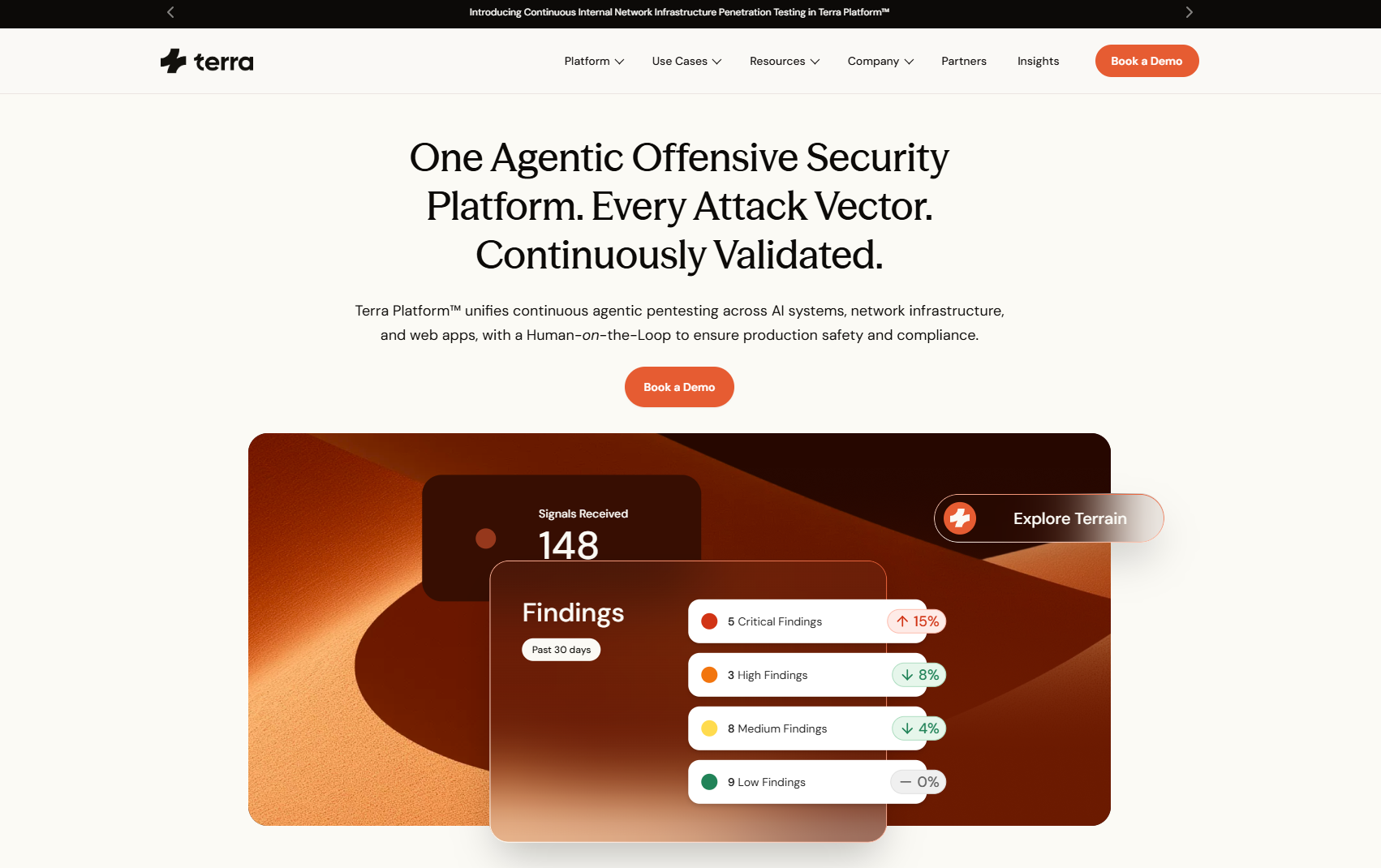
Terra Security
Agentic AI + human-on-the-loop sign-off
Auto-retest after fix or PR merge
Web + internal apps + APIs + AI systems + external network GA; internal network in preview
Business-logic-aware; documentation and API schema ingestion
AWS Security Competency; pentester sign-off gate on intrusive actions
The autonomous pentesting spectrum: what "autonomous" actually means
Vendors in this category implement radically different things under the same "autonomous" label. Naming the spectrum with concrete examples earns clarity, which is what the reader wants when the SERP is dominated by vendor marketing pages that all claim autonomy. Four positions matter.
Position 1: Scanner-derived autonomy
Vendors that autonomously check for known CVEs and infer exploitability from signature match or telemetry. Traditional vulnerability-management leaders (Qualys TruConfirm, Tenable, Rapid7) increasingly sit here. The mechanism is valid for its purpose (rapid coverage of the CVE database against your asset inventory), but it produces potential issues rather than validated exploits. What the reader loses at this position: proof that any given finding is actually exploitable in the specific environment right now.
Position 2: Digital-twin simulation
Vendors that autonomously model attack paths against a graph representation of the environment (XM Cyber, plus adjacent BAS entrants). The mechanism produces attack-path diagrams and control-efficacy scores against modelled adversary behaviour. Valuable for board-level exposure quantification, less directly actionable for engineering teams that want to fix a specific vulnerability tomorrow. The digital twin is a model; the live surface may differ.
Position 3: Hybrid human-on-the-loop
Vendors where AI agents test but human pentesters approve intrusive actions and sign off findings (Terra Security). The mechanism balances agentic depth with human validation gates. The tradeoff is throughput: human-on-the-loop review scales with pentester capacity rather than with compute. Well-suited to organisations that want agentic reasoning with a human sign-off gate on intrusive actions; less well-suited to teams needing 24/7 continuous validation across a large surface.
Position 4: Fully autonomous exploitation with reproducible proof of exploit
Vendors that autonomously execute real, safe-to-fail payloads against the live surface and return reproducible proof of exploit (Ethiack, XBOW, RunSybil, Horizon3.ai NodeZero, Pentera Peer, Hadrian Nova, ProjectDiscovery Neo, Aikido Infinite). The output is a validated exploit chain a developer can reproduce and remediate. The strongest vendors on this end still differ meaningfully by scope (what surface is covered), continuity (how often), and by the retesting model (unlimited portal vs credit-metered). Matching those to the operational obligation is the buyer's job.
What is an autonomous penetration testing platform?
Autonomous pentesting is defined by three properties: agentic AI reasoning across multi-step attack chains, real exploit execution against the live surface, and reproducible proof of exploit as the output. Each property distinguishes the category from adjacent tooling.
How autonomous pentesting differs from traditional pentesting
Traditional pentesting is point-in-time, human-led, and typically scopes weeks per engagement. Autonomous pentesting runs continuously (or on triggers), scales to the full surface without adding headcount, and produces evidence at machine speed. Human red teams remain valuable for deep, creative scenarios; autonomous pentesting complements them by delivering continuous validation across the surface between engagements.
How autonomous pentesting differs from vulnerability scanning
Vulnerability scanners match signatures against known CVEs and check versions; they flag what could be wrong without proving exploitability. Autonomous pentesting executes real, safe-to-fail payloads and returns reproducible proof of exploit. The output is a validated exploited finding rather than an unvalidated potential issue that engineering has to triage.
How autonomous pentesting differs from BAS
Breach and attack simulation (BAS) executes scripted playbooks mapped to MITRE ATT&CK against your controls to test control efficacy. Autonomous pentesting attacks the live surface itself to prove what an attacker can exploit right now. BAS answers "do our controls detect the tradecraft we care about?" Autonomous pentesting answers "what can an attacker actually exploit on my specific surface right now?"
Why autonomous pentesting matters now
The attacker-defender tempo gap has widened across 2025 and 2026, and the AI-vs-AI security discourse triggered by Claude Mythos Preview has moved the operating question from "how often should we test?" to "how do we validate at machine speed continuously?" Autonomous pentesting is the mechanism most commonly cited as the practical answer.
Machine-speed exposure validation matching attacker cadence
Recent CVE incidents have collapsed the window between disclosure and exploitation: Langflow's CVE-2026-33017 (CVSS 9.3) was exploited within 20 hours of disclosure with no public proof-of-concept, and Marimo's CVE-2026-39987 (CVSS 9.3) in under ten hours. Testing that runs every quarter (or every year) does not match this tempo. Continuous autonomous validation does.
Proof of exploit ends the security-engineering debate
Scanner output creates recurring friction: security says "this is critical," engineering says "we can't reproduce it in staging." Proof of exploit closes that loop with a reproducible payload against the specific asset. There is no debate about theoretical severity; there is a working attack chain the engineer can rerun.
Continuous coverage replacing periodic snapshots
Annual pentesting produces one dated snapshot per year. Between engagements, new deploys, new assets, and new CVEs appear on the surface. Continuous autonomous validation produces a rolling evidence stream mapped to specific assets and dated per finding. This is what regulators increasingly expect and what boards increasingly ask for.
Scale that decouples testing throughput from headcount
Human pentester supply is finite and expensive. Autonomous platforms run tests at machine tempo and thousand-fold concurrency, at compute costs. This decouples testing throughput from hiring and lets programmes scale coverage without proportional headcount growth.
Who needs an autonomous pentesting platform
For CISOs and Heads of Security
The trigger is board defensibility: explaining the security programme in terms the board risk committee accepts. The outcome to look for is a multi-factor risk score, exposure evidence tied to specific assets, and reporting that maps to the compliance frameworks (DORA, NIS2, ISO 27001) the board answers to. See pen testing for financial services for the regulated-buyer angle.
For AppSec and SecOps practitioners
The trigger is scanner-critical fatigue: hundreds of new high-severity findings each week and no defensible way to say which to fix first. Proof of exploit removes the triage burden by making every finding actionable evidence, not a claim to investigate. Look for platforms that push validated findings into the ticketing system engineering already uses.
For VP Engineering, CTOs, and DevSecOps
The trigger is deploy velocity: engineering ships to production several times a week, and manual testing cannot keep pace. Look for platforms with CI/CD integration (GitHub, GitLab, Jenkins), PR-triggered runs, and retesting that fits the release cadence rather than fighting it.
For Compliance Officers and Heads of Risk
The trigger is regulatory evidence: DORA, NIS2, ISO 27001, and the EU AI Act all increasingly expect continuous testing evidence rather than annual snapshots. Look for platforms with compliance reporting mapped to the specific frameworks that apply, EU data sovereignty where required, and audit-ready evidence packages.
What "autonomous" actually means when nobody's watching (three tests)
Every vendor in this category calls itself autonomous. The claims mostly diverge at one of three points. Naming the three tests concretely gives the buyer a decision framework that survives vendor pitches. Each test is answered fairly against published vendor documentation.
Test 1: Does the platform find assets you did not scope?
Most autonomous platforms test what you nominate. Depthfirst, XBOW (per its docs, scoped to web + API), RunSybil, Aikido (DNS-verified root domains), Astra (scoped targets), and ProjectDiscovery Neo (target-centric) test what customers hand over. Ethiack pairs continuous attack surface management with autonomous validation so the platform validates assets you did not think to scope. Hadrian pairs Atlas (external discovery) with Nova (autonomous pentesting) in a similar architecture on the external surface only. The buyer question: does your programme need continuous discovery of unknown assets, or is the scoped inventory your source of truth?
Test 2: Does the platform continuously validate, or run on scheduled and change triggers?
Horizon3.ai NodeZero runs on scheduled runners and manual triggers; Pentera Peer is in beta with GA slated for Q4 2026; RunSybil runs on PR + manual + scheduled triggers; ProjectDiscovery Neo runs from PR to production. Ethiack runs 24/7 continuous validation with automatic regression detection: closed findings automatically reopen if they become exploitable again. The buyer question: does your programme need continuous evidence between deploys, or is testing at deploy time enough?
Test 3: Does the platform produce reproducible proof of exploit, or infer exploitability?
Some scanner-adjacent platforms infer exploitability from telemetry or signature match (Rapid7 on cloud workloads, Qualys TruConfirm on known CVE payloads). Ethiack, XBOW, RunSybil, Horizon3.ai NodeZero, Hadrian Nova, ProjectDiscovery Neo, and Terra Security all execute real payloads and return exploit chains a developer can reproduce. The buyer question: does your programme need proof a developer can rerun, or is inferred exploitability sufficient for your risk model?
The 8 best autonomous pentesting platforms in 2026
Selection criteria for this list: commercially available in 2026 (open-source options noted separately), implements autonomous / agentic AI exploitation (excludes pure scanners), and has published capability documentation defensible against public vendor sources. Each review below uses identical structure: Overview, Ideal for, Key features, Pros, Cons framed as tradeoffs, and Verdict.
1. Ethiack (Hackian): Best overall for continuous autonomous validation across the full surface
Ethiack is an EU-based autonomous offensive-security platform. Its purpose-built agentic AI pentester, Hackian, runs 24/7 continuous adversarial exposure validation across external, internal, cloud, and web/API surfaces, producing reproducible proof of exploit for every validated vulnerability. Ethiack is listed as a Top Trending Product in Gartner Peer Insights AEV market and is used by CEGID, ANA Aeroportos, Lusitânia, and Universidade do Porto across regulated European verticals.
Ideal for:
- Regulated European mid-market to enterprise (500+ employees) needing continuous validation across external + internal + cloud + web/API surfaces
- CISO plus AppSec practitioner buying committees under NIS2, DORA, ISO 27001, SOC 2, or PCI DSS pressure
- Engineering-led SaaS teams shipping several times a week that need retest-on-remediation without credit metering
Key features:
- 24/7 continuous AEV with Hackian agentic AI pentesting reasoning across business logic
- Continuous attack surface management (ASM) feeding AEV automatically; assets discovered are validated without a re-scope
- Beacon (CIDR-scoped network-layer tunnel): one machine covers N networks, auto-detects CIDRs from host interfaces, auto-adds to pentest scope
- Multi-factor risk score combining CVSS + CISA KEV + EPSS + asset importance + organisational blind spots
- Automatic regression detection: closed findings automatically reopen when they become exploitable again
- Unlimited portal retesting + usage-based CI/CD retesting via GitHub, GitLab, and Jenkins
- Compliance reporting for DORA, NIS2, ISO 27001, SOC 2, PCI DSS; EU compute (engine servers in Belgium)
Why we stand out:
Ethiack is the only platform in the roster combining continuous 24/7 autonomous validation, full-stack coverage, reproducible proof of exploit for every finding, unlimited portal retesting, and EU compute in a single platform. CEGID moved from checklist-based annual pentesting to autonomous ethical hacking with Ethiack, reporting €12M+ in risk prevented across 2,000+ assets in 20+ companies (Ethiack-reported). See Hackian, the agentic AI pentester for the engine, and adversarial exposure validation for the platform architecture.
Pros:
- Continuous validated exploitability with false-positive rate below 0.5% and proof of exploit for every finding (Ethiack-reported)
- EU data residency (engine servers in Belgium); Gartner Peer Insights AEV Top Trending Product listing
- Unlimited portal retesting removes the credit-metering friction most competitors impose
Cons:
- Active Directory internal testing is a known gap, rolling out by end of Q3 2026 (Ethiack-reported)
- ALE and ROI are a managed feature for select clients, rolling out to product this year; not yet live self-serve platform capability
Pricing:
Per-asset-tier subscription for Continuous plus pentest credits for On-Demand. Not published; sales conversation required.
Verdict:
Best fit for regulated European organisations needing continuous machine-speed autonomous validation with reproducible proof of exploit across the full surface.
2. XBOW: Best for teams wanting top-tier agentic web and API pentesting
XBOW is an autonomous offensive security platform focused on web applications and their APIs. It offers deep agentic AI pentesting on the scoped surface with usage-based attack credits, AWS-native availability, and deterministic validators on confirmed findings. Architecturally very close to Ethiack on web and API depth; the differences are scope breadth and retesting model.
Ideal for:
- Teams whose primary attack surface is web + API and who have limited internal or non-HTTP surface
- SaaS with high-frequency deploys wanting CI/CD-integrated agentic pentesting
- AWS-native buyers valuing AWS Security Competency, ISV Accelerate, and Microsoft Security Copilot / Sentinel integration
Key features:
- Agentic AI pentesting with usage-based attack credits
- CI/CD integration and deterministic validators on confirmed findings
- Board and auditor ready reporting
Pros:
- Very similar architectural depth to Ethiack on web and API
- AWS Marketplace availability with clear listing price
- Strong deterministic validator layer on confirmed findings
Cons:
- Per XBOW documentation, testing excludes mobile applications, network ranges, IP addresses, cloud infrastructure, and internal hosts
- Metered attack credits meter how often teams re-verify fixes, which can shape testing behaviour
- Risk score is severity count without EPSS, CISA KEV, ALE, or ROI factors
Pricing:
Annual contract plus metered credits. AWS Marketplace listing starts from $50,000 per year.
Verdict:
One of the strongest choices for web + API-focused teams. Scope-limited outside those layers; retesting is credit-metered rather than unlimited.
3. Horizon3.ai (NodeZero): Best for internal network + Active Directory exploitation
Horizon3.ai is the established autonomous pentesting category leader, strongest on internal networks, Active Directory credential dumping, and cloud misconfigurations. Its NodeZero WebApp Pentesting module shipped July 2026 on the back of a $250M raise, extending the platform into web application coverage.
Ideal for:
- Organisations whose primary risk is internal lateral movement and Active Directory attack paths
- Large enterprise infrastructure estates with mature SOCs
- US enterprises valuing the category-defining NodeZero brand
Key features:
- NodeZero Runners for internal pentests, often Docker containers
- Scheduled and manually triggered runs; extended agents mode opt-in on WebApp
- 1-Click Verify retest limited to Internal, Phishing, and Insider Threat results
Pros:
- Deep internal network and Active Directory coverage
- Recognised category name with established customer base
Cons:
- Per Horizon3.ai's WebApp launch materials, the module does not claim API-native coverage or automated API specification generation, which are common requirements for API-first environments
- Internal pentests run on scheduled and manual triggers rather than 24/7 continuously
- Per documentation, WebApp tests cannot be scheduled
Pricing:
Not published; enterprise sales conversation required.
Verdict:
One of the strongest choices for internal network and Active Directory autonomous pentesting. Younger and narrower on the application layer than the WebApp release headline suggests.
4. Pentera: Best for automated security validation with human red team backstop
Pentera is a Gartner AEV Representative Vendor with an Automated Security Validation platform strong on ransomware simulation and full-kill-chain emulation across internal networks, cloud, and identity. Pentera 8 (GA Q2 2026) introduced Pentera Peer, a natural language AI interface for guiding adversarial testing. Its separate AI-native web application testing capability launched July 2026 in beta, with GA slated for Q4 2026. The platform holds 300+ ratings on Gartner Peer Insights.
Ideal for:
- Large enterprise infrastructure teams with mature SecOps-led buying committees
- Organisations with existing human red team programmes wanting AEV augmentation
- Buyers prioritising ransomware simulation depth and full-kill-chain testing
Key features:
- Pentera Surface validates web-facing exposure against OWASP
- Pentera Peer natural language AI interface (GA Q2 2026); separate AI-native web app testing with business logic + access-control + authenticated testing behind SSO/MFA/OAuth in beta, GA slated Q4 2026
- Resolve auto-triggers revalidation of the original attack path after a fix
- Jira and ServiceNow routing
Pros:
- Gartner AEV Representative Vendor recognition
- Strong infrastructure and identity depth; ransomware simulation quality
Cons:
- AI-native web app testing is beta until Q4 2026 GA, creating a timing gap for web-heavy buyers
- SecOps-owned revalidation loop; developer initiates less directly
- No expected loss or ROI translation in the platform
Pricing:
Not published; enterprise sales conversation required.
Verdict:
Excellent for infrastructure-heavy SecOps-led buyers wanting AEV Rep Vendor recognition. Timing gap on agentic web/API until Q4 2026 GA is the practical caveat.
5. RunSybil: Best for AI-native agentic exploitation across apps, APIs, cloud, and infrastructure
RunSybil is an AI-native offensive security platform delivering live agentic exploitation across applications, APIs, cloud, and internet-facing infrastructure. Its Sybil orchestrator agent coordinates specialized sub-agents for reconnaissance, exploitation, and validation, running continuously on every deployment and re-evaluating what changed. RunSybil raised $40M led by Khosla Ventures in March 2026; founding team from OpenAI, Meta, Mandiant, and NCC Group.
Ideal for:
- Teams comfortable defining scope and handing targets to the platform
- SaaS and cloud-native organisations with defined attack surface
- Developer-first buying committees valuing PR-triggered testing
Key features:
- Sybil orchestrator with specialized sub-agents for recon, exploitation, and validation
- Black-box testing across apps, APIs, cloud, and infrastructure without source code access
- Continuous testing on every deployment; re-evaluates what changed
- Live exploit validation with reproducible proof of concept
Pros:
- Deep on application and API logic; chains findings into cloud and infrastructure impact
- RunSybil claims 90%+ false-positive reduction
- $40M Series A funding (Khosla Ventures, March 2026); founding team from OpenAI, Meta, Mandiant, and NCC Group
Cons:
- Scoped to targets the customer hands over; no continuous discovery outside handed scope
- No internal network or Active Directory coverage
- No expected loss or ROI translation in the platform
Pricing:
Not published; sales conversation required.
Verdict:
One of the strongest choices for AI-native scoped web / API / cloud / infrastructure engagements. Limited outside handed-over scope.
6. Hadrian (Nova): Best for external attack surface autonomous pentesting
Hadrian is a Gartner AEV Representative Vendor with a dual architecture: Hadrian Atlas provides continuous external attack surface discovery, and Hadrian Nova provides per-test agentic pentesting covering web apps, APIs, and cloud with privilege escalation and cross-account testing. Regression testing runs on resolution, and Hadrian offers event-driven retesting alongside its ticketing, chat, and threat intel integrations.
Ideal for:
- Organisations whose primary risk is the external attack surface
- Teams wanting on-demand deep external tests plus continuous discovery in one platform
- Buyers valuing Gartner AEV Rep Vendor recognition on external AEV
Key features:
- Hadrian Atlas for continuous external attack surface discovery
- Hadrian Nova for per-test agentic pentesting on web apps, APIs, and cloud
- Privilege escalation and cross-account testing
- APEX domains feature (a known gap for Ethiack)
Pros:
- Gartner AEV Rep Vendor recognition
- External AEV maturity with dual Atlas + Nova architecture
- Event-driven retesting on resolution
Cons:
- No internal network coverage
- No published CI/CD integration
- Risk prioritisation is context-driven with no financial translation
Pricing:
Not published; enterprise sales conversation required.
Verdict:
Excellent choice for external-only autonomous validation. Leaves the internal blind spot open for buyers with material internal risk.
7. ProjectDiscovery (Neo): Best for pay-as-you-go autonomous pentesting from $250 per month
ProjectDiscovery grew from open-source Nuclei, Subfinder, and HTTPx into an AI offensive-security platform. Neo is a multi-agent system that runs autonomous testing from pull request to production. Neo reached general availability in August 2026 with a self-serve pay-as-you-go model from $250 per month, credit-metered validation, and Neo Insights + PDF reporting.
Ideal for:
- Developer-first teams comfortable with credit-metered testing
- SaaS with high-frequency deploys wanting testing from PR to production
- Buyers wanting a low-commitment entry point without enterprise sales cycle
Key features:
- 30+ tools built into the platform
- Neo Insights and PDF reporting
- Testing from PR to production with credit-metered validation runs
Pros:
- Accessible pricing entry point at $250 per month
- Reached general availability in August 2026
- Developer-friendly workflow with PR-triggered testing
Cons:
- Per ProjectDiscovery's own published research, Neo carries a 10 to 20% false-positive rate during multi-repository audits
- Baseline scanning still relies on Nuclei template heuristics that flag configuration quirks
- Internal network coverage requires manual VPN or SSH configuration
- No monetary risk translation
Pricing:
Pay-as-you-go from $250 per seat per month; 50 credits included, additional credits at $5 each.
Verdict:
One of the strongest developer-facing entry points. False-positive rate, Nuclei heuristics, and manual internal setup are the tradeoffs.
8. Terra Security: Best for agentic testing with human-on-the-loop pentester sign-off
Terra Security is an agentic AI offensive security platform pairing AI agents with human-on-the-loop pentester sign-off. It is generally available across web applications, internal applications, APIs, and AI systems; external network validation went GA for all customers in May 2026, and internal network testing is in limited preview with design partners. Terra holds AWS Security Competency.
Ideal for:
- Organisations wanting agentic depth with a human validation gate on intrusive actions
- Teams valuing pentester sign-off before findings escalate
- Buyers wanting broad GA scope covering web + internal apps + APIs + AI + external network
Key features:
- Business-logic-aware agentic testing
- Auto-retest after fix or PR merge
- Jira, Linear, ServiceNow integrations
- Ingests documentation, API schemas, and architecture diagrams for context
Pros:
- AWS Security Competency
- Documented human-on-the-loop rigour on intrusive actions
- Broad GA scope for external + web + internal apps + APIs + AI
Cons:
- Default SaaS hosting is US and Israel, a data-residency probe point for EU-sovereignty-sensitive buyers under DORA, NIS2, GDPR, or ECB-scoped procurement
- Internal network testing is a waitlist-gated limited preview with design partners rather than generally available, leaving lateral movement and privilege escalation unvalidated for most buyers outside the design programme
- Human-on-the-loop gating means throughput scales with pentester capacity rather than compute
- No expected loss or ROI translation
Pricing:
Not published; sales conversation required.
Verdict:
Strong choice for teams valuing a human sign-off gate on intrusive actions. Internal network availability is the caveat until GA moves out of limited preview.
Open-source alternatives noted honestly
The current #1 Google result for "autonomous penetration testing platform" is github.com/vxcontrol/pentagi, and PentestGPT appears in the top rankers. Ignoring open-source would look dishonest; naming them fairly earns credibility with the developer traffic that partly dominates this SERP.
PentaGi
PentaGi is a fully autonomous AI agents system for penetration testing, open-source under active community development. Strong developer interest, active issue tracker, and the analytical value of a clean reference implementation. What it is not: a commercial platform, so no vendor support, no compliance reporting, no enterprise integrations, no EU data residency guarantees, no service-level agreements.
PentestGPT
PentestGPT is an autonomous penetration testing prototype using large language models, positioned as a research and community project. Useful for individual practitioners exploring what agentic reasoning can add to security testing workflows. Not positioned as a production-grade enterprise platform.
Nuclei / ProjectDiscovery open-source
The Nuclei templated scanning engine and Subfinder / HTTPx utilities from ProjectDiscovery sit between fully open-source and commercial. They are widely used in the security-engineering community as building blocks for custom offensive workflows. The commercial Neo platform (profiled above) builds on top of these engines.
Honest framing: open-source tools are useful for research, red team practitioners, and organisations building custom offensive-security workflows. Commercial platforms add continuous cadence, safety guardrails, compliance reporting, EU sovereignty, integrations, vendor support, and validated results, which regulated enterprises require.
How to choose an autonomous pentesting platform (7 decision factors)
1. Autonomy scope
Where on the spectrum does the platform sit? Scanner-derived autonomy checks signatures. Digital-twin simulation models attack paths. Hybrid human-on-the-loop lets agents test but humans approve intrusive actions. Fully autonomous exploitation executes real payloads and returns proof of exploit. The buyer's job is matching spectrum position to operational obligation, not chasing the strongest autonomy claim.
2. Continuity model
Does the platform run 24/7 continuously, on scheduled runners, on change triggers (PR-driven), or on-demand only? Continuous validation matches the attacker tempo the Langflow and Marimo CVE incidents demonstrated (exploited within hours of disclosure). Scheduled and on-demand models leave the tempo gap open. Match the continuity model to how quickly your surface changes.
3. Attack surface coverage
Does the platform cover the surface that matters to your risk model? Web + API only, external only, internal + AD only, or full-stack. XBOW is scoped to web + API per its docs. Hadrian is external only. Horizon3.ai is strongest internally. Ethiack covers external + internal (via Beacon) + cloud + web/API. There is no universal answer; there is a fit-to-risk-model answer.
4. Proof of exploit vs inferred exploitability
Does the platform execute real payloads and return reproducible proof of exploit, or infer exploitability from telemetry, signature match, or CVE database lookup? Proof of exploit removes the security-engineering debate by producing evidence a developer can rerun. Inferred exploitability is faster to produce but leaves triage burden on the security team. See adversarial exposure validation for the proof-of-exploit mechanism.
5. Retesting model
Is retesting unlimited through the portal, credit-metered through CI/CD, scheduled through runners, or event-driven on resolution? Teams shipping many times a day need retesting that fits the release cadence. Ethiack offers unlimited portal retesting + usage-based CI/CD; XBOW and ProjectDiscovery Neo meter CI/CD via credits; Horizon3.ai runs 1-Click Verify on specific result classes.
6. Compliance and regulatory posture
Does the platform report against DORA, NIS2, ISO 27001, SOC 2, PCI DSS, and the EU AI Act? Where does data process, and does that meet EU sovereignty requirements? Ethiack processes on EU compute (engine servers in Belgium) and reports against the frameworks above. US-hosted platforms can be used with data-processing addenda; sovereignty is a structural advantage. See Ethiack compliance reporting for the framework mapping.
7. Executive reporting
Does the platform produce a defensible risk score, and does the risk model translate into board-level metrics (expected loss, tool consolidation, mean-time-to-remediation)? Multi-factor risk scores combining CVSS + EPSS + CISA KEV + asset importance + organisational blind spots produce a defensible narrative for the board. Severity counts alone do not. ALE and ROI translation remains a rare feature (Ethiack rolling out to product this year; several competitors do not offer it).
Everything you need to know about autonomous pentesting platforms
Ethiack
Fully autonomous
⭐⭐⭐⭐⭐
⭐⭐⭐⭐⭐
⭐⭐⭐⭐⭐
⭐⭐⭐⭐
⭐⭐⭐⭐⭐
Unlimited portal + CI/CD
⭐⭐⭐ (managed)
XBOW
Fully autonomous
⭐⭐⭐
⭐⭐⭐
⭐⭐⭐⭐⭐
⭐
⭐⭐⭐⭐⭐
Credit-metered
⭐
Horizon3.ai
Fully autonomous
⭐⭐⭐
⭐⭐⭐
⭐⭐⭐
⭐⭐⭐⭐⭐
⭐⭐⭐⭐⭐
1-Click Verify (limited)
⭐⭐
Pentera
AEV + agentic (beta)
⭐⭐⭐⭐
⭐⭐⭐⭐
⭐⭐⭐ (beta)
⭐⭐⭐⭐
⭐⭐⭐⭐
Resolve auto-triggered
⭐
RunSybil
Fully autonomous
⭐⭐⭐
⭐⭐⭐⭐
⭐⭐⭐⭐⭐
⭐
⭐⭐⭐⭐⭐
PR + manual + scheduled
⭐
Hadrian
Fully autonomous per-test
⭐⭐⭐⭐
⭐⭐⭐
⭐⭐⭐⭐
⭐
⭐⭐⭐⭐⭐
Event-driven on resolution
⭐
ProjectDiscovery
Multi-agent
⭐⭐⭐
⭐⭐⭐
⭐⭐⭐⭐
⭐⭐ (manual)
⭐⭐⭐⭐
Credit-metered
⭐
Terra Security
Agentic + human sign-off
⭐⭐⭐
⭐⭐⭐⭐
⭐⭐⭐⭐
⭐⭐ (preview)
⭐⭐⭐⭐⭐
Auto-retest on fix/PR
⭐
See what continuous autonomous validation finds on your live surface
The autonomous pentesting platform you choose should match your operational obligation, not the strongest autonomy claim. Ethiack runs 24/7 continuous adversarial validation across your full surface with reproducible proof of exploit and EU compute. Book a demo, or run a free external test to see the surface as an attacker would.
Frequently asked questions about Autonomous Penetration Testing Platforms
What is an autonomous penetration testing platform?
An autonomous penetration testing platform uses agentic AI to reason about attack paths, execute real exploits, and validate exploitability without step-by-step human direction. It combines discovery, exploitation, and reproducible proof. The strongest platforms produce a proof-of-concept exploit rather than a signature match, and run continuously rather than only in scheduled engagements.
Which is the best autonomous pentesting platform in 2026?
For continuous machine-speed validation across the full surface with reproducible proof of exploit and EU compute, Ethiack. For agentic web and API depth with AWS-native integrations, XBOW. For internal network + Active Directory, Horizon3.ai NodeZero. For automated security validation with human red team backstop, Pentera. Fit-to-obligation matters more than a single overall winner.
How is autonomous pentesting different from a vulnerability scanner?
Vulnerability scanners match signatures and check versions; they flag what could be wrong without proving exploitability. Autonomous pentesting executes real, safe-to-fail payloads and returns reproducible proof of exploit. The output is a validated exploited finding rather than an unvalidated potential issue that engineering has to triage.
Does autonomous pentesting replace human pentesters?
No. Human pentesters remain valuable for deep creative scenarios: business-logic vulnerabilities requiring social context, multi-step attack chains involving human targets, and high-consequence engagements requiring narrative reporting. Autonomous pentesting complements human work by validating at machine speed across the full surface continuously; it does not eliminate the need for human depth on specific scenarios.
How reliable is AI-driven penetration testing?
The most rigorous platforms validate every finding by executing a safe-to-fail exploit and attach reproducible payload evidence. Ethiack reports false-positive rate below 0.5% and 99.5% precision (Ethiack-reported). ProjectDiscovery Neo reports a 10 to 20% false-positive rate in its own published research. Vendor-specific reliability data should be checked in every evaluation.
What is the difference between XBOW and Ethiack?
XBOW and Ethiack offer very similar architectural depth on agentic web and API pentesting. The main differences: Ethiack extends into internal networks (via Beacon) and non-HTTP services; XBOW documentation excludes mobile, network ranges, IPs, cloud infrastructure, and internal hosts. Ethiack offers unlimited portal retesting; XBOW meters retesting via attack credits.
How does Horizon3.ai NodeZero compare on web apps?
NodeZero is strongest on internal networks and Active Directory. Its WebApp Pentesting module shipped July 2026 and its documentation lists GraphQL-specific weaknesses, general business-logic flaws, deserialization, race conditions, and file-upload-to-RCE as not currently covered. Pure web / API-focused organisations may prefer platforms with deeper application-layer heritage.
Is Pentera an autonomous pentesting platform?
Pentera is an Automated Security Validation platform recognised by Gartner as a 2026 AEV Representative Vendor. Its AI-native web app testing (Peer) launched in July 2026 and is in beta with GA slated for Q4 2026. Pentera's DNA is infrastructure and network validation; the agentic web timing gap until Q4 2026 GA is the practical caveat for web-heavy buyers.
Can autonomous pentesting run in CI/CD pipelines?
Yes. Ethiack, XBOW, RunSybil, and ProjectDiscovery Neo all offer CI/CD integration. Ethiack provides unlimited portal retesting plus usage-based CI/CD via GitHub, GitLab, and Jenkins. XBOW and Neo meter CI/CD usage via credits. Choice depends on retesting cadence: teams shipping many times a day should evaluate the cost of metered vs unlimited models.
How much does an autonomous pentesting platform cost?
Pricing varies widely. ProjectDiscovery Neo starts at $250 per month self-serve. XBOW AWS Marketplace lists from $50,000 per year plus metered attack credits. Ethiack, RunSybil, Hadrian, Pentera, Horizon3.ai, and Terra Security do not publish pricing and require a sales conversation. Ethiack pricing is per-asset-tier subscription plus pentest credits.
Is there an open-source autonomous pentesting tool?
Yes. PentaGi (github.com/vxcontrol/pentagi) is an open-source fully autonomous AI agents system. PentestGPT (pentestgpt.com) is a research prototype using large language models. Nuclei from ProjectDiscovery is open-source templated scanning. Open-source options are useful for research and red team work but lack commercial-grade support, compliance reporting, and integrations.
Does Ethiack test AI models or offensive AI like Claude Mythos?
No. Ethiack tests the customer-side application layer including AI-driven components (chatbots, RAG apps, AI agents on customer infrastructure) and third-party integrations reachable from the customer's surface. Ethiack does not test AI models themselves (weights, training data, model internals) and does not test offensive AI models. For model-layer testing, pair Ethiack with an AI-system-testing specialist. See the Mythos AI Security Implications complete guide for the defensive-side context.