Exploitation now happens in hours, not months. That is the tempo defenders now face. Meanwhile, most security programmes still run on a stack built for a slower era: attack surface management (ASM) to see what is exposed, and vulnerability management (VM) to list what is wrong on what you own. Neither answers the question a shrinking exposure window makes urgent: which of those findings can an attacker actually exploit right now?
This piece walks through what each discipline does, where they overlap, and why the honest answer is not "ASM or VM" but "ASM and VM, plus the validation layer that closes the gap between them." That layer is adversarial exposure validation (AEV), and it is the reason NIS2 and DORA auditors now ask for continuous testing evidence rather than snapshots.
Key takeaways
- Verdict: you need both ASM and VM, plus adversarial exposure validation (AEV), the layer that proves which findings an attacker can actually exploit right now
- ASM answers "what is exposed?" by continuously discovering internet-facing, cloud, and third-party surface
- VM answers "what is wrong on what we own?" by cataloguing vulnerabilities on known assets and prioritising fixes
- AEV sits between them: it runs continuously against discovered assets and produces reproducible proof of exploit for every finding
- Gartner's Continuous Threat Exposure Management (CTEM) is the workflow that ties ASM, VM, and AEV together into a single programme
- Ethiack delivers the AEV layer through Hackian, an agentic AI pentester, at 30x manual-pentest speed with a false-positive rate below 0.5% (Ethiack-reported)
The exposure window is collapsing (Zero Day Clock)
Exploitation windows have collapsed from years to days to hours. Approximately 67% of exploited vulnerabilities are now zero-days (zerodayclock.com). Ethiack's own research documents 21 minutes to an AI-led bank security compromise. What used to be an annual pentest cadence now leaves months of exposure between engagements. What used to be a weekly vulnerability queue leaves days between "known" and "exploited".
This is why "ASM vs VM" is the wrong question to stop at. Both are necessary. Neither is sufficient. The buying decision the CISO now presents to the board is not "which category of tool do we buy first". It is "which layer proves exploitability inside a shrinking window, so we can prioritise remediation on what an attacker can actually reach?" That layer is adversarial exposure validation. It is what turns a queue of findings into a short, exploit-ranked action list backed by reproducible proof.
At-a-glance matrix
The table below compares ASM and VM across six dimensions, plus a third column for adversarial exposure validation (AEV). This turns the "vs" question into "which layer answers which question", which is the honest positioning and the shortest path to a good buying decision.
Primary question
What is exposed?
What is wrong on what we own?
Which of these can be exploited right now?
Input
Internet + cloud + third-party surface
Known assets + software inventory
Discovered surface + open findings
Output
Asset inventory with risk context
Findings ranked by score or model
Reproducible proof of exploit for each validated finding
Cadence
Continuous (modern platforms)
Continuous scanning + periodic prioritisation
Trigger-based and continuous
Prioritisation signal
Exposure + criticality
CVSS, EPSS, KEV, model-based risk
Proven exploitability against your environment
What it does NOT do
Prove exploitability
Discover unknown assets or prove exploitability
Replace either; augments both
What is attack surface management?
Attack surface management (ASM) is the continuous discovery, inventory, and monitoring of every asset an attacker could reach: internet-facing services, cloud instances, APIs, third-party surface, forgotten legacy, and post-M&A infrastructure. It answers the question "what is exposed?" and gives security teams a live picture of assets before an attacker maps them. External ASM (EASM) focuses on internet-visible assets; cyber asset ASM (CAASM) extends inside the enterprise.
Modern ASM has moved beyond periodic asset inventory to continuous, always-on discovery, aligned with the Gartner Hype Cycle for Security Operations. Trigger-based discovery fires on new deployments, new subdomains, cloud configuration changes, and third-party surface expansions. This matters because attack surfaces are no longer static: cloud-first architectures, M&A activity, and shadow IT continuously add unknown assets to the exposure profile.
Adjacent categories to know: EASM (external attack surface management) focuses on internet-visible assets; CAASM (cyber asset attack surface management) extends inside the enterprise. Representative ASM platforms in the market include UpGuard, BitSight, CyCognito, Palo Alto Cortex Xpanse, Microsoft Defender EASM, Hadrian, and Detectify. See the Ethiack attack surface management platform for how continuous discovery integrates with the validation layer.
Where AEV fits into the ASM story: discovering an asset is the starting line. Validating what an attacker can exploit on it is the finish. ASM builds the inventory; validation determines which of those assets carry live, exploitable risk right now. Without the validation layer, ASM produces a longer list that a stretched team still has to triage.
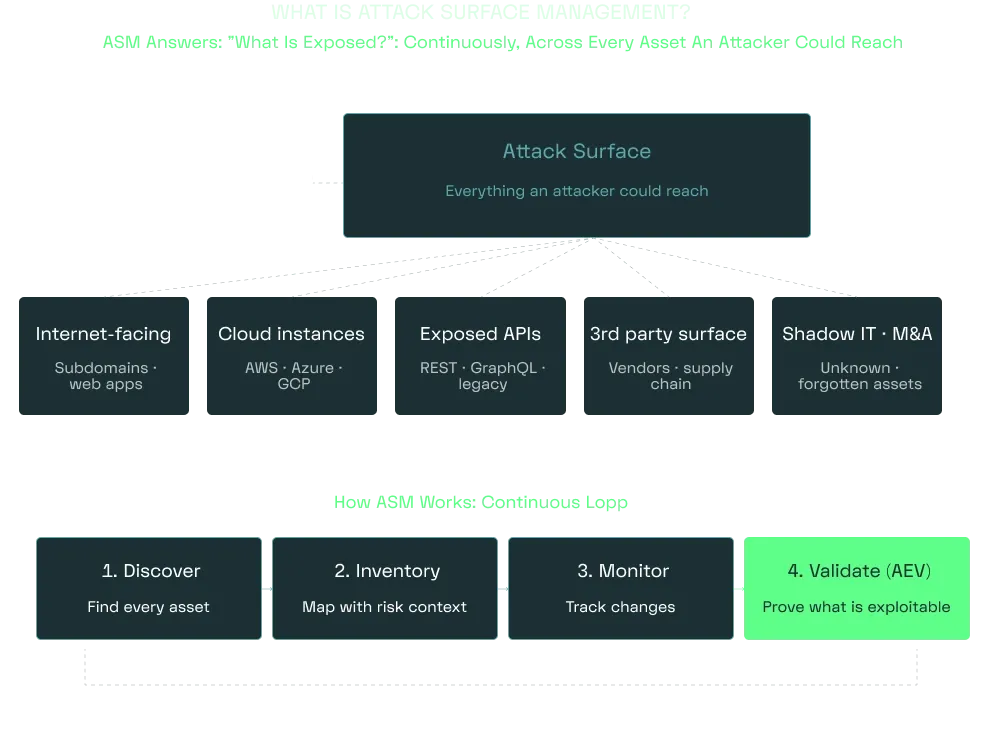 What is Attack Surface Management
What is vulnerability management?
Vulnerability management (VM) is the continuous process of identifying, assessing, prioritising, remediating, and verifying security vulnerabilities on known assets. Traditional VM ran on periodic scanning cycles. Modern risk-based vulnerability management (RBVM) enriches raw findings with EPSS, CISA KEV, and business-context signals so security teams can prioritise remediation by real risk rather than raw CVSS score.
The five phases of a vulnerability management programme are Discover, Assess, Prioritise, Remediate, and Verify. Scanner-heritage VM stacks (Tenable, Qualys, Rapid7, Microsoft Defender VM, CrowdStrike Falcon Exposure, Wiz, Snyk) run the Discover-through-Prioritise phases and have deep integrations with ticketing, patch management, and remediation workflows. See risk-based vulnerability management for how these outputs integrate with continuous validation. Their central limitation is the same for every scanner-based system: they list what could be wrong, not what an attacker will exploit.
RBVM addresses this partially through prioritisation enrichment. EPSS (Exploit Prediction Scoring System) estimates the probability that a CVE will be exploited in the wild within 30 days. CISA KEV catalogues vulnerabilities being actively exploited today. Business-context enrichment factors in asset criticality. All three sharpen the queue.
Where AEV fits into the VM story: listing what could be wrong is different from proving what an attacker will exploit in your environment. AEV runs adaptive, safe-in-production attacks against the assets VM catalogues, and returns a reproducible proof of exploit for every validated finding. The queue collapses because most of what was on it was never actually reachable.
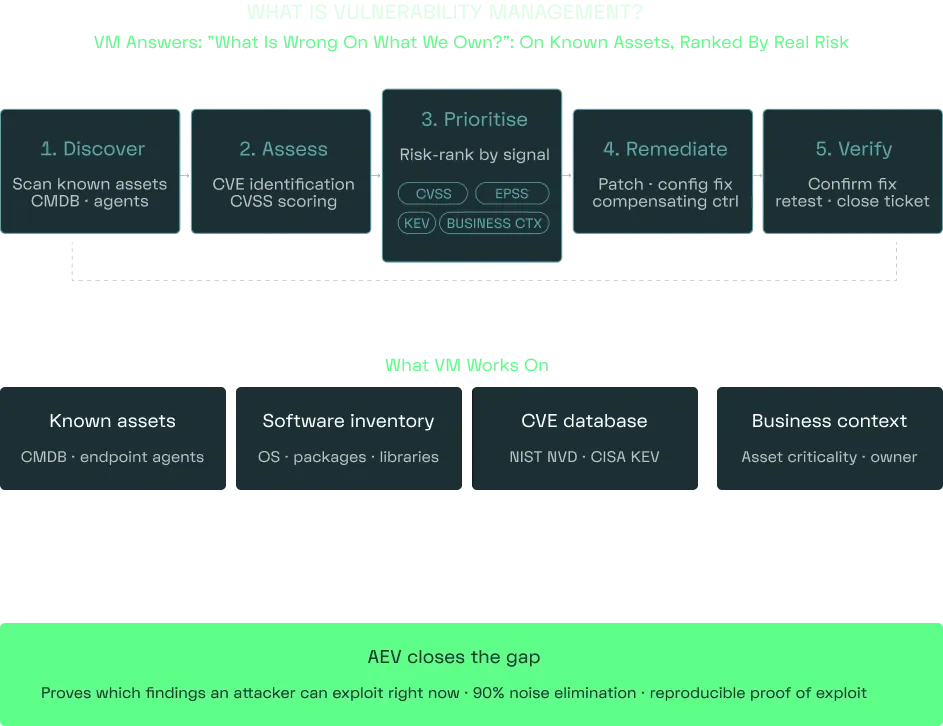 What is Vulnerability Management
ASM vs VM: the six key differences
Same discipline family, different questions. The six dimensions below give buyers a like-for-like frame for a good decision.
1. Primary question
ASM answers "what is exposed?" by cataloguing every asset an attacker could reach across internet-facing, cloud, and third-party surface. VM answers "what is wrong on what we own?" by cataloguing vulnerabilities on assets already known and managed. The two disciplines run against different scopes. Confusing them produces gaps where an unknown asset with a known vulnerability sits unaddressed.
2. Input
ASM ingests continuous discovery data from internet scans, cloud APIs, DNS records, and third-party surface intelligence. VM ingests software inventory data from CMDB, endpoint agents, and asset registries. ASM is looking outward; VM is looking inward. Modern platforms bridge the two with connectors, but the core inputs and vantage points remain distinct.
3. Output
ASM outputs an asset inventory annotated with exposure and criticality context. VM outputs vulnerability findings ranked by CVSS score, EPSS probability, KEV inclusion, or a model-based risk composite. Neither output includes reproducible proof of exploit by default. That is the AEV layer's job.
4. Cadence
Modern ASM runs continuously, with trigger-based discovery on new deployments. VM typically runs continuous scanning against known assets with periodic prioritisation cycles for the security team. Both categories have moved toward continuous mode; neither delivers proof of exploit continuously. AEV runs continuously against the validated intersection of ASM discovery and VM findings.
5. Prioritisation signal
ASM prioritises by exposure characteristics: internet reachability, asset criticality, third-party trust. VM prioritises by vulnerability signal: CVSS severity, EPSS probability, KEV listing, or a model-based composite. Both are proxies for real risk. AEV replaces proxy signals with proven exploitability: the finding is prioritised because an adaptive attack chain reached the objective in your environment.
6. What each does NOT do
ASM does not prove exploitability. VM does not discover unknown assets, does not prove exploitability on the assets it knows about, and in most cases does not test business-logic or chained attack paths. AEV does not replace either. It sits above both, validating which of the assets ASM finds and which of the findings VM lists are exploitable right now.
Where adversarial exposure validation (AEV) fits
AEV is the layer that closes the gap between ASM (discovery) and VM (lifecycle). A discovered asset with a CVSS 9.8 finding is still noise if you cannot prove the finding is exploitable in your environment. AEV turns discovery + findings into a shrinking, exploit-ranked list.
Discovery without validation is noise
ASM produces a list of assets. Modern platforms produce a very long list. A stretched security team cannot triage every discovered asset with the depth an attacker would apply. Validation compresses the list: which of these assets are actually reachable, which host live services, which chain to a real objective. The output is a short list of assets ranked by exploitability, not by discovery order or CVSS proxy.
Findings without validation are queues
VM produces a queue of vulnerabilities. Even with RBVM enrichment, the queue is longer than a team can act on. Most findings are non-exploitable in the specific environment, either because the vulnerable path is not reachable or because compensating controls interrupt the exploit chain. Validation cuts the noise: 90% noise elimination and 80% faster remediation (Ethiack-reported). What is left is a short queue of findings a real attack chain reached.
What validation actually looks like
Hackian, Ethiack's agentic AI pentester, runs continuously against the discovered surface. It chains vulnerabilities dynamically, pivots when initial approaches fail, and constructs payloads on the fly. Every finding ships with reproducible proof of exploit through adversarial exposure validation: the payload, the evidence, and mitigation guidance a developer can act on and re-test. Proof pairing: 30x faster than manual pentesting (Ethiack-reported); €12M+ risk prevented at CEGID across 2,000+ assets (Ethiack-reported).
How ASM, VM, and AEV work together inside CTEM
Gartner's Continuous Threat Exposure Management (CTEM) is the workflow that ties ASM, VM, and AEV together. It defines five phases: Scoping, Discovery, Prioritisation, Validation, and Mobilisation. Each phase is a distinct question the programme answers.
Scoping is a programme decision, not a tool category: which parts of the business surface fall in scope, and at what depth. Discovery is where ASM lives, delivering continuous asset inventory and exposure mapping across internet-facing, cloud, and third-party surface. Prioritisation is where VM and AEV overlap: RBVM enriches CVE findings with EPSS, KEV, and business-context signals, and AEV overlays with proven exploitability so the queue reflects real risk. Validation is where AEV lives: reproducible proof of exploit for each finding, running continuously. Mobilisation is where remediation happens: developer workflows, patch management, compensating controls, retesting.
Ethiack sits at the Discovery + Validation + Prioritisation core, integrating with existing VM data lakes and ticketing rather than replacing them. The three layers ship together in a single product line, so CTEM programmes stand up without stitching four vendors together.
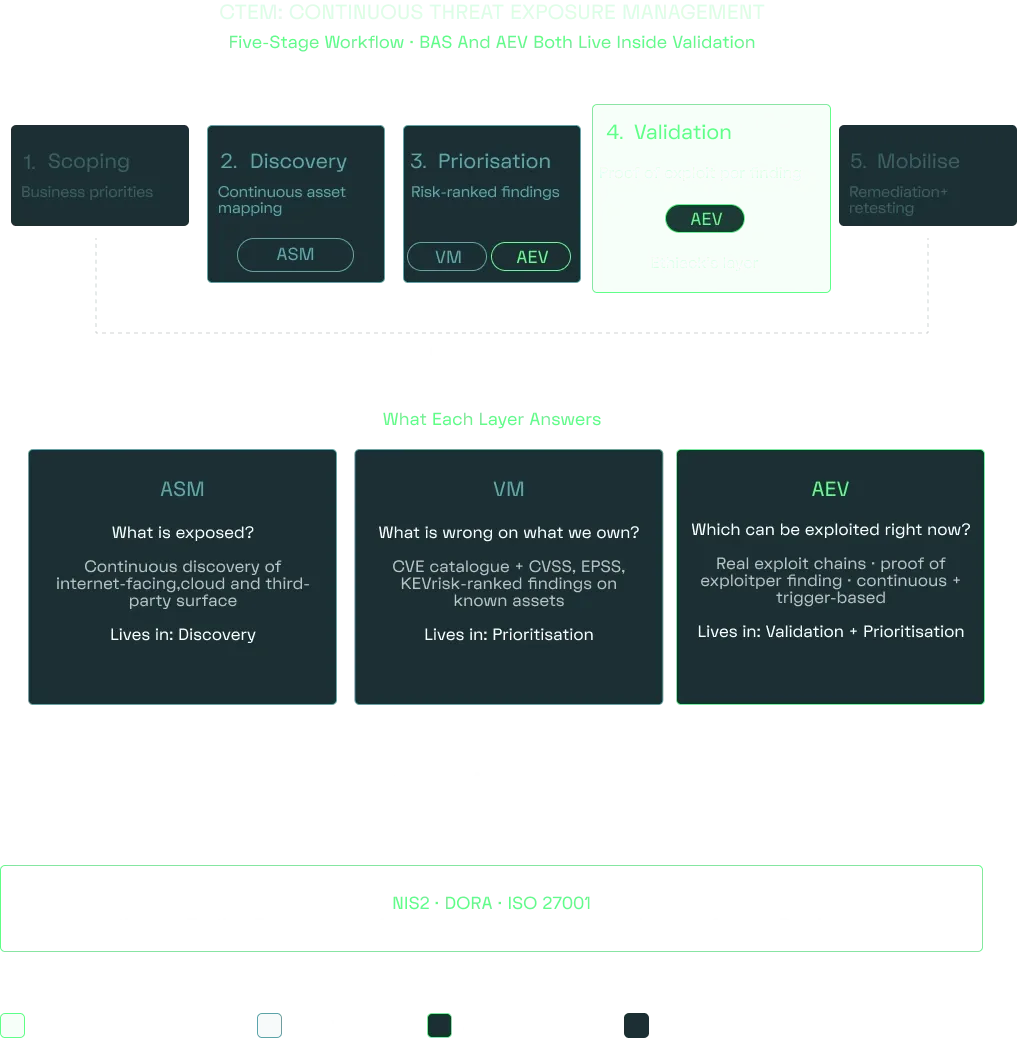 The five stages of CTEM, with ASM in Discovery, VM in Prioritisation, and AEV proving exploitability in Validation.
Who should focus on which (persona map)
Four personas own four different conversations on this topic. Each should read this section for the answer that maps to their day.
For SecOps and AppSec practitioners
VM is where your day lives: triaging findings, chasing patch windows, updating tickets. AEV cuts the queue by proving which findings are exploitable, so you triage a short list instead of a long one. 90% noise elimination and 80% faster remediation (Ethiack-reported). ASM feeds you the assets you may not know exist yet.
For VP Engineering and DevSecOps
ASM is what changes with every deploy: new subdomains, new APIs, new cloud instances. AEV is the trigger-based validation loop that runs against those changes as they ship, closing the gap between "code merged" and "surface validated". VM handles the standing queue; AEV keeps the delta between deploys under continuous test, at machine speed. Safe in production through benign-payload exploitation.
For CISOs
Both categories matter for the board conversation. AEV is what turns a report of findings into an ROI story: proven exploitability, ALE-based risk quantification, and evidence of a shrinking exposure window. Every metric attributed and reproducible. This is the difference between a compliance-tint programme and a defensible offensive-security posture.
For Compliance Officers and Heads of Risk
NIS2 and DORA auditors are no longer asking "do you have a vulnerability programme?" They are asking for evidence of continuous testing: dated, reproducible, mapped to specific controls. Periodic pentest reports no longer satisfy audit requirements under NIS2 (Article 21) and DORA (Article 25). AEV is the mechanism that produces the required evidence trail continuously: dated per finding, reproducible via proof of exploit, and mapped to the specific controls auditors ask about. Without it, teams stitch audit evidence together from snapshots that were stale the day they landed. See ASM and VM for financial services (DORA) for the sector-specific framing.
Compliance mapping (NIS2, DORA, ISO 27001)
NIS2 (Article 21), DORA (Article 25), and ISO 27001 (Annex A controls) all require continuous testing evidence. The table below maps which framework clause each layer addresses, and where AEV closes the continuous-testing and audit-evidence obligations both frameworks now emphasise.
NIS2
Article 21 (cybersecurity risk-management measures)
Asset visibility across essential and important surface
Vulnerability handling and disclosure
Continuous testing evidence with proof of exploit
DORA
Article 25 (ICT-related security testing)
Third-party ICT surface visibility
Vulnerability assessment on covered ICT systems
Continuous adversarial validation aligned with TIBER-EU cycles
ISO 27001
A.8 Asset Management
Live asset inventory across cloud and third-party
Vulnerability catalogue on managed assets
Validated exploitability per asset, mapped to control statements
ISO 27001
A.12 Operations Security
External exposure baseline
Vulnerability management process
Reproducible evidence of remediation effectiveness
Every finding maps to the specific clause it evidences. Continuous NIS2 and DORA compliance reporting outputs are auditor- and insurer-ready on demand. For deeper framing, see continuous testing and DORA.
Migration and integration considerations
The most frequent objection from buyers running a mature VM stack is "do I have to rip and replace?" The answer is no. Ethiack sits alongside scanner-heritage VM tools and augments them with the validation and discovery layers most VM stacks were never built for.
Augment, not replace
Existing VM data (scanner findings, asset inventories, CMDB) feeds into Ethiack. Ethiack validates which of those findings are actually exploitable, discovers assets the VM tool missed (unknown subdomains, exposed APIs, forgotten cloud instances), and closes the loop with proof of exploit. The VM stack keeps running. No parallel dashboards. No double reporting.
Integration mechanisms (by name)
REST APIs for bidirectional data exchange. Webhooks for event-driven triggers: new asset live, new finding, remediation confirmed, retest required. SIEM and SOAR feeds for correlation with detection data (Splunk, Microsoft Sentinel, Google Chronicle, and equivalents). Ticketing and remediation routing (Jira, Slack, ServiceNow, PagerDuty). VM-data-lake ingestion so validated findings enrich existing dashboards instead of creating a parallel one. Ethiack's platform is API-first by design, which means the finding flow can start or terminate anywhere the security team already operates.
What changes vs what stays
Scanner-heritage VM stacks keep their role: broad CVE surveillance, asset baseline, and lifecycle process. Ethiack adds two layers on top: continuous validation of what is actually exploitable, and discovery of surface the VM tool cannot see (external, third-party, post-M&A, shadow IT). No rip-and-replace. No forced migration window. The buyer keeps the current stack and adds the layer that turns proxy signals into proven exploitability.
See what an attacker can exploit across your surface. Run a free external test, no installation required, results in 24 hours. Reproducible proof of exploit for every validated finding.
Trusted by CEGID (€12M+ risk prevented across 2,000+ assets), Lusitânia (10x ROI, 80% MTTR reduction), and ANA Aeroportos (650% ROI). All Ethiack-reported.
Frequently asked questions about ASM and VM
What is the difference between ASM and VM?
ASM answers "what is exposed?" by continuously discovering all internet-facing, cloud, and third-party assets. VM answers "what is wrong on what we own?" by cataloguing vulnerabilities on known assets and prioritising fixes. They are complementary, not competing. Adversarial exposure validation (AEV) is the layer that proves which findings an attacker can exploit right now.
What is an attack surface as compared to a vulnerability?
Your attack surface is every asset an attacker could reach: internet-facing services, cloud instances, APIs, third-party surface, forgotten legacy, and shadow IT. A vulnerability is a specific weakness on one of those assets: a missing patch, a misconfiguration, a code flaw. ASM inventories the surface; VM catalogues the vulnerabilities. Different scope, different lifecycle.
What is the difference between ASM and VAPT?
ASM is a continuous discipline focused on asset discovery and exposure monitoring. VAPT (Vulnerability Assessment and Penetration Testing) is a scoped, human-led engagement that assesses and exploits a defined target. ASM tells you what to test; VAPT tests it. Modern platforms combine both, with AEV automating the exploitation-validation step continuously.
Do we need both ASM and VM?
Yes, for any organisation with meaningful digital surface. ASM prevents unknown assets from being unmanaged. VM prevents known vulnerabilities from lingering. Running one without the other leaves a blind spot. Adding AEV closes both gaps by proving what an attacker can actually exploit right now, continuously.
Should we use ASM or VM first?
ASM first if your surface changes frequently (M&A, fast-shipping SaaS, cloud-native architecture) because you cannot patch what you have not discovered. VM first if your surface is stable but your vulnerability backlog is large. Modern platforms run both continuously and layer AEV on top so priorities emerge from proof, not queue order.
Where does adversarial exposure validation (AEV) fit between ASM and VM?
AEV is the validation layer that turns ASM discovery and VM findings into a shrinking, exploit-ranked action list. It runs continuously against discovered assets, chains vulnerabilities into real exploit paths, and produces reproducible proof of exploit for every finding. Ethiack is one of the reference platforms in this category.
What is CTEM and how do ASM and VM fit inside it?
Continuous Threat Exposure Management is a Gartner-defined workflow with five stages: Scoping, Discovery, Prioritisation, Validation, and Mobilisation. ASM sits in Discovery. VM sits in Prioritisation. AEV sits in Validation and feeds Prioritisation. CTEM is the process; ASM, VM, and AEV are the capabilities that populate it.
Which is compliant with NIS2 and DORA?
Both frameworks require continuous testing evidence and third-party surface visibility. ASM addresses the asset-inventory obligation. VM addresses the vulnerability-remediation obligation. AEV addresses the continuous-testing and audit-evidence obligations both frameworks now emphasise: dated, reproducible, mapped to specific controls. EU data residency is a structural, not contractual, advantage.
What are the best ASM and VM tools?
For ASM: UpGuard, BitSight, CyCognito, Palo Alto Cortex Xpanse, Microsoft Defender EASM, Hadrian, and Detectify. For VM: Tenable, Qualys, Rapid7, Wiz, and Snyk. For AEV: Ethiack, Pentera, Horizon3.ai, Synack. Choose based on coverage breadth, EU data residency, integration depth, and whether the platform adds validation on top of discovery and prioritisation.