Every article on this topic ends the same way: use manual for depth, use automated for scale, use both. That advice was correct in 2018. It is incomplete in 2026, because "automated" now means two very different things: legacy scanning that flags potential issues, and agentic AI pentesting that proves what an attacker can actually exploit. This piece unpacks all three.
Exploitation now happens in hours, not months (Zero Day Clock, Ethiack-reported). That is why cadence matters and why annual-only manual pentesting leaves a coverage gap that legacy scanners cannot fill. Security teams do not lack findings, they lack validated exposures. The rest of this piece walks through what manual delivers, what automated has bifurcated into, and where the third category sits.
Key takeaways
- Verdict: manual pentesting + agentic AI pentesting is the modern combination; legacy automated scanning is a hygiene layer, not a pentest
- Manual pentesting is human-led: skilled ethical hackers chain vulnerabilities, exploit business logic, and produce contextual reports; scoped, annual, or per major release
- Legacy automated scanning is signature-based; it flags potential vulnerabilities from a known-CVE database and produces a queue, not proof
- Agentic AI pentesting is a distinct third category: purpose-built AI agents chain real exploits, generate payloads dynamically, and produce reproducible proof of exploit continuously
- Modern security programmes run all three with clear division of labour: scanning for hygiene, agentic AI for continuous validation, manual for depth-critical engagements
- Ethiack delivers the agentic AI layer through Hackian at 30x manual-pentest speed with a false-positive rate below 0.5% (Ethiack-reported)
At-a-glance matrix
The table below compares manual pentesting, legacy automated scanning, and agentic AI pentesting across seven dimensions. Reading the three columns like-for-like exposes what the surface-level "manual vs automated" debate obscures: a bifurcation inside the "automated" side that changes the answer.
What it is
Skilled human ethical hackers
Signature-based software flagging potential vulnerabilities
Purpose-built AI agents chaining real exploits
Primary output
Contextual report with human validation
List of potential CVEs to triage
Reproducible proof of exploit for every real finding
Cadence
Annual or per major release
Continuous
Continuous and trigger-based (change, CVE, deploy)
Depth of exploit chaining
Deepest (creativity, novel paths)
None (single-finding signatures)
High (dynamic payload generation, adaptive chaining)
Coverage and scale
Scoped narrow
Broad but shallow
Broad and deep across the full surface
False positives
Near zero (human validation)
High (category-wide review theme)
Below 0.5% (Ethiack-reported)
Regulatory posture
Satisfies PCI DSS annual requirement
Hygiene layer, not a pentest
NIS2 / DORA continuous testing evidence; complementary to annual manual
What is manual penetration testing?
Manual penetration testing is a scoped, human-led security assessment in which skilled ethical hackers attempt to compromise a target system, chain vulnerabilities into real exploit paths, and produce a contextual report of what they found and how. It aligns with NIST SP 800-115 and CREST methodology. Cadence is typically annual or per major release.
The depth-and-creativity strength
Manual pentesting is where creative attackers apply intuition and domain expertise to problems automated systems still struggle with: business logic flaws, novel attack paths that combine several small weaknesses into a serious one, complex authentication bypasses, and human-factor attacks (social engineering, phishing simulation). This is what a mature red team engagement looks like: a specific, scoped campaign against a defined target with clear objectives.
The scale-and-cost limitation
Manual pentesting is expensive per engagement and does not scale to continuous coverage. A scoped assessment is a snapshot of the surface on the day it was tested. Attack surfaces change with every deploy, and annual pentest reports are stale before they are bound. Manual also cannot cover the full third-party surface: it tests what the scope allows, not what an attacker would probe from the outside.
Leading manual pentest firms include NCC Group, Bishop Fox, Trustwave SpiderLabs, Sentrium, Redscan (Kroll), and Netragard. Hybrid PTaaS models (Cobalt, HackerOne, Bugcrowd, Synack) combine crowdsourced human effort with platform delivery. Manual and hybrid have genuine value for TIBER-EU engagements, board-narrative reports, and depth-critical assessments.
What is automated penetration testing?
Automated penetration testing splits into two very different categories: legacy automated scanning (signature-based, potential-only, no exploit chaining) and agentic AI pentesting (chains real exploits, produces reproducible proof, runs continuously). Confusing the two produces the "AI pentesting is unreliable" objection. They are different categories that answer different questions.
Automated scanning: signature-based, potential-only
Vulnerability scanners run signature checks against a target system: known-CVE fingerprints, misconfiguration patterns, exposed-service signatures, dependency vulnerabilities. Output is a list of potential findings ranked by CVSS. There is no exploit chaining, no proof of exploit, and no reasoning about whether the flagged issue is reachable in the target's environment. Leading scanners include Nessus (Tenable), Qualys, Rapid7 InsightVM, Burp Suite Pro, OWASP ZAP, and Nuclei (ProjectDiscovery). Scanners are essential hygiene. They are not a penetration test.
Agentic AI pentesting: chains real exploits, produces proof
Agentic AI pentesting uses purpose-built AI agents (not LLM wrappers) that reason about a target, plan multi-step attacks, generate payloads dynamically, chain vulnerabilities, and adapt to what the application returns (Zero Day Clock). Output is reproducible proof of exploit for every validated exposure: the payload, the evidence, the impact. This is a pentest in the classical sense, delivered at machine speed and continuously. Leading agentic AI pentesting platforms include Ethiack, Pentera, Horizon3.ai (NodeZero), and XBOW.
Why the two get lumped together
Vendors have historically labelled anything algorithmic as "automated pentesting", which conflates a scanner's signature-matching with an agent's dynamic reasoning. The results the two produce are as different as a spellcheck flag and a copy-edited draft. Both are useful. Only one is a penetration test.
Manual vs Automated: the six key differences
The head-to-head debate the SERP asks for. Below is the honest comparison across six dimensions. Note: "automated" here refers to the modern category (agentic AI pentesting). Legacy scanning is a separate hygiene layer and is not a pentest at all.
1. Who runs the test (human vs agent)
Manual pentesting is delivered by skilled ethical hackers. They bring creativity, intuition, and domain expertise. Agentic AI pentesting is delivered by purpose-built AI agents that reason, plan, and execute multi-step attacks, backed by a hacker-intelligence research loop that feeds them early exploit intelligence. Different actors, similar output patterns: adaptive attacks with proof.
2. What it produces (report vs proof of exploit)
Manual pentesting produces a contextual report: findings, exploit paths, business-impact assessment, and a remediation narrative appropriate for the board. Agentic AI pentesting produces reproducible proof of exploit per finding: payload, evidence, mitigation guidance. Both are evidence artefacts. Manual is stronger for board-narrative reports; agentic AI is stronger for developer-ready remediation at velocity.
3. Cadence (annual vs continuous)
Manual pentesting is typically annual or per major release, satisfying regulatory cadence such as PCI DSS v4.0. Agentic AI pentesting runs continuously, triggered by change events: a new deployment, a new CVE published, a configuration change, a remediation event. This is where the machine-speed argument closes: your validation cadence matches the attacker's opportunity cadence, not the audit calendar.
4. Depth of exploit chaining
Manual delivers the deepest exploit chaining: creative, novel paths that combine several small weaknesses into a serious one. Agentic AI chains vulnerabilities dynamically and generates payloads on the fly, closing much of the gap manual once uniquely covered. On complex bespoke targets, manual still leads. On common exploit-chain patterns across a broad surface, agentic AI matches or exceeds it at machine speed.
5. Scale of coverage
Manual is scoped narrow by design: a defined target, a defined timeframe, a defined objective. Agentic AI covers the full surface continuously: external, internal, cloud, third-party, and the assets that shipped this morning. Coverage-vs-depth is the tradeoff the whole debate has been stuck on. The third category collapses it: broad and deep, at the same time.
6. Cost model and TCO
Manual pentesting is per-engagement pricing: high unit cost, low frequency, annual or per major release. Agentic AI pentesting is per-asset subscription: predictable, continuous, and often consolidates multiple point-solution budgets (scanning, ASM, PTaaS). Total cost of ownership matters more than sticker price. Continuous models typically reduce operational overhead (report chasing, ticket routing, retest cycles) that manual engagements produce as a byproduct of their scoped nature.
The third category the debate misses: agentic AI pentesting
Agentic AI pentesting is a distinct third category most articles on this topic still miss. Purpose-built AI agents chain vulnerabilities, generate payloads dynamically, adapt to context, and produce reproducible proof of exploit like a skilled human pentester would, at machine speed, continuously.
How agentic AI actually works
An agentic pentester has four components: a reasoning agent (plans and executes multi-step attacks), a hacker-intelligence loop (feeds the agent with early exploit intelligence from an in-house research team), a deterministic execution engine (runs adaptive payloads safely against production targets), and safe-in-production guardrails (three layers: prompt-level behaviour shaping, deterministic rule-based filters, and a second-layer agent evaluating actions before they run). This architecture reduces the probability of destructive actions to near zero (Ethiack-reported). Hackian is Ethiack's implementation.
What agentic AI does that automated scanning does not
Scanning flags potential issues from signatures. Agentic AI reasons about the target, chains vulnerabilities into real exploit paths, generates payloads dynamically, adapts to what the application returns, and validates that each finding is exploitable. Where scanning produces a queue of "maybe" findings, agentic AI produces validated exposures with reproducible proof: the payload, the evidence, the impact.
The common objection ("AI cannot think, adapt, or create new attack paths"), most visibly held by manual firms such as Netragard, is answered by public evidence: business-logic exploitation research, a Grafana CVE-2025-6023 bypass deep-dive, and Verifier, the exploit-verification technology that adds a second layer of validation to every finding. Category-wide false-positive rate below 0.5% (Ethiack-reported) against a scanner review theme of high false-positive noise.
What agentic AI does that manual cannot
Manual pentesting cannot run continuously at machine speed against the full surface. It cannot auto-retest after remediation to confirm a fix works. It cannot cover an asset that shipped this morning within the same engagement window. Agentic AI does all three. On a mature engagement, continuous validation between annual manual pentests closes the coverage gap regulators now flag under NIS2 and DORA. €12M+ risk prevented at CEGID across 2,000+ assets (Ethiack-reported) demonstrates both velocity and scale in a live enterprise environment.
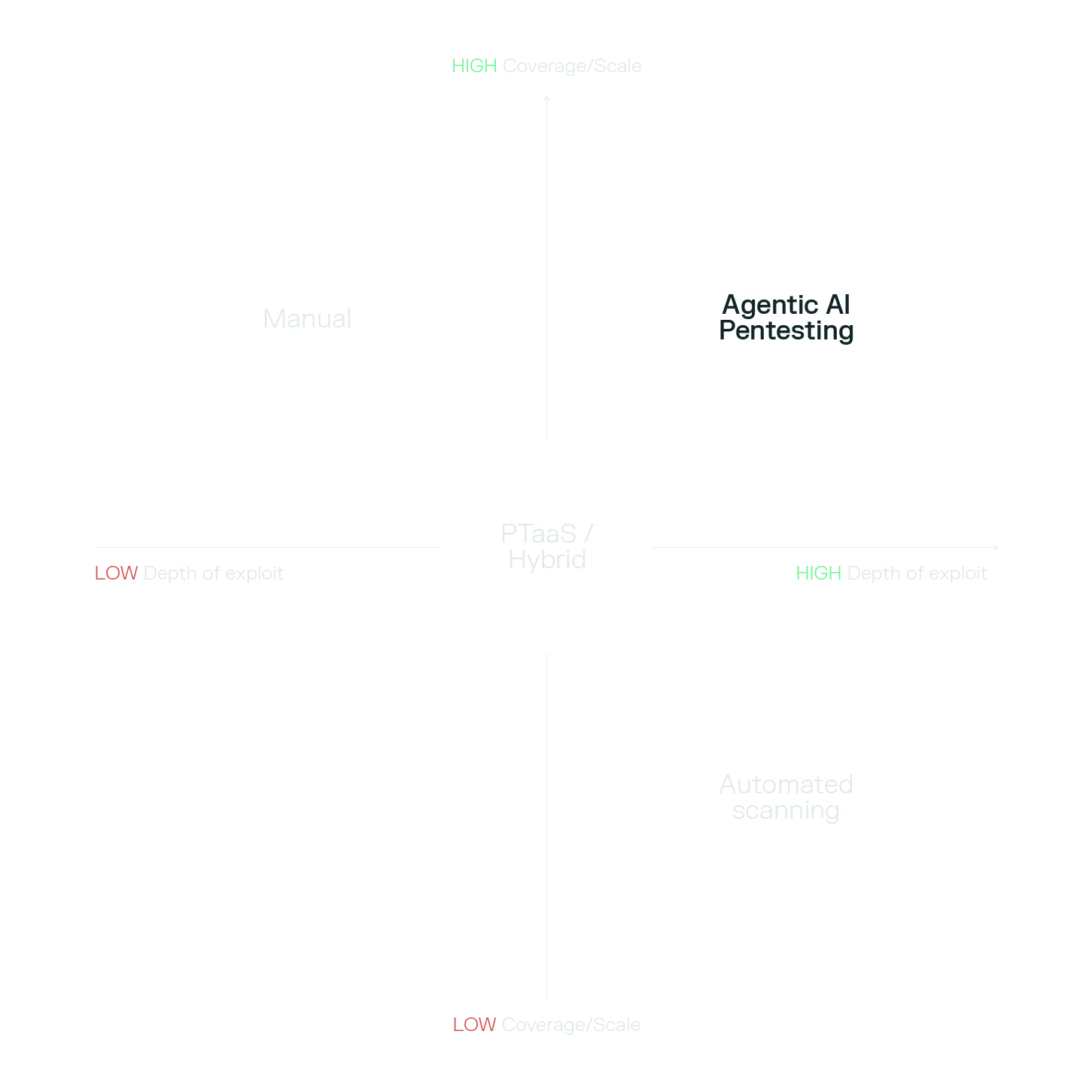
The coverage-vs-depth quadrant
The tradeoff at the centre of the whole debate is coverage versus depth. Two axes, four quadrants.
Manual pentesting sits top-left: high depth of exploit (creativity, novel paths, business logic), low coverage (scoped narrow, annual cadence). It is deep on a small target.
Automated scanning sits bottom-right: low depth of exploit (signature-based, no chaining, no proof), high coverage (broad and continuous). It is wide and shallow.
PTaaS and manual hybrid delivery sits centre: mid-depth (crowdsourced human effort at platform scale), mid-coverage (better than manual alone, still scoped). It splits the difference.
Agentic AI pentesting sits top-right: high depth of exploit (chains vulnerabilities, generates payloads dynamically) at high coverage (full surface, continuous). This is where the tradeoff collapses. For most enterprise programmes, the goal is to reach the top-right quadrant while retaining the top-left for depth-critical engagements. Legacy scanning remains a useful hygiene layer at the bottom-right.
When to use each (and when to use them together)
The practical question is not "which one wins" but "when to run which". Modern programmes run all three layers with clear division of labour.
When to run manual pentesting
Annual PCI DSS engagement. Board-narrative reports where a human explanation matters more than machine-speed volume. TIBER-EU engagements and other threat-led red team exercises. Complex M&A due diligence. Bespoke assessments against custom targets where creativity and domain expertise outperform automation. This is where manual retains its unique value.
When to run agentic AI pentesting
Continuous validation against production surface. CI/CD-integrated testing (triggered by every deploy, every configuration change). External, internal, cloud, and third-party surface coverage. Regulatory environments needing continuous testing evidence (NIS2 Article 21, DORA Article 25). Programmes where remediation velocity is the constraint. Any team where the security surface changes faster than the manual pentest cadence, which now describes almost every enterprise shipping software regularly.
When to run automated scanning
Baseline hygiene: developer-owned scans in CI, dependency and IaC checks, container image scanning, secrets detection. Scanning does the CVE-catalogue work: broad, cheap, and useful as a hygiene layer. It is not a substitute for a pentest, and treating a scanner report as a pentest report is the mismatch this piece exists to correct.
The hybrid programme most enterprises actually need
All three, with clear roles: scanning for CVE hygiene in CI, agentic AI for continuous validation and proof of exploit across the live surface, manual for annual PCI DSS and depth-critical engagements. See the companion CTEM vs BAS for how these layers fit inside the broader continuous exposure management workflow.
Compliance considerations (PCI DSS, NIS2, DORA, TIBER-EU, ISO 27001)
Frameworks disagree on what "penetration testing" requires. PCI DSS v4.0 mandates annual manual pentesting; NIS2 emphasises continuous testing evidence; DORA requires ICT testing including advanced threat-led penetration testing under Article 26 (TIBER-EU-aligned).
PCI DSS v4.0
Annual penetration testing by qualified tester
Yes (annual, satisfied by scoped human engagement)
No (scanning is a separate requirement, not a substitute)
Complementary between annual engagements
NIS2
Article 21 (cybersecurity risk-management measures)
Not explicit
Insufficient alone
Produces continuous testing evidence auditors now require
DORA
Article 25 (ICT security testing)
Not explicit
Insufficient alone
Continuous adversarial validation with proof of exploit
DORA
Article 26 (advanced threat-led testing)
Yes for TLPT cycles
No
Continuous validation aligned with TIBER-EU cycles
ISO 27001
A.12 Operations Security
Not explicit
Vulnerability management input
Reproducible evidence of remediation effectiveness
PCI DSS annual manual pentesting is not replaced by continuous validation; it is complemented by it. Auditors on NIS2 and DORA engagements increasingly recognise continuous testing evidence as a mature-programme signal above and beyond the annual snapshot. Continuous NIS2 and DORA compliance reporting outputs cover both the annual-manual and continuous-validation obligations. For DORA-scoped buyers, see continuous testing and DORA for the deeper framing on Article 25 and Article 26 obligations.
How much does each cost?
Pricing depends less on category than on delivery model. Three commercial models dominate, each mapping to a different category of penetration testing.
Per-engagement (manual pentesting)
High unit cost, low frequency. A scoped manual engagement is priced on scope depth, tester days, and report deliverable. Annual and per-release. This is what a mature enterprise budgets for PCI DSS and board-narrative reports. Cost-per-finding is high; cost-per-artefact is worth it for depth cases.
Per-scan or per-user (automated scanning)
Lower unit cost, high frequency. Scanning platforms are typically priced per scanned asset, per user, or as a flat licence. Cheap per scan. High operational cost in triage, since output is a queue of potential findings that still requires human triage to distinguish real risk from noise.
Per-asset subscription (agentic AI pentesting)
Predictable, continuous. Priced on assets under continuous validation, not on engagement time. Total cost of ownership is often lower than manual + scanning combined, because a continuous platform consolidates several point-solution budgets (scanning, ASM, PTaaS). Ethiack has reported >200% ROI on an ALE basis and 50%+ tool-consolidation savings (Ethiack-reported).
Who should focus on which (persona map)
Five personas own five different conversations on this topic. Here is what each should focus on.
For CISOs
All three feed the board story. Manual delivers the depth narrative for the annual board presentation. Agentic AI delivers the ROI narrative continuously: exposure reduction, ALE-based risk quantification, and evidence of a shrinking exposure window. Legacy scanning does the hygiene work. This is the difference between a compliance-tint programme and a defensible offensive-security posture.
For SecOps and AppSec
Agentic AI is where your day lives: validated exposures with reproducible proof, prioritised by real exploitability rather than CVSS proxy. Scanning does the CVE-catalogue work. Manual covers depth cases (business logic, novel paths). Between them, you should never receive a report that starts with "we found 12,000 potential vulnerabilities".
For VP Engineering and DevSecOps
Agentic AI plugs into CI/CD: triggered on every deploy, every configuration change. Manual is annual. Scanning runs in the pipeline for dependency and IaC checks. Your day-to-day loop is agentic AI: it validates every change the moment it ships, so the feedback lands with the engineer who made it.
For Compliance Officers
Manual satisfies PCI DSS annual. Agentic AI produces the NIS2 Article 21 and DORA Article 25 continuous testing evidence auditors now require. Scanning is treated as a separate hygiene requirement, not a pentest. Both categories feed the evidence trail; running only one of the three creates an audit gap somewhere.
For Heads of Risk
Agentic AI maps to real-world exposure quantification for ALE-based ROI. Proven exploitability plus the assets that carried the exposure equals a defensible number for board risk reporting. Manual output is harder to translate into monetary risk. Scanning output usually cannot be translated at all.
See what an attacker can exploit across your surface. Run a free external test, no installation required, results in 24 hours. Reproducible proof of exploit for every validated exposure.
Trusted by CEGID (€12M+ risk prevented across 2,000+ assets), Lusitânia (10x ROI, 80% MTTR reduction), and ANA Aeroportos (650% ROI). All Ethiack-reported.
Frequently asked questions about manual and automated penetration testing
What is the difference between manual and automated penetration testing?
Manual penetration testing is human-led: skilled ethical hackers chain vulnerabilities, exploit business logic, and produce contextual reports. Automated penetration testing has bifurcated: legacy scanning flags potential issues from signatures, while agentic AI pentesting chains real exploits and produces reproducible proof, like a human pentester at machine speed.
Which is better, manual or automated penetration testing?
Neither replaces the other. Manual delivers depth on complex or bespoke targets (business logic, red team, TIBER-EU). Agentic AI delivers depth continuously across the full surface. Legacy automated scanning is a hygiene layer, not a pentest. Modern security programmes run all three with clear division of labour.
Can automated pentesting replace manual pentesting?
Agentic AI pentesting closes most of the gap manual pentesting once uniquely covered: exploit chaining, business logic, novel attack paths, at machine speed with reproducible proof. Manual still leads on bespoke red teaming, TIBER-EU engagements, and board-narrative reports. Most enterprises need both, not one instead of the other.
What is agentic AI penetration testing?
Agentic AI pentesting uses purpose-built AI agents (not LLM wrappers) that reason, plan, and execute multi-step attacks. Agents chain vulnerabilities, generate payloads dynamically, adapt to context, and produce reproducible proof of exploit. It is a distinct category from legacy automated scanning, positioned under adversarial exposure validation. Ethiack's Hackian is one reference implementation.
Is automated pentesting the same as vulnerability scanning?
No. Vulnerability scanning is signature-based and produces a list of potential issues. Automated pentesting in the modern agentic sense chains real exploits and proves what is exploitable. The confusion comes from vendors historically labelling scanners as "automated pentesting". A scanner flags; a pentest exploits. Ethiack proves.
Can AI actually run a penetration test?
Yes, when the agent is purpose-built (not a foundation-model wrapper) and produces reproducible proof of exploit. Agentic pentesters chain vulnerabilities, generate payloads dynamically, adapt to context, and verify remediation. Public evidence includes Ethiack research on business-logic exploitation, real-world CVE deep-dives, and reproducible exploit chains against production targets.
What is the best automated penetration testing tool?
For legacy automated scanning: Nessus (Tenable), Qualys, Burp Suite Pro, OWASP ZAP, and Nuclei. For agentic AI pentesting: Ethiack, Pentera, Horizon3.ai (NodeZero), and XBOW. Choose based on whether you need signature-based coverage (scanning) or reproducible proof of exploit with continuous validation (agentic AI). They are different categories, not competing options.
How often should you run penetration testing?
Manual pentesting is typically annual or per major release, matching regulatory cadence (PCI DSS annual). Agentic AI pentesting runs continuously, triggered by change (new asset, new CVE, configuration change, deploy). The right cadence matches your surface: change-driven for cloud-native and SaaS; annual-plus-continuous for regulated enterprises.
Does PCI DSS require manual penetration testing?
PCI DSS v4.0 requires annual penetration testing performed by a qualified tester, satisfied by a scoped human engagement. Agentic AI pentesting does not replace the annual manual requirement but complements it with continuous exposure validation between engagements, which auditors increasingly recognise as evidence of a mature testing programme.
What does a penetration test cost?
Three commercial models dominate: per-engagement consultancy (manual, high unit cost, annual), per-scan or per-user (automated scanning, lower unit cost, hygiene), per-asset subscription (agentic AI, predictable, continuous). Total cost of ownership matters more than sticker price. Continuous models often consolidate multiple point solutions, delivering better economics at enterprise scale.