A CVE (Common Vulnerabilities and Exposures) is the unique public identifier assigned to a specific, disclosed cybersecurity vulnerability, formatted as CVE-YYYY-NNNNN. The CVE Program and its public database at cve.org give every disclosed vulnerability a single identifier the whole industry can reference, so defenders, vendors, and researchers all speak about the same bug in the same language.
That is the textbook answer. The operational reality is sharper: the CVE is a backward-looking anchor in a race attackers have already started. Exploitation now happens in hours, not months, and roughly 67% of exploited vulnerabilities today are zero-days.
This guide covers what a technical, security, or compliance reader needs to know about CVE: what the acronym stands for, how the list is maintained, how CVSS, EPSS, and KEV sit alongside it, and why a CVE identifier, on its own, is no longer sufficient evidence of what an attacker can exploit on your surface right now.
That final gap is where adversarial exposure validation (AEV) sits, and it is the reason NIS2 and DORA auditors now ask for continuous testing evidence rather than CVE snapshots.
Key takeaways
- What is a CVE: a CVE is a public identifier (CVE-YYYY-NNNNN) that uniquely names one disclosed vulnerability so every stakeholder in the ecosystem can reference the same bug.
- The CVE Program is operated by MITRE Corporation as Secretariat, sponsored by CISA, and run through more than 400 CVE Numbering Authorities (CNAs) worldwide, including major vendors, coordination centres, and bug bounty platforms.
- The CVE List is the public database at cve.org; 72,812 CVEs were published in the first nine months of 2026 alone, averaging over 270 new entries every day.
- CVE is an identifier, not a severity score. CVSS, EPSS, and CISA KEV sit alongside it to describe theoretical severity, exploit probability, and confirmed in-the-wild exploitation respectively.
- Exploitation often begins before a CVE is assigned; Ethiack Zero has validated 9% of tracked vulnerabilities as exploitable before cve.org publication (Ethiack-reported).
- Adversarial exposure validation (AEV) is the layer that proves which CVEs are actually exploitable on a specific attack surface right now. Ethiack delivers AEV through Hackian, its agentic AI pentester, with a false-positive rate below 0.5% and at 30x the speed of manual pentesting (Ethiack-reported).
What does CVE stand for?
CVE stands for Common Vulnerabilities and Exposures. It is also the full form referenced in cyber security documentation, vendor bulletins, and compliance guidance. The acronym describes both the identifier itself (a single CVE ID, such as CVE-2026-111497) and the public programme that assigns and maintains those identifiers.
Three terms get used interchangeably but describe different things. A CVE is the identifier assigned to one vulnerability. The CVE List is the public record of all CVEs, hosted at cve.org. The CVE Program is the global organisation that governs how identifiers are assigned, by whom, and against what standards. Treating the three as one blurs where authority sits in the ecosystem and who to engage when reporting a new vulnerability.
What is a CVE?
A CVE (Common Vulnerabilities and Exposures) is a public identifier for a specific, disclosed cybersecurity vulnerability or exposure in a software product, firmware, hardware device, or protocol. Each CVE references one vulnerability, and the identifier itself is a stable string every stakeholder uses to talk about it, regardless of vendor nomenclature.
The function of a CVE is coordination, not scoring. Before the CVE Program existed, every vendor and every vulnerability database used its own naming. The same issue could appear under three different labels across four different security advisories. CVE identifiers solved that problem by giving every public vulnerability one canonical handle.
What a CVE does not do is prove exploitability in your environment. A CVE record documents the existence of a vulnerability and its basic properties. It does not confirm whether the vulnerable code path is reachable on your systems, whether compensating controls block the exploit chain, or whether an attacker can combine that CVE with others to reach a real objective. That gap is where adversarial exposure validation sits, and this guide returns to it later.
How a CVE ID is structured
Every CVE identifier follows the format CVE-YYYY-NNNNN:
- CVE is the prefix, always uppercase
- YYYY is the four-digit year the CVE ID was reserved, not necessarily the year the vulnerability was discovered or disclosed
- NNNNN is the sequence number, four or more digits, assigned by a CVE Numbering Authority
Real example: CVE-2026-111497 was assigned in 2026 and refers to the Brotli decoder out-of-bounds write that affects Node.js runtimes, popularly nicknamed Node2Shell. The sequence number (111497) distinguishes it from every other CVE issued in 2026.
A common misconception: the year in the ID is the year the identifier was assigned, not the year the bug was disclosed to the public. A vulnerability discovered in 2026 and reserved as CVE-2026-xxxxx might not be published on cve.org until months later, after coordinated disclosure with the vendor is completed.
Who runs the CVE Program?
The CVE Program is operated by MITRE Corporation as the primary CNA and Secretariat, under sponsorship from the US Cybersecurity and Infrastructure Security Agency (CISA), part of the Department of Homeland Security. MITRE maintains the authoritative CVE List and the cve.org website.
Day-to-day, identifiers are assigned by CVE Numbering Authorities (CNAs): organisations authorised to allocate CVE IDs for vulnerabilities in their own products or a defined scope. There are more than 400 CNAs globally, including major vendors (Microsoft, Google, Apple, Oracle, Red Hat, Cisco, Adobe), coordination centres (CERT/CC), bug bounty platforms (HackerOne, Bugcrowd), and research organisations. CNAs operate under rules set by the CVE Board, a group of representatives from government, industry, and research communities that governs the programme.
For technical and compliance readers: when a vulnerability is reported in a vendor's product, that vendor's CNA usually assigns the CVE ID, not MITRE directly. MITRE assigns identifiers only when a vendor is not a CNA, or when the vulnerability falls outside any CNA's scope.
How a CVE gets published: the lifecycle
A CVE record moves through a lifecycle that is longer and messier than most people assume:
1. Discovery: a researcher, vendor, or automated system identifies a vulnerability.
2. Reporting: the finding is submitted to the appropriate CNA, usually the vendor.
3. Reservation: the CNA reserves a CVE ID, which becomes a placeholder while details are kept private.
4. Coordinated disclosure: the vendor develops and tests a patch, communicates with the researcher, and prepares an advisory.
5. Publication: the CVE record is published on cve.org with full details.
6. Enrichment: CVSS scores, CWE classifications, references, and external advisories accumulate over time.
The gap between step 3 (reservation) and step 5 (publication) is the critical window. During that window, the vulnerability is known to the vendor, the researcher, and whoever else the vendor coordinates with, such as KEV listing bodies, a security consortium, or a coordinated set of large customers. It is not yet publicly documented. If the patch ships before the CVE is published, reverse-engineering the patch gives attackers a working exploit well before most defenders know a vulnerability exists.
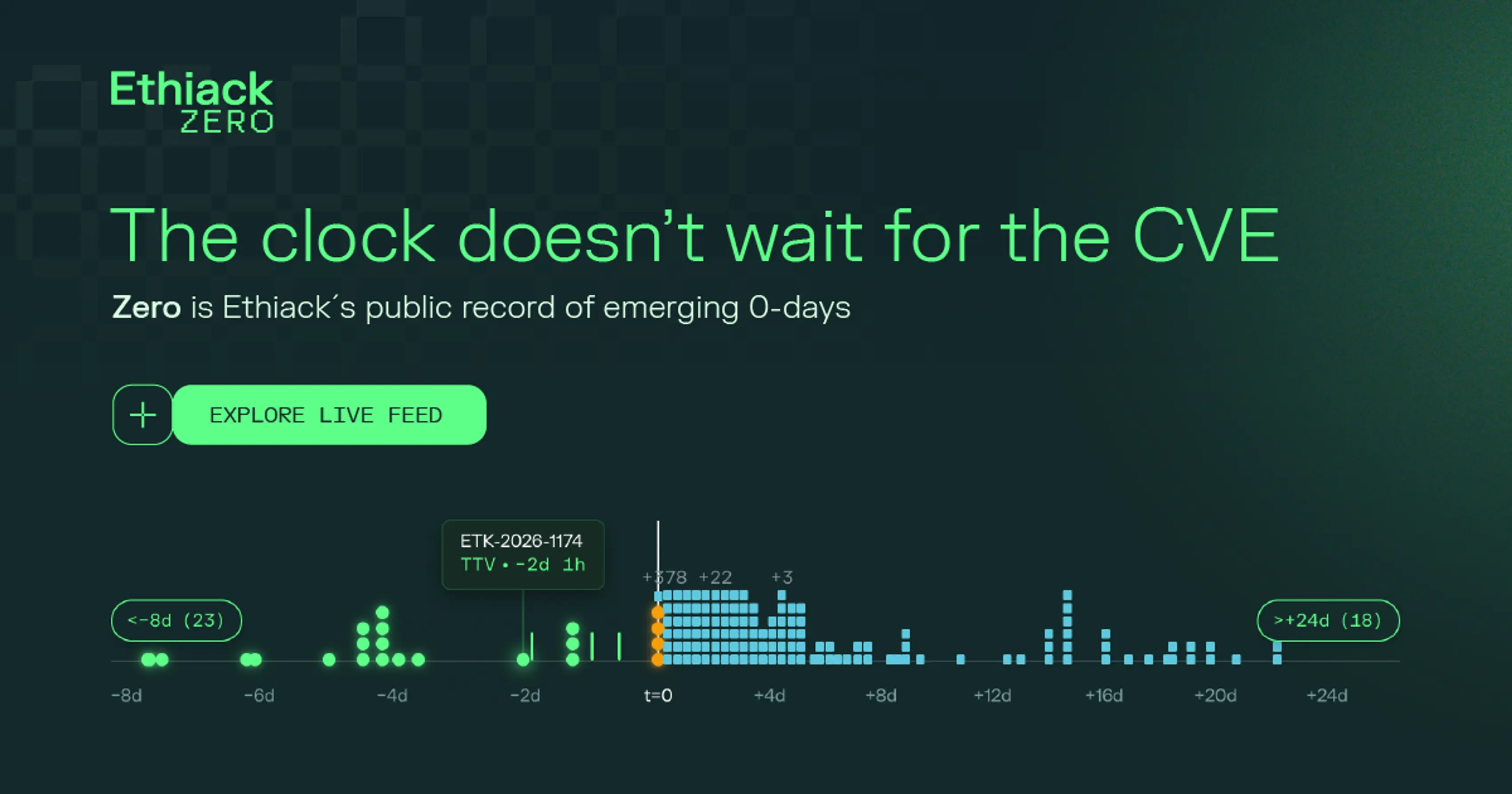
Ethiack Zero is Ethiack's public record of that lag. It tracks the earliest signals (patches, advisories, bug reports, GHSA entries) and validates whether they are exploitable, publishing a Time-to-Validate (TTV) measurement for each one, anchored to the moment cve.org publishes the full record. 9% of entries Ethiack Zero has validated were confirmed exploitable before the CVE went public (Ethiack-reported).
CVSS, EPSS, KEV: the signals around a CVE
A CVE is an identifier, not a verdict. Three complementary scoring and cataloguing systems sit alongside it, and most real-world vulnerability management programmes combine them.
CVSS (Common Vulnerability Scoring System) is a severity score, 0.0 to 10.0, maintained by FIRST.org. It evaluates a vulnerability on dimensions like attack vector, attack complexity, privileges required, and impact to confidentiality, integrity, and availability. CVSS is static: it describes the theoretical severity of a bug, not whether it is being exploited in the wild.
EPSS (Exploit Prediction Scoring System) is a probability score, 0.0 to 1.0, that estimates the likelihood a CVE will be exploited in the wild within 30 days. EPSS is updated daily and draws on real-world exploitation data, PoC availability, and reference signals. EPSS tells you probability; it does not confirm current exploitation.
KEV (CISA Known Exploited Vulnerabilities catalogue) is a public list maintained by CISA of CVEs with confirmed real-world exploitation. If a CVE appears in KEV, exploitation is observed, not predicted. Federal civilian agencies have binding remediation deadlines for KEV entries, and the catalogue has become a de facto priority queue for enterprise security teams globally.
The pattern most mature RBVM programmes use: CVE identifies the vulnerability, CVSS and EPSS prioritise the queue, KEV flags confirm real-world exploitation. Three signals, all backward-looking, none of which proves exploitability in your specific environment. See risk-based vulnerability management for how Ethiack layers proof of exploit on top of these signals.
What is the CVE list?
The CVE List is the public database of every published CVE, maintained by MITRE at cve.org. It is free, API-accessible, and the authoritative source for CVE records. Downstream databases enrich the base data: the National Vulnerability Database (NVD) adds CVSS scores and CWE classifications; EPSS, VulnDB, and vendor-specific advisories add exploitation probability and remediation guidance.
The volume is significant and growing. In the first nine months of 2026 alone, 72,812 CVEs were published on the list, a pace that outstrips every previous year on record (data tracked by Ethiack Zero). The CVE list grew by roughly 270 entries every day across that period. Any team trying to monitor the list manually is doing something else by lunchtime.
For a live view of emerging vulnerabilities and how fast they are being validated as exploitable, Ethiack Zero publishes the record openly at zero.ethiack.com, with a public REST API and MCP endpoint for direct integration into security workflows and AI agents.
Why a CVE on its own is no longer enough (Zero Day Clock)
The CVE Program was designed in an era when disclosure cycles ran in weeks or months. Exploitation now runs in hours.
A few numbers describe the collapsed window:
- Roughly 67% of exploited vulnerabilities today are zero-days (per Zero Day Clock).
- 72,812 CVEs were published in the first nine months of 2026, with 845 confirmed exploited in the wild during the same period.
- Ethiack documented a 21-minute path to an AI-led bank security compromise, from initial surface map to full exploitation (Ethiack-reported).
- Ethiack Zero has validated 9% of tracked vulnerabilities as exploitable before the CVE was published on cve.org (Ethiack-reported).
The implication for anyone relying on CVE-based workflows: by the time a CVE lands on the list, the exposure window may have been open for days. Reviewing the list weekly, or waiting for CVSS enrichment before triaging, means operating permanently behind the attacker. Attackers do not wait for the CVE, and neither does validation.
The honest framing is not "monitor the CVE list better". It is "add a layer that proves which of the CVEs on your surface are actually exploitable right now, so prioritisation reflects attacker reality, not catalogue order". See the attack surface management vs vulnerability management piece for the full category mapping.
From CVE knowledge to validated exposure (where AEV fits)
Adversarial exposure validation (AEV) is the layer that turns CVE knowledge into actionable priorities.
- A CVE list tells you what vulnerabilities exist in the broader ecosystem.
- A scanner-based vulnerability programme tells you which of those vulnerabilities appear in software you operate.
- AEV goes one step further: it validates which of those vulnerabilities an attacker can actually exploit in your environment, chained with others, against a real objective.
Ethiack delivers AEV through Hackian, an agentic AI pentester that runs continuously against the discovered attack surface. Hackian chains vulnerabilities dynamically, pivots when initial approaches fail, and constructs payloads on the fly. Every validated finding ships with reproducible proof of exploit: the payload, the evidence, and mitigation guidance a developer can act on and re-test. The result is a short, actionable, exploit-ranked findings list rather than a 10,000-row CVE triage queue.
Two proof anchors. Hackian runs at 30x the speed of manual pentesting with a false-positive rate below 0.5% (Ethiack-reported). CEGID prevented €12M+ in risk across 2,000+ assets by moving from checklist pentesting to continuous validation (Ethiack-reported).
How Ethiack participates in the CVE ecosystem (and Ethiack Zero)
 Ethiack Zero - Public record of emerging CVEs
Ethiack participates in the CVE ecosystem as both a researcher and an operator.
As a researcher, Ethiack's offensive security team discovers novel vulnerabilities in third-party software and coordinates with vendors through the standard disclosure process. New vulnerabilities get an internal ETK ID (for example, ETK-2026-1337) when analysis begins, which can be before a CVE identifier is even reserved. When a CVE is later assigned, the entry adopts it; the ETK ID persists so the vulnerability can be cited consistently from the moment it opens, through assignment, publication, and enrichment. Ethiack is not a CNA and assigns no CVE identifiers of its own.
As an operator, Ethiack Zero watches for the earliest public signals (vendor advisories, GHSA entries, KEV listings, patches with no CVE yet) and runs them through an AI-driven analysis pipeline that attempts to produce a check or a working proof of exploit. Every entry on Zero publishes:
- The vulnerability ID (CVE and/or ETK)
- Time-to-Validate (TTV), measured against the moment cve.org published the CVE (t=0)
- Time-to-Exploit (TTE), measured against t=0, drawn from CISA KEV, EUVD KEV, and VulnCheck KEV catalogues
- The source signals, timestamps, and public PoC references
- A mitigation written from the collected information
Ethiack Zero does not publish working exploit code. Holding it back gives defenders time to patch before it circulates further. The Zero methodology page documents how entries open, what the figures mean, and the limits of what the feed can claim. The feed is available via a public REST API and an MCP server for direct integration into AI agents and security workflows, no authentication required.
What CVE knowledge means for compliance (NIS2, DORA, ISO 27001)
Three frameworks matter for European organisations, and each one has moved past "do you track CVEs" as a compliance question.
NIS2 Article 21 requires essential and important entities to implement appropriate and proportionate technical, operational, and organisational measures to manage cybersecurity risks, including continuous testing and vulnerability handling. CVE awareness is a floor, not a ceiling. Auditors are asking for continuous testing evidence (dated, reproducible, mapped to controls), not quarterly CVE reviews. See everything financial institutions need to know about the NIS2 directive for the sector-specific detail.
DORA Article 25 mandates ICT-related security testing for financial entities, including threat-led penetration testing (TLPT) for larger entities and regular vulnerability assessment for all. The compliance obligation is explicit: continuous adversarial validation aligned with TIBER-EU cycles, not periodic pentest reports. See navigating DORA for the full breakdown.
ISO 27001 (Annex A) controls A.8 (Asset Management) and A.12 (Operations Security) require a current, documented vulnerability catalogue mapped to assets, with evidence that identified vulnerabilities are remediated. CVE awareness is an input to this process. Documented evidence of remediation effectiveness, including re-testing after patching, is the audit output.
Across all three frameworks, the common thread is the same. Snapshots are not sufficient as audit evidence anymore. Continuous compliance reporting is now the operational baseline, not the exceptional case.
Quick reference: what each term in the CVE ecosystem covers
CVE
A single public identifier (CVE-YYYY-NNNNN) assigned to one specific disclosed vulnerability.
CVE List
The public database of all published CVEs, hosted at cve.org and maintained by MITRE.
CVE Program
The global governance body that assigns identifiers, sets rules, and operates the CVE List through MITRE and 400+ CNAs.
CNA
CVE Numbering Authority: an organisation authorised to assign CVE IDs within its defined scope.
CVSS
Severity score (0.0-10.0) assigned to a CVE. Describes theoretical impact, not current exploitation.
EPSS
Exploit Prediction Scoring System: 0.0-1.0 probability of a CVE being exploited in the wild within 30 days.
KEV
CISA Known Exploited Vulnerabilities catalogue: CVEs with confirmed real-world exploitation.
ETK ID
Ethiack's internal permanent identifier for a tracked vulnerability, often assigned before a CVE exists.
AEV
Adversarial Exposure Validation: the layer that proves which CVEs are actually exploitable in a given environment.
Who should care about CVE (persona map)
Four groups own four different conversations around CVE.
For SecOps and AppSec practitioners
SecOps and AppSec practitioners live in the CVE queue. The daily reality is a vulnerability list far larger than the team can act on. CVE identifiers are the input; prioritisation signals (CVSS, EPSS, KEV) sharpen the queue partially; AEV collapses it by proving which entries are exploitable in the current environment. Ethiack reports 90% noise elimination and 80% faster remediation after introducing adversarial validation (Ethiack-reported).
For VP Engineering and DevSecOps
VP Engineering and DevSecOps leaders think about CVE in the context of shipping velocity. New CVEs land in dependencies continuously. The question is not "which CVEs matter" in the abstract, but "which CVEs matter for the code we deploy, and which are introduced by the changes we ship this sprint". Trigger-based validation closes the gap between code merge and exploit confirmation at machine speed, through continuous agentic pentesting.
For CISOs
CISOs need CVE context for board conversations, insurance renewals, and regulatory filings. The question auditors and insurers now ask is no longer "how many CVEs do you track?" but "what proportion of exploitable exposure on your surface is actually mitigated, and what is your window?" AEV makes that question answerable with evidence. The outputs are ALE-based risk quantification and a defensible, dated record of validated remediation.
For Compliance Officers and Heads of Risk
Compliance Officers and Heads of Risk carry the regulatory consequence. NIS2 (Article 21), DORA (Article 25), and ISO 27001 all now require continuous testing evidence, not snapshot reports. Dated, reproducible, mapped to specific controls. CVE awareness is required; evidence of validated exploitability with controlled re-testing is what satisfies modern audit requirements. See ASM and VM for financial services (DORA) for the sector-specific framing.
See which CVEs on your surface are actually exploitable
A CVE list is a long catalogue of what could be wrong somewhere. A validated exposure report is a short list of what an attacker can exploit on you right now. Run a free external test, no installation required, results in 24 hours. Reproducible proof of exploit for every validated finding, not a longer CVE queue.
Trusted by CEGID (€12M+ risk prevented across 2,000+ assets), Lusitânia (10x ROI, 80% MTTR reduction), and ANA Aeroportos (650% ROI). All Ethiack-reported.
Frequently asked questions about CVE
What does CVE stand for?
CVE stands for Common Vulnerabilities and Exposures. The acronym refers to a public identifier assigned to a specific, disclosed cybersecurity vulnerability, formatted as CVE-YYYY-NNNNN. The same abbreviation describes the global programme that assigns identifiers and the public list at cve.org where every CVE record is published. Vendors, researchers, and security platforms all reference CVE IDs as the canonical handle for a given vulnerability.
What is CVE in cyber security?
In cyber security, a CVE is the shared public reference used to identify one specific vulnerability so vendors, researchers, auditors, and security platforms can all talk about the same bug. The CVE identifier is not a severity score, a patch, or proof of exploitation; it is a stable name. Severity scoring (CVSS), exploit probability (EPSS), and real-world exploitation data (CISA KEV) are layered on top of the CVE ID by the ecosystem around the CVE Program. Modern programmes add adversarial exposure validation on top to confirm which CVEs are actually exploitable on a specific attack surface.
What is the CVE list?
The CVE list is the public database of all published CVE records, maintained by MITRE at cve.org. In the first nine months of 2026 alone, 72,812 CVEs were published on the list, a pace that averages over 270 new entries per day. The list is free, API-accessible, and downstream enriched by databases like the National Vulnerability Database (NVD) with CVSS scoring and CWE classifications. Ethiack Zero publishes a live validation record on top of the CVE list at zero.ethiack.com.
Who maintains the CVE list?
The CVE Program is operated by MITRE Corporation as the primary CNA and Secretariat, under sponsorship from the US Cybersecurity and Infrastructure Security Agency (CISA). Day-to-day CVE assignments come from more than 400 CVE Numbering Authorities (CNAs) worldwide, including major vendors (Microsoft, Google, Apple, Oracle, Red Hat), coordination centres (CERT/CC), bug bounty platforms (HackerOne, Bugcrowd), and research organisations. The CVE Board governs the programme rules and admits new CNAs.
How is a CVE ID assigned?
A CVE ID is assigned by a CVE Numbering Authority (CNA) when a vulnerability is reported in software or hardware within that CNA's scope. The CNA reserves a CVE identifier early in the disclosure process, usually before public disclosure, so the identifier can be referenced consistently across advisories. The CVE record is then published on cve.org once the coordinated disclosure completes. Researchers who report vulnerabilities to vendors typically receive a CVE ID from that vendor's CNA.
What is the difference between CVE and CVSS?
CVE is the identifier; CVSS is the severity score. A CVE is a stable public name (such as CVE-2026-111497) for a specific vulnerability. CVSS (Common Vulnerability Scoring System) is a 0.0 to 10.0 score that evaluates the theoretical severity of that vulnerability based on factors like attack vector, attack complexity, privileges required, and impact. One vulnerability has one CVE ID and (usually) one CVSS score. CVE answers "which vulnerability", CVSS answers "how severe in theory".
What is the difference between a CVE and a vulnerability?
A vulnerability is a weakness in code, configuration, or design that can be exploited by an attacker. A CVE is a public identifier assigned to a specific disclosed vulnerability. Not every vulnerability has a CVE: many are internal, undisclosed, or outside the scope of any CVE Numbering Authority. A CVE represents the subset of vulnerabilities that have been formally documented in the public CVE List and given a canonical identifier the ecosystem can reference.
What is a zero-day vs a CVE?
A zero-day is a vulnerability that has been discovered and (usually) exploited before the vendor has issued a patch, so defenders have had "zero days" to prepare. A CVE is the public identifier any vulnerability can receive, zero-day or otherwise. A zero-day typically receives a CVE once it enters the public coordinated disclosure process, often after initial exploitation has already occurred. Roughly 67% of exploited vulnerabilities today are zero-days, per the Zero Day Clock, which is why CVE assignment often lags attacker activity.
How do I check if a CVE affects my systems?
Three steps, in order. First, inventory your software (through SBOM, CMDB, or asset discovery). Second, match each component and version against the published CVE list and vendor advisories. Third, validate whether the vulnerable code path is actually reachable and exploitable in your environment. Vulnerability scanners automate the first two steps and flag matches; adversarial exposure validation handles the third by running real exploit attempts against the discovered surface and confirming which CVEs are genuinely exploitable, not just present. The last step is what distinguishes a long triage queue from a short action list.