"CTEM vs BAS" is the wrong question. CTEM is a workflow. BAS is a product category that fits inside one stage of that workflow. The comparison people actually need is BAS vs adversarial exposure validation (AEV), both of which sit inside CTEM's Validation stage.
Exploitation now happens in hours, not months (Zero Day Clock, Ethiack-reported). That is why the Validation question matters. This piece walks through what CTEM is, what BAS is, and where AEV fits inside CTEM as the modern validation layer. It also explains when to run BAS, when to run AEV, and when to run both. The honest answer is that BAS is a mature category with genuine value for SOC-owning enterprises, and AEV is doing the work most buyers expect BAS to do. Both belong in a mature programme. Small and mid-market teams often get more from AEV alone.
Key takeaways
- Verdict: CTEM is a framework, BAS is a product category, and AEV is the modern validation layer inside CTEM
- CTEM (continuous threat exposure management) is Gartner's five-stage workflow: Scoping, Discovery, Prioritisation, Validation, Mobilisation
- BAS (breach and attack simulation) is a product category that simulates known attack techniques against your controls to test detection efficacy
- AEV (adversarial exposure validation) is a product category that executes real exploit chains against real assets, safely, and produces reproducible proof of exploit
- The useful comparison is BAS vs AEV inside CTEM's Validation stage, not CTEM vs BAS across categories
- Ethiack delivers the AEV layer through Hackian, its agentic AI pentester, at 30x manual-pentest speed with a false-positive rate below 0.5% (Ethiack-reported)
At-a-glance matrix
The table below compares CTEM (workflow), BAS (product category), and AEV (product category) across six dimensions. Reading the three columns like-for-like exposes what the surface-level "CTEM vs BAS" query obscures: a category mismatch between a process framework and a product type.
Nature
Process framework
Product category
Product category
Primary question
How do we run continuous exposure management?
Would our controls catch this attack technique?
What can an attacker exploit on our surface right now?
Target
The whole surface + workflow
Your controls and SOC stack
Your actual assets and vulnerabilities
Method
Five-stage workflow
Simulates known attack techniques (MITRE ATT&CK) against controls
Executes real exploit chains against real assets, safely
Output
A prioritised, mobilised remediation plan
Control-efficacy scores per technique
Reproducible proof of exploit for every finding
Ideal buyer
Any security programme
SOC-owning enterprises with mature detection and response
Any team with an external or mixed surface, especially regulated
What is CTEM (continuous threat exposure management)?
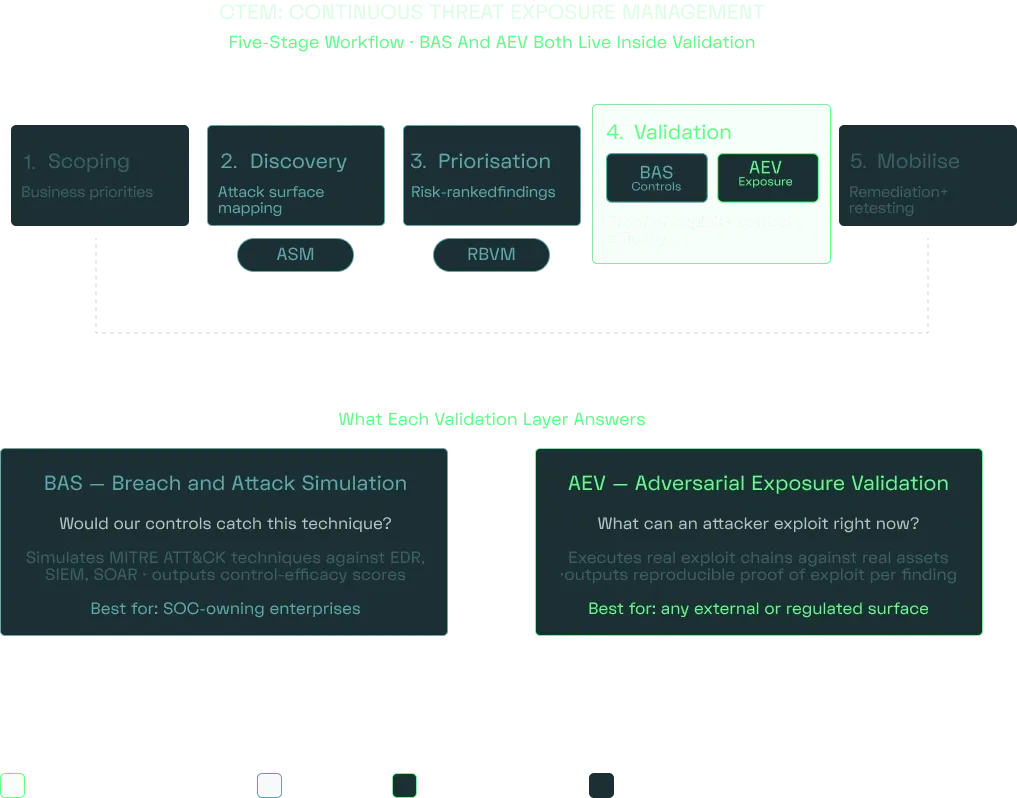 The five stages of CTEM, with BAS and AEV both sitting inside the Validation stage - the layer where exposure becomes evidence.
Continuous Threat Exposure Management (CTEM) is a Gartner-defined process framework for managing security exposures across a modern attack surface. It runs as a five-stage workflow: Scoping, Discovery, Prioritisation, Validation, Mobilisation. CTEM is not a product. Vendors ship products that populate one or more stages; no single product is CTEM.
CTEM formalises what mature security programmes have been building ad-hoc for years: a continuous loop from "what is exposed" through "what actually matters" to "what got fixed and how do we know". The five stages work as follows.
- Scoping. A programme decision. Which parts of the business surface fall in scope, and at what depth. Not a product category.
Discovery. Continuous asset inventory and exposure mapping across internet-facing, cloud, and third-party surface. This is where attack surface management (ASM) lives.
Prioritisation. Ranking findings by real risk. Risk-based vulnerability management (RBVM) sits here, enriched by EPSS, KEV, and business-context signals.
- Validation. Confirming what an attacker can actually do against the environment. Two product categories populate this stage: BAS (simulates known techniques against controls) and AEV (executes real exploit chains against real assets).
- Mobilisation. Where remediation happens: developer workflows, patch management, compensating controls, retesting.
The Validation stage is where the "CTEM vs BAS" confusion originates. Buyers ask "which product covers Validation?" and the honest answer is "it depends on what you need to validate". Detection efficacy against known techniques is one question; exposure to real exploit chains is another. Both are valid Validation questions. They just have different answers.
What is breach and attack simulation (BAS)?
Breach and Attack Simulation (BAS) is a product category that emulates known attack techniques (typically mapped to MITRE ATT&CK) against your existing controls to test whether detection and response actually work. BAS answers "would our EDR, SIEM, and SOAR stack catch this technique if it happened?" It sits inside CTEM's Validation stage.
BAS is a mature category. Leading BAS platforms include Picus Security, AttackIQ, SafeBreach, Cymulate, XM Cyber, and IBM Randori Attack. They ship libraries of attack techniques mapped to MITRE ATT&CK, run them against your control stack on a scheduled or on-demand basis, and score how well each control caught, blocked, or missed the technique. Output is a control-efficacy score per technique, per control, over time.
What BAS does well
Detection-efficacy testing, purple-teaming, SOC readiness measurement, and continuous validation of the EDR, SIEM, and SOAR stack. BAS is the natural companion for a mature security operations centre.
What BAS does not do
BAS does not execute real exploits against production assets. It does not discover unknown surface (external subdomains, shadow IT, forgotten cloud). It does not produce reproducible proof of exploit against your specific assets. And it does not answer the question a regulated buyer's auditor now asks: "can you show continuous evidence of exploitability testing against your actual environment?"
That gap is where AEV enters. Not to replace BAS, but to answer a different Validation question. Both categories sit in CTEM's Validation stage. Both belong in a mature programme. Which one comes first depends on where your programme is strongest today.
CTEM vs BAS: the honest comparison
The comparison the SERP asks for is a category mismatch: framework versus product. Here is the honest read across six dimensions, each answering a distinct question.
1. Nature (workflow vs product)
CTEM is Gartner's process framework. It defines how to run continuous exposure management as a five-stage loop. BAS is a product category. It is a type of product you buy, deploy, and run inside CTEM's Validation stage. Comparing them directly is like comparing DevOps to Terraform. Both are valid concepts; they exist at different levels of the stack.
2. Primary question (how to run vs would controls catch)
CTEM asks "how do we run continuous exposure management end to end?" BAS asks "would our controls catch this specific attack technique if it happened?" These are complementary questions, not competing ones. CTEM needs BAS output (or AEV output) to answer the Validation-stage question. BAS produces one type of Validation-stage evidence; AEV produces another.
3. Target (workflow vs controls)
CTEM targets the whole security programme: workflow, personnel, and process across the exposure lifecycle. BAS targets your controls and SOC stack: EDR, SIEM, SOAR, network detection, email security. It measures whether those controls perform against library attack techniques. AEV, for contrast, targets your actual assets and open findings.
4. Method (five stages vs technique simulation)
CTEM is a five-stage workflow: Scoping, Discovery, Prioritisation, Validation, Mobilisation. BAS is a simulation method: it replays MITRE ATT&CK techniques against your controls, on a schedule or on demand, and scores the response. AEV is an execution method: it runs real, adaptive exploit chains against production assets, safely, and captures the evidence.
5. Output (mobilisation vs efficacy score)
CTEM outputs a prioritised, mobilised remediation plan produced by the programme as a whole. BAS outputs control-efficacy scores per MITRE ATT&CK technique, per control. Useful for measuring SOC readiness and detection-tuning progress. AEV outputs reproducible proof of exploit for every validated finding: the payload, the evidence, and mitigation guidance a developer can act on and re-test.
6. Ideal buyer (any programme vs SOC-owning enterprise)
CTEM applies to any security programme, at any size. BAS pays back most when the SOC has mature detection and response infrastructure to route control-efficacy scores to. AEV pays back on any external or mixed surface, especially in regulated environments where continuous testing evidence is the compliance obligation.
Where adversarial exposure validation (AEV) fits inside CTEM
AEV is the product category that populates the Validation stage of CTEM with proven exploitability, not just simulated detection. Here is why it exists, what it replaces, and what it complements. When to use each in practice sits in the next section.
What AEV replaces
AEV replaces the periodic pentest as the primary source of exploitability evidence. A pentest is a snapshot valid the day it lands. Attack surfaces change with every deploy; an annual pentest report is stale before it is bound. AEV also replaces the CVSS-driven queue as the primary prioritisation signal. CVSS ranks severity in theory; AEV ranks findings by whether an adaptive attack chain reached the objective in your environment. Proven exploitability is a different signal from proxied severity, and it produces the shorter queue teams actually work.
What AEV complements
AEV complements attack surface management on the discovery side: ASM finds the assets, AEV validates which of those assets carry live exploitable risk. AEV complements risk-based vulnerability management on the prioritisation side: RBVM enriches CVE findings with EPSS and KEV signals, AEV overlays with proven exploitability so the queue reflects reality. AEV complements BAS on the controls-validation side: BAS validates detection efficacy, AEV validates exposure. Together they cover CTEM's Validation stage completely.
Why AEV is the modern Validation layer
AEV is continuous, trigger-based, and safe in production. It runs against real assets rather than instrumented environments. It produces reproducible proof of exploit for every finding, not just an efficacy score. It aligns with the Validation-stage intent Gartner defines: converting a picture of possible exposure into a picture of proven exposure. Ethiack delivers this through adversarial exposure validation, its agentic AI pentester approach, at 30x manual-pentest speed with a false-positive rate below 0.5% (Ethiack-reported), and €12M+ risk prevented at CEGID across 2,000+ assets validated (Ethiack-reported).
BAS vs AEV: when to use which
The practical question is not "which category is better" but "which does what, when, and when do we run both?" Here is the buyer-side view.
What each one produces
BAS produces control-efficacy scores per MITRE ATT&CK technique, per control, over time. The unit of value is detection tuning: did the EDR block, did the SIEM alert, did the SOAR route? AEV produces reproducible proof of exploit per finding, per validated asset, over time. The unit of value is remediation: what was exploitable, what payload confirmed it, and what fix removes the risk. Both are evidence artefacts. They evidence different questions.
When BAS is the right primary choice
Mature SOC. Deep EDR, SIEM, and SOAR stack. Internal-heavy surface where controls do most of the defensive work. Detection efficacy is a leadership KPI. Purple-teaming is a running discipline. In these environments BAS extends what the team already does well and lands its output on a queue the SOC can act on.
When AEV is the right primary choice
External-heavy or mixed surface where unknown assets are the risk. Small-to-mid security team without a mature SOC. Regulated environment where auditors ask for continuous testing evidence and exploitability validation, not detection scores. Programmes where remediation velocity is the constraint and a shorter, exploit-proven queue matters more than detection tuning.
When to run both
Mature CTEM programmes with a SOC and meaningful external surface run both. BAS validates detection; AEV validates exposure. Together they close CTEM's Validation stage completely: what an attacker can exploit + whether your controls would catch them if they did.
How to choose the right validation layer for your CTEM programme
Six factors decide the choice for most buyers. Factors 2 and 4 are usually where the decision actually lands.
1. Where you are strongest today
Start where the weakness is bigger. If your controls stack is your strength (mature EDR, SIEM, SOAR), BAS extends what you already do well. If your exposure discovery is thin (unknown subdomains, third-party surface, cloud sprawl), AEV closes the harder gap. Do not buy what duplicates your best capability.
2. SOC maturity
BAS payoff scales with SOC maturity, because its output (control-efficacy scores) is only useful if someone acts on it. Illustrative example: a bank with a 24/7 SOC, tuned EDR, and a mature purple-team programme gets high leverage from BAS. A mid-market SaaS with two security engineers and no SOC gets almost none, because there is no team to route the efficacy scores to. AEV lands harder in the second scenario: it produces remediation-ready findings the small team can action directly, without SOC orchestration in between.
3. External vs internal surface emphasis
AEV wins on external, mixed, and third-party surface because it discovers and validates unknown assets. BAS wins on internal control validation. Map your risk register: if the top exposures sit outside the firewall, AEV is the primary; if they sit inside a well-instrumented network, BAS is.
4. Regulatory posture
NIS2, DORA, and TIBER-EU auditors are asking for evidence of continuous testing and exploitability validation. AEV produces that evidence natively as an artefact. BAS produces control-effectiveness evidence, a different obligation. Illustrative example: a DORA-scoped financial entity needs continuous testing evidence with reproducible proof, mapped to specific controls. AEV output slots directly into an auditor's evidence pack. BAS output supports the control-testing obligation but does not answer the exploitability question the regulator now asks separately, which means auditors on DORA and TIBER-EU engagements typically need both.
5. Team size and orchestration
BAS needs SOC integration and campaign management to produce its full value; AEV runs continuously without that overhead. Small teams should weigh how much operating cost each platform adds beyond the licence. AEV-first programmes typically stand up in weeks; mature BAS programmes take longer to reach full leverage.
6. Data residency
Ethiack processes all data in the EU, on servers in Belgium. Most BAS vendors are US-hosted. For NIS2 and DORA-scoped buyers and any organisation constrained by GDPR data-transfer rules, EU-native processing is a structural, not contractual, advantage.
Who should focus on what (persona map)
Five personas own five different conversations on this topic. Here is what each should focus on.
For CISOs
Both categories feed the ROI story. AEV is faster to demonstrate exposure reduction because its output (proof of exploit + ALE-based risk quantification) speaks directly to board members who ask "what were we exposed to, and what did we fix?" BAS complements with detection-efficacy evidence when the SOC is mature.
For SecOps and SOC teams
BAS is your day: campaign management, detection tuning, purple-teaming, control validation across MITRE ATT&CK. AEV augments without replacing: it feeds you the short queue of validated exposures the SOC actually needs to defend against, so tuning priorities emerge from real risk rather than random alert volume.
For AppSec and product security
AEV is closer to your daily deploy loop. Every new subdomain, every API deployment, every configuration change is a trigger event that AEV validates against continuously. BAS lives in the SOC's world; AEV lives in yours. Proof-of-exploit output maps directly to the developer's remediation workflow.
For Compliance Officers
Both feed the evidence trail. AEV produces auditor-ready proof of exploit continuously, mapped to specific controls, dated per finding. This is the format NIS2 (Article 21) and DORA (Article 25) auditors now ask for. BAS produces control-effectiveness evidence, which supports a different clause but is not a substitute. See exposure validation for financial services (DORA + TIBER-EU) for the sector-specific framing.
For Heads of Risk
AEV maps to real-world exposure quantification for ALE-based ROI. Proven exploitability + the assets that carried the exposure = a defensible number for board risk reporting. BAS output supports control-efficacy KPIs, useful for SOC benchmarking but harder to translate into monetary risk figures.
Compliance mapping (NIS2, DORA, ISO 27001, TIBER-EU)
NIS2, DORA, TIBER-EU, and ISO 27001 all now emphasise continuous testing evidence. The table below maps which framework clause BAS addresses, which AEV addresses, and which CTEM stage the answer sits inside.
NIS2
Article 21 (cybersecurity risk-management measures)
Control effectiveness testing on covered systems
Continuous testing evidence with reproducible proof of exploit
Validation
DORA
Article 25 (ICT security testing)
Detection efficacy on covered ICT systems
Continuous adversarial validation against production surface
Validation
DORA
Article 26 (advanced threat-led testing)
Structured control-testing campaigns
Continuous adversarial validation aligned with TIBER-EU cycles
Validation
TIBER-EU
ECB threat-led penetration testing framework
Between-cycle control validation
Between-cycle exposure validation with continuous evidence
Validation
ISO 27001
A.12 Operations Security
Detection-tuning evidence
Reproducible evidence of remediation effectiveness
Validation + Mobilisation
Every finding maps to the specific clause it evidences. Continuous NIS2 and DORA compliance reporting outputs cover both control-testing and exposure-validation obligations. For DORA-scoped buyers, see continuous testing and DORA for the deeper framing on Article 25 and Article 26 obligations.
Migration considerations (already running BAS, adding AEV)
Buyers already running a mature BAS platform ask whether adding AEV means rip-and-replace. It does not. Adding AEV alongside BAS is a coverage-gap fix, not a category swap. Keep the BAS for control validation. Add AEV for exposure validation.
Augment, not replace
BAS keeps its role: measuring detection efficacy, tuning SOC controls, running purple-team campaigns on MITRE ATT&CK techniques. AEV adds the layer BAS was never built for: discovery of unknown surface, execution of real exploit chains against real assets, and reproducible proof of exploit on validated findings. The two produce complementary evidence artefacts that populate CTEM's Validation stage from opposite ends.
Integration mechanisms
REST APIs, webhooks, and SIEM/SOAR feeds (Splunk, Microsoft Sentinel, Google Chronicle, and equivalents) connect BAS control-efficacy telemetry with AEV exploitability evidence so both flow into the same correlation layer. Ticketing routes (Jira, Slack, ServiceNow, PagerDuty) accept both feeds. BAS output flags detection gaps; AEV output flags remediation gaps. No parallel dashboards. No forced migration window.
See the companion piece on attack surface management vs vulnerability management for how ASM and RBVM sit alongside these two Validation-stage categories inside the broader CTEM workflow.
See what an attacker can exploit across your surface. Run a free external test, no installation required, results in 24 hours. Reproducible proof of exploit for every validated finding.
Trusted by CEGID (€12M+ risk prevented across 2,000+ assets), Lusitânia (10x ROI, 80% MTTR reduction), and ANA Aeroportos (650% ROI). All Ethiack-reported.
Frequently asked questions about CTEM, BAS and AEV
What is the difference between CTEM and BAS?
CTEM is a process framework defined by Gartner with five stages: Scoping, Discovery, Prioritisation, Validation, Mobilisation. BAS is a product category that simulates known attack techniques against your controls. CTEM is the workflow; BAS is one of two product categories that fit inside its Validation stage. Adversarial exposure validation is the other.
Is CTEM a product or a framework?
CTEM is a framework, not a product. Gartner defines it as a continuous, five-stage workflow for exposure management. Vendors ship products that fit into one or more stages, but no single product is CTEM. Marketing that describes a specific product as "CTEM" is category confusion.
What is BAS?
Breach and Attack Simulation is a product category that emulates known attack techniques (typically mapped to MITRE ATT&CK) against your existing controls, to test whether detection and response actually work. Leading BAS platforms include Picus Security, AttackIQ, SafeBreach, Cymulate, and XM Cyber. BAS sits inside CTEM's Validation stage.
What is the best breach and attack simulation tool?
The leading BAS platforms are Picus Security, AttackIQ, SafeBreach, Cymulate, and XM Cyber. The right choice depends on how mature your SOC is, which SIEM and EDR you run, and whether you need built-in remediation guidance. All ship coverage against MITRE ATT&CK techniques; differentiation is on integrations, scoring model, and enterprise workflow.
Is BAS the same as AEV (adversarial exposure validation)?
No. BAS simulates known attack techniques against your controls to validate detection. AEV executes real exploit chains against your actual production surface to validate exposure. Different questions, different value. Both belong in a mature CTEM programme. Small and mid-market teams often get more from AEV alone.
How is BAS different from a penetration test?
BAS is automated, continuous, and technique-based, running library attacks against your controls. A pentest is scoped, human-led, and objective-based, testing whether an attacker can reach a specific target. Modern platforms in the AEV category close the gap by combining automated continuous testing with reproducible proof of exploit on real assets.
What is the difference between BAS and adversarial exposure validation?
BAS simulates known attack techniques (from libraries like MITRE ATT&CK) against your controls; AEV executes real exploit chains against your actual surface. BAS answers "would our EDR catch this technique?" AEV answers "what can an attacker exploit on our environment right now?" One tests control coverage; the other tests exposure reality.
Do we need BAS if we have AEV?
It depends on whether you own a SOC with mature detection and response. If yes, BAS complements AEV by validating that your controls catch known techniques. If your programme focuses on external exposure, third-party surface, or continuous validation for regulatory evidence, AEV often covers what you need without BAS.
Which is compliant with NIS2 and DORA?
Both frameworks emphasise continuous testing evidence. BAS addresses the control-effectiveness testing obligation. AEV addresses the continuous testing and exploitability validation obligations both frameworks now require. Ethiack processes all data in the EU, on servers in Belgium, which is a structural rather than contractual data-residency advantage over most BAS vendors, which are US-hosted.
How do you implement a CTEM programme?
Start with Gartner's five stages. Scope the business initiatives at risk. Discover the surface (ASM). Prioritise by exploitability (RBVM + AEV signals). Validate with real exploit chains (AEV) and control simulation (BAS). Mobilise remediation with named owners and SLAs. Product categories populate each stage; the process is the CTEM.