The CVE system converts a discovered cybersecurity vulnerability into a public, globally-referenced identifier through a coordinated process involving the discoverer, a CVE Numbering Authority (CNA), the affected vendor, and MITRE's publication to cve.org. The full journey, from the moment a researcher spots an unsafe code path to the moment auditors can reference the CVE in a compliance report, typically spans seven distinct stages and anywhere from a few days to many months.
That is how it works on paper. The operational reality is that attackers rarely wait for the final stage. Exploitation now runs ahead of publication in the majority of serious cases, roughly 67% of exploited vulnerabilities today are zero-days, and the reservation-to-publication window has become the critical gap for defenders.
This guide walks through every stage of the CVE lifecycle, names the actors involved and the typical timings, and explains why the system does not, on its own, tell you which CVEs are actually exploitable on your surface. That final gap is where adversarial exposure validation (AEV) sits, and it is why NIS2 and DORA auditors now ask for continuous testing evidence rather than CVE paperwork.
Key takeaways
- Verdict: the CVE system is a seven-stage coordinated process from discovery to disclosure, operated by MITRE and more than 400 CVE Numbering Authorities (CNAs) under rules set by the CVE Board.
- Vulnerabilities are discovered by internal security teams, external researchers, bug bounty hunters, incident responders, and increasingly by AI-driven offensive agents like Ethiack's Hackian.
- CVE identifiers are reserved early in the process, often weeks or months before public disclosure, so they can be referenced consistently across coordinated advisories and patch commits.
- NVD (nvd.nist.gov) is separate from cve.org: cve.org publishes the authoritative base record, NVD enriches it with CVSS base scores, CWE classifications, and affected-product configurations.
- Coordinated disclosure typically runs on 30-120 day embargoes, but patch-diff reverse engineering means attackers often have working exploits before publication.
- Ethiack Zero has validated 9% of tracked vulnerabilities as exploitable before cve.org publication, a measurable indication of how much of the disclosure process now sits inside the attacker's advantage window (Ethiack-reported).
- Adversarial exposure validation (AEV) is the layer that proves which CVEs are exploitable on a specific attack surface right now. Ethiack delivers AEV through Hackian at 30x manual-pentest speed with a false-positive rate below 0.5% (Ethiack-reported).
At a glance: the seven stages of a CVE
The CVE process runs through seven stages, each with its own actors, typical duration, and visibility to attackers. The table below is the backbone of the rest of this guide.
1. Discovery
Researcher, vendor, AI agent
Days to months
Vulnerability is identified in code or in a running deployment.
Nothing public yet, unless an attacker discovered the same bug in parallel.
2. Reporting
Discoverer → CNA or vendor
Hours to days
Finding submitted via PSIRT, security.txt, or bug bounty channel.
Nothing public.
3. Reservation
CNA
Minutes to hours
CVE ID reserved as a placeholder with no technical detail.
Reserved IDs are listed on cve.org with no description.
4. Coordinated disclosure
Vendor + discoverer
30-120 days typical
Patch developed, tested, and coordinated with other affected parties.
Patch commits may surface in open-source repositories before advisory.
5. Publication
MITRE / CNA
Hours after embargo lifts
CVE record published on cve.org with full technical detail.
Full technical detail is now public.
6. Enrichment
NVD, EPSS, CISA, vendors
Hours to weeks post-publication
CVSS, CWE, EPSS probability, KEV listing added by downstream systems.
Everything the catalogue ecosystem knows.
7. Remediation and re-validation
Defender + AEV layer
Immediate to years
Patch deployed, controls verified, re-tested against the original exploit chain.
Exploitation shifts to hosts that remain unpatched or mis-configured.
Each stage is unpacked in detail below, with the actors, timings, and gates explained.
Stage 1: Discovery
Every CVE starts with someone finding a vulnerability. Discovery happens in six main ways:
- Internal vendor security teams running their own code reviews, fuzzing, penetration tests, or red team exercises
- External security researchers who specialise in finding bugs in third-party software
- Bug bounty programmes operated by vendors or coordinated through platforms like HackerOne, Bugcrowd, and Intigriti
- Academic researchers working on new attack classes or cryptographic weaknesses
- Incident responders who identify a previously-unknown vulnerability during a breach investigation
- Automated and AI-driven discovery systems that analyse code, binaries, or running services at scale
The discovery stage is private by default. A researcher who finds a vulnerability does not announce it to the world; they begin the coordinated disclosure process so that a patch can be developed before the vulnerability becomes widely known. The discovery timeline varies significantly: a critical remote code execution bug might be identified in hours of fuzzing a release, while a subtle cryptographic weakness might surface after months of academic analysis.
Ethiack contributes at both the automated and research ends of the discovery spectrum. The Hackian engine validates vulnerabilities continuously against customer attack surfaces, and the Ethiack research team coordinates disclosure for novel findings through the standard CVE process. Research findings also feed the live record of emerging 0-days, which tracks the earliest public signals of vulnerabilities before they are formally disclosed.
Stage 2: Reporting to the right party
Once a vulnerability is discovered, it must be reported to the party that can fix it. This usually means the vendor whose code is affected, and it almost always means going through a formal security contact channel rather than a public bug tracker.
Three mechanisms dominate:
- PSIRT (Product Security Incident Response Team) channels: most major software vendors operate dedicated security contact emails or submission portals
- security.txt files: a standard (RFC 9116) that places contact information at a well-known URL (/.well-known/security.txt) for researchers to find
- Bug bounty platforms: HackerOne, Bugcrowd, Intigriti, and others operate as intermediaries between researchers and vendor security teams, with formal disclosure policies attached
When a vendor has no security contact, discoverers escalate to coordination centres such as CERT/CC or the vendor's CNA parent. This is the stage where the researcher commits to coordinated disclosure, which means publishing nothing until the vendor has had reasonable time to respond.
A typical professional norm is the 90-day disclosure window popularised by Google Project Zero. The vendor has 90 days from notification to ship a patch, after which the researcher may publish details regardless. Shorter deadlines apply in cases of active exploitation; longer extensions are sometimes granted for complex supply-chain vulnerabilities.
Stage 3: CVE ID reservation
The CNA receiving the report reserves a CVE ID early in the coordination process, usually within hours or days of first contact. Reservation gives the vulnerability a stable identifier that all coordinating parties can use in internal communications, draft advisories, and patch commit messages, before any detail is made public.
A reserved CVE appears on cve.org with a status of RESERVED and no vulnerability detail. The record is a placeholder: the ID exists, is allocated, and cannot be re-assigned, but the technical description is withheld until publication.
There are more than 400 CNAs globally, including major vendors (Microsoft, Google, Apple, Oracle, Red Hat, Cisco, Adobe), coordination centres (CERT/CC), bug bounty platforms (HackerOne, Bugcrowd), research organisations, and sector-specific authorities. Each CNA has a defined scope, usually its own products or a specific technology domain. MITRE acts as the root CNA and assigns identifiers when a vulnerability falls outside any other CNA's scope.
For the companion guide on what a CVE actually is, including the identifier format and the CNA role in depth, see the sibling piece in this hub.
Stage 4: Coordinated disclosure (vendor patch development)
The longest stage of the CVE process. During coordinated disclosure, the vendor develops, tests, and prepares to ship a patch while the researcher waits. Typical durations:
- Simple bugs in well-maintained software: 30 to 60 days
- Complex bugs or bugs across a product family: 60 to 120 days
- Supply-chain vulnerabilities affecting downstream vendors: 90 days with potential extensions
What actually happens during coordination:
- The vendor's engineering team develops and tests a patch
- The security team reviews for edge cases, regressions, and incomplete fixes
- The vendor coordinates with downstream consumers (cloud providers, OS distributors, device manufacturers) who may need lead time
- Advisories are drafted and translated
- CISA KEV listing bodies or sector coordination groups may be alerted ahead of public disclosure
- The researcher is kept informed and reviews the technical description before publication
This stage is where embargoes operate. An embargo is an agreement among all parties with knowledge of the vulnerability to withhold public disclosure until a coordinated release date. When embargoes break, which happens either accidentally (an early patch commit) or deliberately (a researcher publishing after the deadline), the vulnerability becomes exploitable before the patch is widely deployed.
The Zero Day Clock consequence: patch diffs can be reverse-engineered. Open-source projects publish commits before formal advisories. A security researcher watching commit streams for Node.js, OpenSSL, or Linux kernel subsystems can reconstruct an exploit from the patch before the CVE reaches publication. Attackers do the same at scale.
Stage 5: Publication on cve.org
When the embargo lifts, MITRE publishes the CVE record on cve.org with the full technical description, affected products, and reference links. The record moves from RESERVED to PUBLIC status. From this moment:
- Security teams worldwide can discover the CVE through monitoring platforms, newsletters, and vendor advisories
- Vulnerability scanners update their signature databases to detect the CVE across customer estates
- Incident responders begin asking whether they have been exploited before the patch is deployed
- Regulators and compliance frameworks begin counting the clock on remediation deadlines (CISA KEV entries carry 21-day federal remediation windows under BOD 22-01)
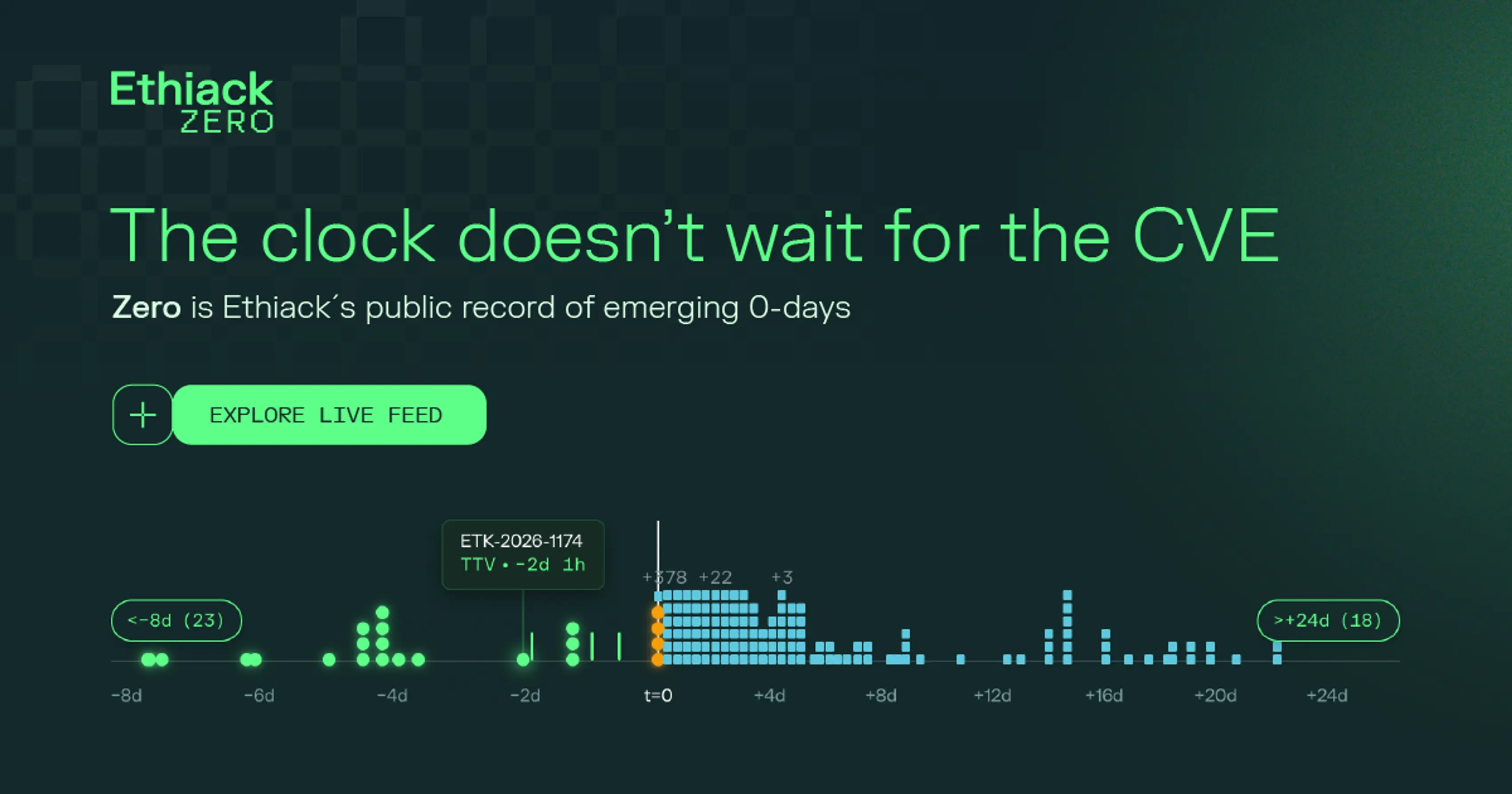
Publication is t=0 in Ethiack Zero's methodology. Every time measurement in Zero's public feed is anchored to this moment. CVEs validated by Ethiack before t=0 (which currently stands at 9% of the tracked pool, per Ethiack-reported figures) are vulnerabilities for which Ethiack had a working check or exploit before the catalogue published the record.
Stage 6: Enrichment (NVD, EPSS, KEV, vendor advisories)
A CVE record on cve.org is lean by design. The authoritative catalogue entry includes the identifier, description, references, and CNA assignment. Everything else is added downstream by separate systems.
NVD (National Vulnerability Database) is maintained by NIST and is separate from the CVE Program. NVD ingests published CVEs and adds CVSS base scores, CWE weakness classifications, and affected-product configurations in Common Platform Enumeration (CPE) format. NVD enrichment typically arrives within hours to days of cve.org publication, though backlogs have periodically delayed enrichment by weeks.
EPSS (Exploit Prediction Scoring System) is maintained by FIRST.org and updated daily. EPSS assigns each CVE a probability (0.0 to 1.0) that it will be exploited in the wild within the next 30 days, based on real-world exploitation signals, PoC availability, and reference patterns.
CISA KEV (Known Exploited Vulnerabilities catalogue) is maintained by the US Cybersecurity and Infrastructure Security Agency and lists CVEs with confirmed real-world exploitation. If a CVE appears in KEV, exploitation is observed, not predicted. KEV has become a de facto priority queue for enterprise security teams globally.
Vendor-specific advisories add exploitation chains, mitigation detail, and version-specific remediation guidance.
The enrichment stage is where most RBVM programmes actually source their prioritisation signal. CVE identifies the vulnerability; CVSS and EPSS prioritise the queue; KEV flags real-world exploitation. For a deeper breakdown of how these signals combine into a remediation queue, see Ethiack's risk-based vulnerability management.
Stage 7: Remediation and re-validation
The final stage is where defenders act. Patches are deployed, compensating controls are applied, and the vulnerability is removed from the exploitable surface. Three practical realities shape this stage:
- Patch deployment is slow. Even for critical vulnerabilities, enterprise patching typically takes weeks. Devices without automatic update mechanisms (OT systems, air-gapped networks, legacy appliances) can take months or never.
- Partial fixes are common. A CVE may be remediated on production systems but linger in development environments, backups, or forgotten cloud instances.
- Re-validation is often skipped. Patches are deployed, ticket closed, with no proof that the specific vulnerability is no longer exploitable in the affected environment.
Re-validation is the AEV loop. Adversarial exposure validation means the same exploit chain that was validated pre-patch can be re-run post-patch to confirm remediation. Without that loop, "patched" is a ticket status, not evidence of security. Ethiack's platform retains both the validated proof and the re-test result against the same exploit chain.
Across 2,000+ assets, CEGID moved from checklist-based pentesting to autonomous ethical hacking, preventing more than €12M in risk through continuous validation (Ethiack-reported).
Where the system breaks down (the Zero Day Clock)
The CVE lifecycle was designed for a world in which coordinated disclosure outran attacker research. That is no longer the world defenders operate in.
Three structural gaps leave the current process behind the attacker:
- The reservation-to-publication window. During coordinated disclosure, the vulnerability is known to the vendor, the researcher, and whoever they coordinate with. It is not yet publicly documented. If a patch ships during this window, reverse-engineering the patch gives attackers a working exploit well before most defenders know a vulnerability exists.
- Open-source patch commits. Open-source projects publish fixes publicly in their commit streams before formal advisories are issued. A watcher of GitHub commits on security-sensitive projects can see the fix minutes after it lands, long before cve.org catches up.
- The exploit-to-advisory lag. CISA KEV only flags a CVE after exploitation has been observed, confirmed, and catalogued. That process takes days. The actual exploitation begins earlier, and the real time-to-exploit interval is shorter than any KEV listing can report.
The stats describe the shape of the gap:
- Roughly 67% of exploited vulnerabilities today are zero-days (per Zero Day Clock)
- 72,812 CVEs were published in the first nine months of 2026, with 845 confirmed exploited in the wild during the same period
- Ethiack Zero has validated 9% of tracked vulnerabilities as exploitable before the CVE went public on cve.org (Ethiack-reported)
Ethiack Zero is the public record of this gap. It watches the earliest signals (vendor advisories, GHSA entries, patch commits, KEV listings, bug reports) and validates whether they are exploitable, publishing Time-to-Validate for each entry and anchoring the measurement to cve.org publication. Zero's methodology documents how entries open, close, and are corrected, and the feed is available via public REST API and MCP endpoint with no authentication required.
See also the Ethiack Zero launch research for the operational framing of why the CVE lifecycle is no longer the fastest signal defenders have.
What if a CVE is rejected or disputed?
Not every reserved CVE ID ends up as a published record. Four exit states are possible:
- PUBLIC: the normal published record
- REJECTED: the CNA has determined the reported issue is not a vulnerability, is a duplicate, or does not meet CVE assignment criteria
- DISPUTED: the vulnerability is published but a party (usually the vendor) contests its characterisation, scope, or severity
- RESERVED: the ID is allocated but no publication has occurred, often because coordinated disclosure is ongoing
Disputed CVEs are a particular challenge for defenders. A vendor may dispute the severity scoring or the affected version range. This disagreement can leave exposure assessments in limbo, especially where the dispute hinges on whether a code path is reachable in a particular configuration. The CVE Program allows for dispute notices in the record, but the authoritative call usually sits with the CNA that assigned the ID.
Reserved-but-unpublished CVEs are the other operational concern. An ID reserved months ago and still unpublished may indicate an ongoing embargo, a stalled coordinated disclosure, or a researcher who moved on. For defenders, the reserved status gives no actionable information; the vulnerability may or may not exist in deployed code.
Where Ethiack sits in the CVE lifecycle
Ethiack operates at three points of the CVE lifecycle simultaneously.
As a discoverer (stages 1-2). Ethiack's offensive security team discovers novel vulnerabilities in third-party software through continuous research and coordinates with vendors through standard disclosure processes. New findings get an internal ETK ID when analysis begins, often weeks before any CVE identifier is reserved. The ETK ID persists through assignment, publication, and enrichment; both identifiers resolve to the same tracked entry.
As an operator (stages 3-6, in public view). Ethiack Zero watches the earliest public signals from vendor advisories, GHSA entries, patch commits, and KEV listings, and runs them through an AI-driven analysis pipeline. Entries produce a check, a validated proof of exploit, or a waiting status with a Time-to-Validate measurement attached. Zero publishes mitigation guidance for every entry it can validate, and holds back working exploit code so defenders retain lead time against attackers.
As a validator (stage 7, for customers). Hackian runs continuously against customer attack surfaces, chaining vulnerabilities and validating which CVEs on each customer's specific environment are actually exploitable. Every validated finding ships with the payload, the evidence, and mitigation guidance. The re-test loop confirms that remediation closed the exploit chain, not just the specific CVE.
Three perspectives, one platform. The CVE process produces a global catalogue; Ethiack produces an environment-specific action list anchored to the same identifiers.
Why the CVE lifecycle alone is not enough (the AEV wedge)
Running a well-tuned CVE monitoring programme is necessary, and no longer sufficient. The lifecycle gives defenders a shared language and a signal of what vulnerabilities exist in the broader ecosystem. It does not tell you which of those vulnerabilities are exploitable on your specific attack surface.
Adversarial exposure validation (AEV) is the layer that does. AEV runs real exploit attempts against the discovered surface, chains vulnerabilities into end-to-end attack paths, and produces reproducible proof of exploit for every validated finding. Where CVE enrichment tells you theoretical severity and global exploit probability, AEV tells you demonstrated exploitability in your environment, right now.
The proof pairing: Hackian runs at 30x the speed of manual pentesting with a false-positive rate below 0.5% (Ethiack-reported). Across the CEGID deployment, continuous validation prevented more than €12M in risk across 2,000+ assets (Ethiack-reported).
For the full category comparison of how CVE monitoring, attack surface management, and validation combine, see the full ASM and VM category breakdown.
Who should care about the CVE lifecycle (persona map)
Four groups own four different conversations around the CVE lifecycle.
For SecOps and vulnerability management practitioners
The CVE lifecycle is the input to the daily triage queue. Understanding the enrichment timeline (NVD, EPSS, KEV) sharpens prioritisation; understanding the reservation-to-publication window sharpens response planning. AEV compresses the daily queue by proving which catalogued CVEs are exploitable in the current environment. Ethiack reports 90% noise elimination and 80% faster remediation after introducing adversarial validation (Ethiack-reported).
For AppSec and DevSecOps leaders
CVEs land in third-party dependencies constantly. Modern application security teams integrate CVE monitoring into CI/CD pipelines, but patch-cycle compliance is not the same as exploit safety. Trigger-based validation closes the gap between dependency bump and exploit confirmation, aligned with the deployment cadence of the engineering team.
For CISOs
The board conversation is no longer "how many CVEs did we patch"; it is "what proportion of exploitable exposure on our surface is actually mitigated, and what is our window". The CVE lifecycle feeds the inputs; AEV supplies the evidence; the result is ALE-based risk quantification and a defensible, dated record of validated remediation that insurers and regulators can audit.
For Compliance Officers and Heads of Risk
NIS2 directive requirements for financial institutions, DORA continuous testing obligations, and ISO 27001 all now require evidence of continuous testing. CVE records satisfy the identification-and-tracking obligation; AEV satisfies the validated-remediation obligation. See auditor-ready compliance reporting for how Ethiack outputs the evidence trail auditors ask for.
See which CVEs on your surface are actually exploitable
A CVE record is a global signal of what could be wrong somewhere. A validated exposure report is a short list of what an attacker can exploit on you right now. Validate your attack surface for free, no installation required, with results in 24 hours. Reproducible proof of exploit for every validated finding, not a longer CVE queue.
Trusted by CEGID (€12M+ risk prevented across 2,000+ assets), Lusitânia (10x ROI, 80% MTTR reduction), and ANA Aeroportos (650% ROI). All Ethiack-reported.
Frequently asked questions about the CVE system
How does the CVE system work?
The CVE system works by assigning a globally-unique public identifier to every disclosed cybersecurity vulnerability through a coordinated process involving the discoverer, a CVE Numbering Authority (CNA), the affected vendor, and MITRE as the programme Secretariat. The seven stages run from discovery through reporting, reservation, coordinated disclosure, publication on cve.org, enrichment by NVD, EPSS, and CISA KEV, and finally remediation. Timings range from a few days for well-coordinated advisories to many months for complex supply-chain vulnerabilities, and the reservation-to-publication window has become the critical gap for defenders.
How does a CVE get assigned?
A CVE is assigned by a CVE Numbering Authority (CNA) when a vulnerability is reported within that CNA's scope. The CNA reserves a CVE identifier early in the coordination process, usually within hours or days of first contact, so the identifier can be referenced across coordinated advisories before any public disclosure. There are more than 400 CNAs globally, including major vendors, coordination centres, bug bounty platforms, and research organisations. MITRE acts as the root CNA for vulnerabilities that fall outside any other CNA's scope.
How long does the CVE assignment process take?
CVE ID reservation typically takes hours to days after the initial vulnerability report. Full publication on cve.org takes much longer, usually 30 to 120 days, because it waits for coordinated disclosure to complete: the vendor develops and tests a patch, downstream parties are notified, and advisories are prepared. Complex supply-chain vulnerabilities can extend the window further. Google Project Zero's 90-day disclosure norm is a widely-cited reference point, with shorter windows applied when active exploitation is observed.
What is the difference between CVE reservation and publication?
Reservation is the allocation of a CVE ID as a placeholder; publication is the release of the full vulnerability record on cve.org. A reserved CVE appears on cve.org with a status of RESERVED and no technical detail, allowing all coordinating parties to reference the identifier internally before public disclosure. Publication moves the record to PUBLIC status and releases the description, affected products, and references. The window between reservation and publication is where coordinated disclosure happens, and it is also where attackers watching patch commits and advisory drafts gain their advantage.
What is coordinated disclosure?
Coordinated disclosure is the agreement among the researcher, the vendor, and other affected parties to withhold public disclosure of a vulnerability until a patch is ready and distributed. A typical coordinated disclosure runs 30 to 120 days, with the researcher committing to silence and the vendor committing to patch development within an agreed window. Google Project Zero's 90-day norm is widely referenced, with shorter windows applied when active exploitation is observed. When embargoes hold, the coordinated model protects defenders; when they break, the vulnerability becomes exploitable before patches are deployed.
Is NVD the same as cve.org?
No. cve.org is maintained by MITRE as the authoritative CVE List and publishes the base CVE record. NVD (National Vulnerability Database, at nvd.nist.gov) is maintained by NIST and enriches published CVEs with CVSS base scores, CWE classifications, and affected-product configurations in CPE format. Most vulnerability management programmes use NVD as their data source because of the enrichment, but the authoritative CVE record itself lives at cve.org.
How is CVSS scoring assigned to a CVE?
CVSS (Common Vulnerability Scoring System) base scores are typically assigned by the CNA that reserved the CVE, often with input from the researcher, and published alongside the CVE record. NVD then adds its own CVSS base score during the enrichment stage, which may differ from the CNA's score; both are published when they differ. CVSS v3.1 is the current widely-used version, and CVSS v4.0 was finalised in 2023 and is in gradual adoption. Scoring reflects theoretical severity, not real-world exploitation; EPSS and CISA KEV provide complementary signals.
Can a CVE be rejected or disputed?
Yes. A CNA can mark a CVE as REJECTED when the reported issue is determined not to be a vulnerability, is a duplicate, or does not meet CVE assignment criteria. A CVE can also be marked DISPUTED when a party (usually the vendor) contests the characterisation, scope, or severity after publication. The record remains visible with the dispute notice attached. Reserved-but-unpublished CVEs are a separate state, usually indicating an ongoing embargo or stalled coordinated disclosure, rather than a formal rejection.
Where can I see CVE records before they are published?
Reserved CVE IDs appear on cve.org with RESERVED status and no detail. For richer pre-publication intelligence, platforms that watch early signals (vendor patch commits, GHSA entries, KEV listings, bug reports) publish validated detail ahead of CVE publication. Ethiack Zero at zero.ethiack.com publishes the earliest validated signals it can confirm, with Time-to-Validate measured against cve.org publication. The feed is public, free, and available via REST API and MCP endpoint for direct integration into security workflows and AI agents.
How are CVE IDs assigned?
CVE IDs are assigned by CVE Numbering Authorities (CNAs), organisations authorised by the CVE Program to allocate identifiers for vulnerabilities within a defined scope. Each CNA decides whether an incoming report qualifies for a CVE under the programme’s assignment rules, reserves an identifier (which appears on cve.org with RESERVED status), then populates the full record during coordinated disclosure. There are more than 400 CNAs globally, including major vendors like Microsoft, Google, Apple, and Red Hat, coordination centres such as CERT/CC, bug bounty platforms like HackerOne and Bugcrowd, and research organisations. MITRE acts as the root CNA and assigns identifiers for vulnerabilities that fall outside any other CNA’s scope, including those reported by independent researchers to vendors that are not themselves CNAs.
How do I request a CVE ID?
The route to request a CVE ID depends on who the affected vendor is. If the vendor is itself a CNA (most major software and hardware vendors are), researchers report the vulnerability directly through the vendor’s PSIRT channel or security.txt contact, and the vendor’s CNA assigns the identifier as part of coordinated disclosure. If the vendor is not a CNA, researchers can request an ID through the CVE Program’s public web form at cveform.mitre.org, which routes requests to MITRE as the root CNA or to a participating coordination centre. Bug bounty platforms like HackerOne, Bugcrowd, and Intigriti can also assign CVE IDs for vulnerabilities reported through their programmes, because they themselves are CNAs with defined scopes. In every case, coordinated disclosure commits the researcher to withholding public detail until the vendor has had reasonable time to respond.
How do I look up a specific CVE ID?
The authoritative source for every CVE record is cve.org, where searching by the CVE ID (for example CVE-2026-111497) returns the official record including description, references, and CNA assignment. For enriched data (CVSS base scores, CWE classifications, affected-product configurations in CPE format), the National Vulnerability Database at nvd.nist.gov is the standard downstream source and typically updates within hours to days of cve.org publication. Vendor-specific advisories are the primary source for patch guidance and version-specific remediation detail. For pre-publication intelligence and Time-to-Validate measurements on emerging vulnerabilities, Ethiack Zero publishes the earliest validated signals at zero.ethiack.com, with public REST and MCP access for direct integration into security workflows and AI agents.
How do CVSS severity scores work?
CVSS (Common Vulnerability Scoring System) base scores range from 0.0 to 10.0 and fall into five severity buckets: None (0.0), Low (0.1-3.9), Medium (4.0-6.9), High (7.0-8.9), and Critical (9.0-10.0). The base score is calculated from a vector string encoding eight metrics across two groups: Exploitability (Attack Vector, Attack Complexity, Privileges Required, User Interaction) and Impact (Confidentiality, Integrity, Availability, with a Scope modifier). CVSS v3.1 is the current widely-used version; CVSS v4.0 was finalised in 2023 and adds new metrics around Attack Requirements and Subsequent System Impact, with gradual adoption across CNAs. Scoring is theoretical: a CVSS 9.8 describes severity in a reference configuration, not whether the vulnerability is exploitable on a specific attack surface, which is what EPSS probability signals, CISA KEV listings, and adversarial exposure validation address alongside the base score.
How do IT and security teams use CVE?
IT and security teams use CVE records as the common reference point for every vulnerability-handling workflow across the organisation. Vulnerability management teams ingest CVE data from NVD and vendor advisories, match CVEs against the software inventory, prioritise using CVSS, EPSS, and CISA KEV signals, and track remediation through ticketing platforms like Jira or ServiceNow. AppSec teams use CVE data to catch vulnerable dependencies in CI/CD pipelines through software composition analysis, and to route CWE-classified findings into secure-coding training programmes. IT operations teams use CVE identifiers to coordinate patch cycles with vendors and to communicate risk status to the wider business in a shared vocabulary. Across all of these workflows, CVE is the common handle; adversarial exposure validation adds the layer that confirms which catalogued CVEs are actually exploitable in the organisation’s environment, which is increasingly what auditors ask to see as evidence.