CVE identifies a vulnerability, CWE classifies the underlying weakness, and CVSS assesses its severity using standardized criteria. Each serves a different purpose: CVE tells you which vulnerability you're dealing with, CWE explains what type of weakness it involves, and CVSS indicates how severe it is based on its characteristics. Together, they provide a common framework for vulnerability reporting, but they don't tell the whole story. Severity alone doesn't establish whether a vulnerability is being actively exploited or how much risk it poses to a specific organization.
All three are necessary. None of them, on its own or in combination, tells you what a security team actually needs to know in the morning: which of these vulnerabilities an attacker can exploit on your surface right now. That gap has widened as exploitation windows collapse, roughly 67% of exploited vulnerabilities today are zero-days, and it is why NIS2 and DORA auditors have moved from asking for CVE reports to asking for continuous testing evidence.
This guide explains each standard in plain terms, shows how they fit together in a real vulnerability record, and names the layer that complements all three: adversarial exposure validation (AEV).
Key takeaways
- Verdict: three standards, three questions. CVE answers "which vulnerability", CVSS answers "how severe", CWE answers "what type of weakness".
- CVE is a MITRE-governed public identifier (CVE-YYYY-NNNNN) for a specific disclosed vulnerability.
- CVSS (Common Vulnerability Scoring System) is a 0.0-10.0 numeric severity score maintained by FIRST.org and used across every mainstream vulnerability management platform.
- CWE (Common Weakness Enumeration) is a MITRE-maintained taxonomy of software and hardware weakness types, each with a CWE-NNN identifier.
- A real CVE record cites all three: the CVE ID, the CWE classification of the underlying weakness, and the CVSS base score with its vector string.
- CVSS v3.1 is the current widely-used scoring version; CVSS v4.0 was finalised in 2023 and is in gradual adoption. The CWE Top 25 Most Dangerous Software Weaknesses is the annual ranking of most AppSec programmes track.
- None of CVE, CVSS, or CWE proves exploitability on a specific attack surface. Adversarial exposure validation (AEV) does: whether any of these vulnerabilities an attacker can actually exploit against your environment right now. Ethiack delivers AEV through Hackian at 30x manual-pentest speed with a false-positive rate below 0.5% (Ethiack-reported).
At a glance: CVE vs CVSS vs CWE (plus what AEV adds)
The three standards answer three different questions about the same vulnerability. The table below compares them across six dimensions, with a fourth column for the layer that fills the gap all three leave open.
Primary question
Which vulnerability?
How severe is it in theory?
What type of weakness causes it?
What it is
A public identifier for one specific disclosed vulnerability.
A 0.0-10.0 severity score with a published vector string.
A taxonomy of weakness types, each with a CWE-NNN identifier.
Scope
One specific disclosed bug.
One specific vulnerability's theoretical severity.
The underlying class of flaw (shared across many CVEs).
Example
CVE-2026-111497 (Node2Shell).
9.2 Critical (CVSS v4.0 vector AV:N/AC:L/AT:N/PR:N/UI:N).
CWE-787: Out-of-bounds Write.
Who maintains it
MITRE (as Secretariat) and 400+ CNAs.
FIRST.org (Forum of Incident Response and Security Teams).
MITRE (as programme steward).
What it does NOT tell you
Severity, weakness type, or whether it affects your environment.
The weakness type, current exploitation, or environment-specific risk.
Whether a specific instance exists in your code or is exploitable.
The fourth answer, which none of the three standards gives, is whether an attacker can actually exploit the vulnerability on your attack surface right now. That is the question the validation layer that proves exploitability was built to answer.
What is CVE?
CVE (Common Vulnerabilities and Exposures) is a public identifier assigned to a specific disclosed cybersecurity vulnerability. Every CVE is formatted as CVE-YYYY-NNNNN, where YYYY is the year the ID was reserved and NNNNN is the sequence number. CVE identifiers give the security ecosystem one canonical handle for a vulnerability: the same bug carries the same CVE ID across every vendor advisory, security tool, and compliance report.
The CVE Program is operated by MITRE Corporation under sponsorship from CISA, with day-to-day assignment handled by more than 400 CVE Numbering Authorities (CNAs) worldwide. The CVE List itself is published at cve.org and is free to query.
For the full definitional treatment, see the dedicated CVE primer. For how a CVE moves from discovery to publication, see the full seven-stage CVE lifecycle.
What CVE does not do: it does not score severity, classify the underlying weakness type, or prove exploitability. Those are CVSS, CWE, and AEV respectively.
What is CVSS?
CVSS (Common Vulnerability Scoring System) is a numeric severity score, from 0.0 to 10.0, that evaluates how severe a vulnerability is in theoretical terms. CVSS is maintained by FIRST.org (the Forum of Incident Response and Security Teams) and is the default severity signal across vulnerability management platforms, compliance frameworks, and security advisories.
CVSS scores fall into five severity buckets:
- None: 0.0
- Low: 0.1 to 3.9
- Medium: 4.0 to 6.9
- High: 7.0 to 8.9
- Critical: 9.0 to 10.0
The CVSS base score components
A CVSS base score is calculated from a published vector string that encodes eight metrics across two groups. The Exploitability metrics describe how easy the vulnerability is to exploit:
- Attack Vector (AV): Network, Adjacent, Local, Physical
- Attack Complexity (AC): Low, High
- Privileges Required (PR): None, Low, High
- User Interaction (UI): None, Required
The Impact metrics describe what an attacker can do if the exploit succeeds, measured on confidentiality, integrity, and availability (each rated None, Low, or High). Scope describes whether the vulnerability can affect resources beyond the vulnerable component.
CVSS v3.1 vs CVSS v4.0
CVSS v3.1 is the version in widest use today across NVD enrichment and vulnerability management platforms. CVSS v4.0 was finalised by FIRST.org in late 2023 and is being adopted gradually by CNAs. The v4.0 release added new metrics (Attack Requirements, more granular User Interaction, and Subsequent System Impact) and revised the scoring formula to reduce the cluster of scores in the 9.0-10.0 range that critics argued flattened real-world prioritisation.
During the transition, many CVE records carry both v3.1 and v4.0 scores. Vulnerability management programmes need to decide which version to prioritise against; most retain v3.1 as the primary signal for backward comparability while tracking v4.0 where available.
Who assigns CVSS scores
CVSS base scores are typically assigned by the CNA that reserved the CVE, often with input from the researcher who reported the vulnerability. NVD (the National Vulnerability Database) assigns its own CVSS base score during the enrichment stage after CVE publication. When CNA and NVD scores differ, both are published on the CVE record; downstream platforms choose which to prioritise.
What is CWE?
CWE (Common Weakness Enumeration) is a taxonomy of software and hardware weakness types, each with a unique CWE-NNN identifier. Where a CVE identifies a specific instance of a vulnerability in a specific product, a CWE describes the underlying class of flaw: the pattern of coding mistake, design error, or configuration weakness that led to the vulnerability existing.
CWE is maintained by MITRE as programme steward, with contributions from a broad community of researchers, vendors, and security organisations. The CWE List currently contains over 900 entries organised into views: Software Development, Hardware Design, and Research Concepts being the most widely referenced.
Examples of common CWE identifiers
- CWE-79: Improper Neutralization of Input During Web Page Generation (Cross-site Scripting, XSS)
- CWE-89: Improper Neutralization of Special Elements used in an SQL Command (SQL Injection)
- CWE-787: Out-of-bounds Write
- CWE-20: Improper Input Validation
- CWE-287: Improper Authentication
- CWE-502: Deserialization of Untrusted Data
The CWE Top 25 Most Dangerous Software Weaknesses
Each year MITRE publishes the CWE Top 25, a ranked list of the most dangerous and prevalent software weakness types, derived from analysis of CVE data from the previous two years. The Top 25 is the de facto priority list for application security teams designing training programmes, selecting security testing scope, and reviewing architectural controls. It is also the taxonomy SAST, DAST and SCA testing categories use to classify and report findings.
How CVE, CVSS and CWE work together
A vulnerability record can bring together all three, providing different layers of information about the same vulnerability:
- CVE ID: Identifies the specific vulnerability.
- CWE classification: Describes the type of underlying weakness.
- CVSS score and vector: Assess the vulnerability's severity and describe the characteristics used to calculate it.
Worked example: CVE-2026-111497 (Node2Shell)
A real CVE record published in 2026 illustrates how the three standards fit together. CVE-2026-111497, popularly nicknamed Node2Shell, describes an out-of-bounds write in Google's Brotli decoder affecting Node.js runtimes. The record cites:
- CVE identifier: CVE-2026-111497
- CWE classification: CWE-787 (Out-of-bounds Write), the weakness type behind the specific bug
- CVSS v4.0 base score: 9.2 Critical, with vector CVSS:4.0/AV:N/AC:L/AT:N/PR:N/UI:N (Network attack vector, Low attack complexity, no privileges or user interaction required)
Each standard contributes a different piece of the picture. CVE lets a defender reference this specific bug in a patch request. CWE tells an AppSec team the weakness pattern, which informs training, static analysis tuning, and architectural review. CVSS tells a prioritisation engine where in the triage queue this vulnerability sits.
Historical example: CVE-2021-44228 (Log4Shell) scored a CVSS 10.0 and triggered emergency remediation efforts worldwide. The CWE classification varied by source but included CWE-917 (Improper Neutralization of Special Elements used in an Expression Language Statement) as a primary mapping. The three standards gave security teams a shared vocabulary for an event that affected millions of deployments.
CVE vs CVSS: the key differences
CVE and CVSS answer different questions about the same vulnerability.
- CVE is an identifier; CVSS is a score. A CVE ID (CVE-2026-111497) names one specific vulnerability. A CVSS score (9.2) rates its theoretical severity.
- CVE is maintained by MITRE and 400+ CNAs; CVSS is maintained by FIRST.org.
- Every CVE record carries at least one CVSS score (and often two, one from the CNA and one from NVD). CVSS scores do not exist independently of a vulnerability; they describe a specific CVE.
- CVE answers "which vulnerability"; CVSS answers "how severe in theory". Neither answers "is this exploitable in my environment right now". That is where the Ethiack risk-based prioritisation layer layers proven exploitability on top of the signals the CVE record carries.
CVE vs CWE: the key differences
CVE identifies a specific vulnerability. CWE classifies the underlying weakness type.
- CVE is an instance; CWE is a class. CVE-2026-111497 is a specific out-of-bounds write in Brotli. CWE-787 is the general category of out-of-bounds writes, which covers thousands of different CVEs.
- A vulnerability has one CVE identifier. It can map to one or more CWE classifications when multiple weakness types contribute to the same bug.
- CVE is useful for patch management, advisory tracking, and compliance reporting. CWE is useful for AppSec training, static analysis configuration, and systemic weakness reduction.
- Both are maintained by MITRE but operate under different taxonomies, update cadences, and contributor communities.
CVSS vs CWE: the key differences
CVSS scores severity. CWE classifies weakness type. They are not alternatives; they describe different properties of the same vulnerability.
- CVSS is a number (with a vector string); CWE is a category (with an identifier).
- Two CVEs with the same CWE classification (both CWE-787 Out-of-bounds Write) can have wildly different CVSS scores, because severity depends on attack vector, complexity, privileges required, and impact, which are instance-specific.
- CVSS tells a triage engine where to sort the vulnerability; CWE tells a code review what pattern to look for across the codebase.
- For AppSec programmes, the CWE Top 25 is the training and detection curriculum; CVSS is the remediation deadline driver for individual findings.
What none of CVE, CVSS and CWE tells you (the exposure gap)
The three standards together give a vulnerability a shared name, a severity score, and a weakness classification. None of them tells you whether a specific attacker can exploit a specific CVE on a specific asset in your environment right now.
Three structural limits explain the gap:
A CVSS score is theoretical, not environmental. CVSS v3.1 and v4.0 both measure base-score severity in a reference configuration. Your actual exposure depends on whether the vulnerable code path is reachable, whether compensating controls block the exploit chain, and whether an attacker can combine this vulnerability with others to reach a real objective. A CVSS 9.8 bug behind an internal-only service with strong network segmentation may represent less real-world risk than a CVSS 6.5 bug on an internet-facing API.
A CWE classification describes the pattern, not the instance. Knowing that a bug is CWE-787 Out-of-bounds Write tells you nothing about whether that specific bug is reachable in your deployment, whether your runtime version is affected, or whether a working exploit exists in the wild.
A CVE identifier guarantees nothing about your exposure. A CVE is published for every disclosed vulnerability. Whether the vulnerability affects your deployment depends on the specific product versions you run, the configuration options enabled, and the deployment context. CVE presence on a vendor's advisory list is a prompt to investigate, not evidence of exploitable exposure.
Adversarial exposure validation (AEV) is the layer that answers the exposure question the three standards do not. AEV runs real exploit attempts against the discovered attack surface, chains vulnerabilities into end-to-end attack paths, and produces reproducible proof of exploit for every validated finding. Where CVE identifies, CWE classifies, and CVSS scores, AEV demonstrates.
Where this matters in practice: vulnerability management programmes
A typical risk-based vulnerability management (RBVM) programme uses all three standards together, plus two additional signals:
- CVE: the identifier used for tracking, ticketing, and compliance reporting
- CVSS base score: the first-pass severity sort
- CWE classification: input into systemic weakness reduction programmes and AppSec training
- EPSS (Exploit Prediction Scoring System): probability that the CVE will be exploited in the wild within 30 days
- CISA KEV: confirmed real-world exploitation flag, which usually drives emergency remediation deadlines
Even with all five signals combined, the output is a prioritised list of what could be a problem, ranked by likelihood. AEV sits on top and marks which entries are actually exploitable on the specific attack surface. Ethiack reports that layer collapses the queue by 90% through noise elimination and accelerates remediation by 80% (Ethiack-reported).
For a deeper breakdown of where this fits across the broader vulnerability discipline landscape, see ASM and VM as complementary disciplines.
Compliance mapping (NIS2, DORA, ISO 27001)
Regulatory frameworks reference CVE and CVSS routinely, and CWE increasingly, as the shared vocabulary for vulnerability obligations.
NIS2 Article 21 requires essential and important entities to implement appropriate and proportionate measures for cybersecurity risk management, including vulnerability handling and continuous testing. Auditors expect CVE-level tracking for every identified vulnerability, CVSS-based prioritisation evidence, and documented remediation outcomes. See the NIS2 directive guidance for financial services for sector-specific detail.
DORA Article 25 mandates ICT-related security testing for financial entities. CVE and CVSS data feeds the vulnerability assessment obligation; AEV evidence feeds the threat-led penetration testing obligation for larger entities. See navigating the DORA testing requirements for the full breakdown.
ISO 27001 Annex A controls A.8 (Asset Management) and A.12 (Operations Security) require current, documented vulnerability catalogues with evidence of remediation. CVE lists satisfy the identification obligation; CVSS prioritisation satisfies the risk-assessment obligation; validated exposure proof satisfies the remediation-effectiveness obligation. Evidence-first compliance output from Ethiack maps each validated finding to the specific clause it evidences.
Who should care about CVE, CVSS and CWE (persona map)
For SecOps and vulnerability management practitioners
CVE identifies the ticket, CVSS sorts the queue, CWE informs the systemic reduction programme. Daily triage lives in the intersection of these three, plus EPSS and KEV. AEV layers proven exploitability on top so the list of CVEs you work tomorrow reflects what an attacker can actually exploit.
For AppSec and DevSecOps leaders
CWE is the primary signal for AppSec. The CWE Top 25 informs secure coding training, SAST rule tuning, DAST scope decisions, and threat-modelling priorities. CVE and CVSS enter the pipeline at dependency-bump time: which CVEs land in which transitive dependencies, at what severity. Machine-speed exploit validation closes the gap between dependency update and exposure confirmation.
For CISOs
CVE and CVSS feed the board conversation on vulnerability posture; CWE Top 25 performance over time is a credible indicator of secure-coding programme maturity. AEV supplies the evidence that prioritisation outputs map to actual exploit paths, not catalogue noise, which is what insurers and auditors increasingly want to see.
For Compliance Officers and Heads of Risk
Auditors reference CVE identifiers in finding reports, CVSS scores in risk assessments, and CWE classifications in secure-coding policy reviews. The evidence they ask for is dated, reproducible, and mapped to specific controls. Where CVE/CVSS/CWE provide the vocabulary, AEV provides the proof of remediation effectiveness, which is where most audit reports now spend their time.
A CVSS 9.8 tells you how severe a vulnerability is. Validation tells you whether it's exploitable in your environment.
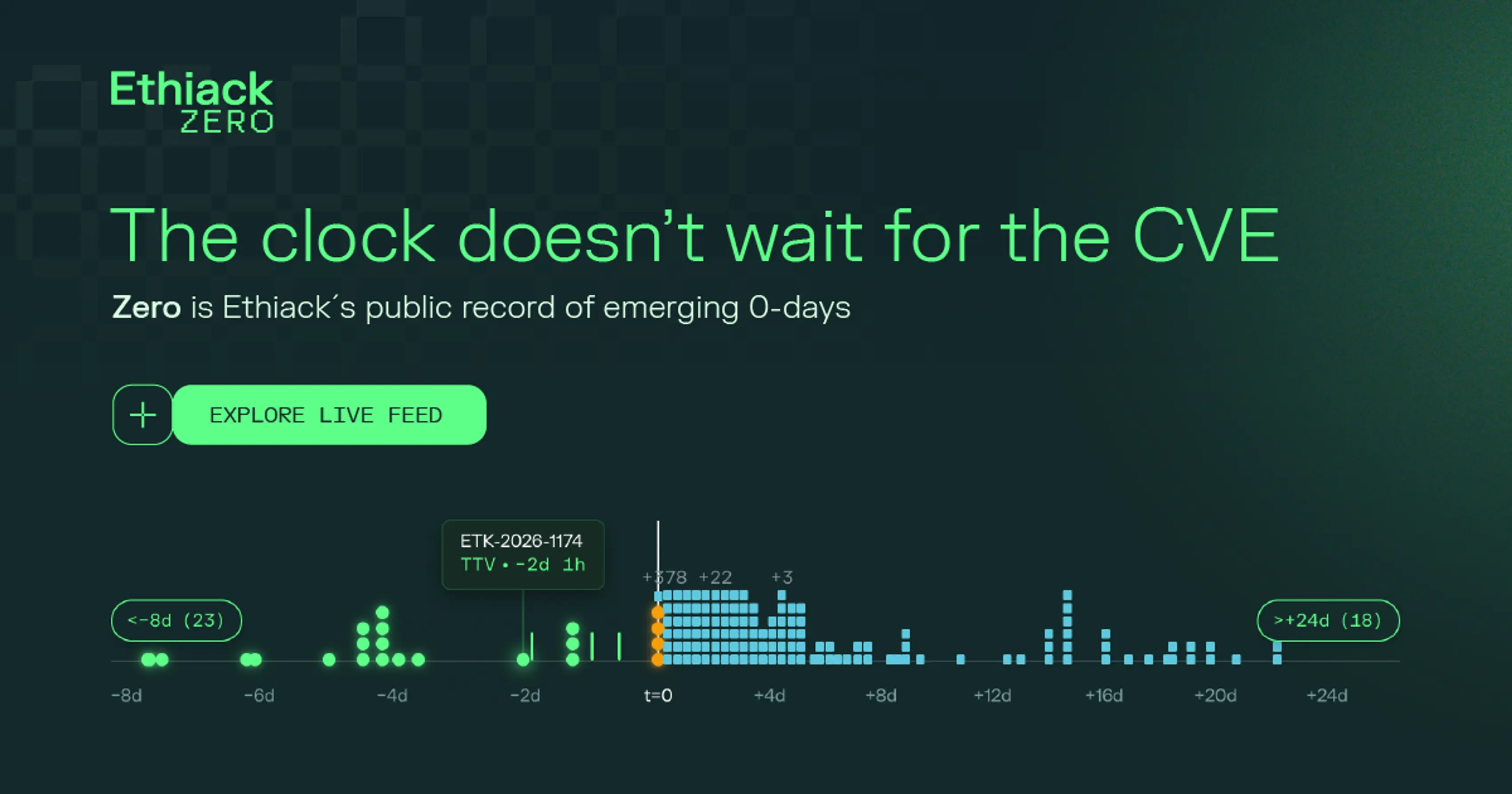
CVE, CVSS and CWE give a vulnerability a name, a severity rating, and a weakness classification. None of them tells you whether an attacker can reach the vulnerable code path on your specific attack surface, chain it with other weaknesses, or achieve a real objective. That is the question research on the CVE publication lag asked when Ethiack Zero launched, and the question Ethiack's public 0-day validation feed tracks openly in public, with every Time-to-Validate measurement documented in the Ethiack Zero methodology documentation.
For the step of proving which CVEs on your specific surface an attacker can actually exploit, start a free Ethiack external test, no installation required, with results in 24 hours. Reproducible proof of exploit for every validated finding.
Trusted by CEGID (€12M+ risk prevented across 2,000+ assets, see the CEGID autonomous ethical hacking deployment), Lusitânia (10x ROI, 80% MTTR reduction), and ANA Aeroportos (650% ROI). All Ethiack-reported.
Frequently asked questions about CVE, CVSS and CWE
What is the difference between CVE, CVSS and CWE?
CVE is a public identifier for a specific disclosed vulnerability (CVE-YYYY-NNNNN). CVSS is a 0.0-10.0 numeric severity score that rates the theoretical severity of that vulnerability. CWE is a taxonomy of weakness types (CWE-NNN) that classifies the underlying flaw pattern behind the vulnerability. The three answer different questions about the same bug: CVE names it, CVSS scores it, CWE classifies it. A modern vulnerability record carries all three.
What does CVE stand for?
CVE stands for Common Vulnerabilities and Exposures. It is the public identifier assigned to a specific disclosed cybersecurity vulnerability, maintained by MITRE Corporation as programme Secretariat under sponsorship from CISA. The CVE List is published at cve.org and is the authoritative catalogue of every published CVE record, free to query and used as the canonical reference across every mainstream vulnerability management programme.
What is CWE?
CWE (Common Weakness Enumeration) is a taxonomy of software and hardware weakness types, maintained by MITRE. Each entry has a unique CWE-NNN identifier and describes a class of flaw: CWE-79 is Cross-site Scripting, CWE-89 is SQL Injection, CWE-787 is Out-of-bounds Write, and so on. CWE classifies the pattern of weakness behind a vulnerability, which is useful for AppSec training, secure-coding programmes, and systemic risk reduction. The CWE Top 25 Most Dangerous Software Weaknesses is the annual priority list most AppSec teams reference.
What is a CVSS score?
A CVSS score is a numeric severity rating from 0.0 to 10.0 assigned to a specific vulnerability by the Common Vulnerability Scoring System, maintained by FIRST.org. Scores fall into five buckets: None (0.0), Low (0.1-3.9), Medium (4.0-6.9), High (7.0-8.9), and Critical (9.0-10.0). The score is calculated from a published vector string that encodes attack vector, attack complexity, privileges required, user interaction, scope, and the impact to confidentiality, integrity, and availability. CVSS v3.1 is the current widely-used version, with v4.0 in gradual adoption.
What is the difference between CVE and CVSS?
CVE is an identifier; CVSS is a score. A CVE (CVE-2026-111497) is a public name for one specific disclosed vulnerability. A CVSS score (9.2) rates how severe that vulnerability is in theoretical terms. Every CVE record carries at least one CVSS score (often two, one from the assigning CNA and one from NVD); CVSS scores do not exist independently of a vulnerability. CVE is maintained by MITRE and 400+ CNAs; CVSS is maintained by FIRST.org.
What is the difference between CVE and CWE?
CVE identifies a specific vulnerability; CWE classifies the underlying weakness type. A CVE is an instance (CVE-2026-111497 is one specific out-of-bounds write in Brotli); a CWE is a class (CWE-787 is the category of all out-of-bounds writes, across thousands of CVEs). A vulnerability has one CVE identifier but can map to one or more CWE classifications when multiple weakness types contribute. Both are maintained by MITRE but serve different purposes: CVE for tracking and compliance, CWE for systemic weakness reduction.
What is the difference between CVSS and CWE?
CVSS scores severity; CWE classifies weakness type. CVSS is a 0.0-10.0 numeric rating of how severe a vulnerability is in theory. CWE is a categorical label describing the pattern of flaw behind it. Two vulnerabilities with the same CWE classification can have wildly different CVSS scores because severity depends on attack vector, privileges required, and impact, all of which are instance-specific. CVSS is maintained by FIRST.org; CWE is maintained by MITRE.
Is a CVSS score the same as proven exploitability?
No. A CVSS score measures theoretical severity in a reference configuration, not whether a specific attacker can exploit a specific vulnerability on your specific attack surface. A CVSS 9.8 vulnerability behind strong network segmentation may represent less real-world risk than a CVSS 6.5 vulnerability on an internet-facing API. CVSS, CVE, and CWE together tell you what exists and how severe it is in theory; adversarial exposure validation (AEV) tells you whether it is exploitable in your environment. That distinction is why NIS2 and DORA auditors now expect continuous testing evidence, not CVSS reports alone.
What is CVE management?
CVE management is the operational practice of tracking, prioritising, and remediating vulnerabilities identified by CVE record across an organisation's asset estate. A CVE management programme ingests CVE data from NVD, vendor advisories, and security feeds; matches CVEs against the software inventory; prioritises using CVSS, EPSS, and KEV signals; and tracks remediation to completion. CVE management software (vulnerability management platforms such as Tenable, Qualys, Rapid7, Wiz, and others) automates the ingestion, matching, and tracking steps. Adversarial exposure validation sits on top of CVE management, proving which of the managed CVEs an attacker can actually exploit, so remediation effort reflects real risk rather than catalogue order.